
Pulp Fiction, 1865 · page 190 of 400
The Argosy — page 190: what you’re looking at
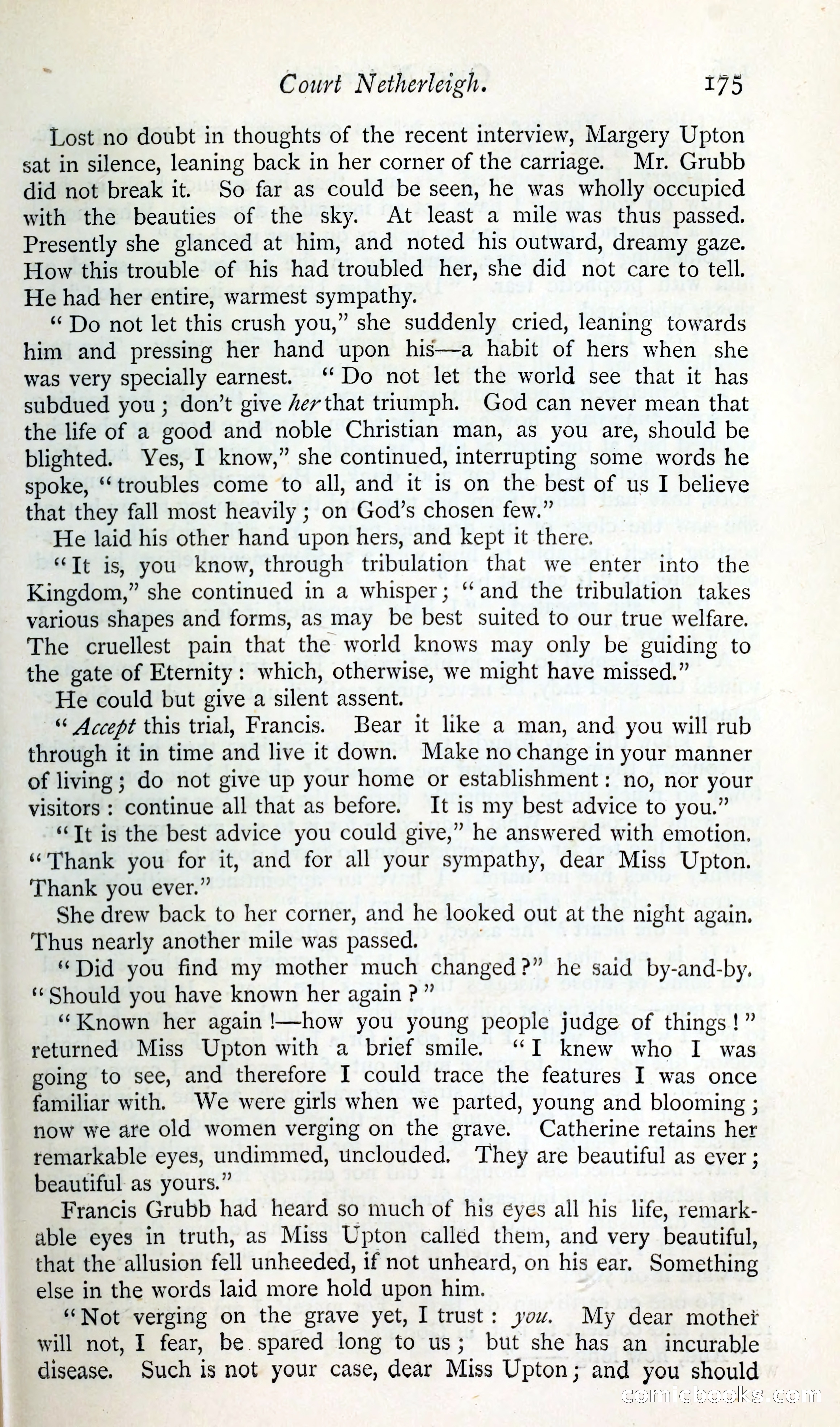
A restored page from Pulp Fiction, 1865. Page through the whole issue in the reader above.
📄 Transcribed text from this page (OCR, searchable)
Machine-transcribed from the original scan — historical spelling and the odd misread are preserved.
Court Netherleigh. 175 Lost no doubt in thoughts of the recent interview, Margery Upton sat in silence, leaning back in her corner of the carriage. Mr. Grubb did not break it. So far as could be seen, he was wholly occupied with the beauties of the sky. At least a mile was thus passed. Presently she glanced at him, and noted his outward, dreamy gaze. How this trouble of his had troubled her, she did not care to tell. He had her entire, warmest sympathy. ‘Do not let this crush you,” she suddenly cried, leaning towards him and pressing her hand upon his—a habit of hers when she was very specially earnest. ‘Do not let the world see that it has subdued you; don’t give Zev that triumph. God can never mean that the life of a good and noble Christian man, as you are, should be blighted. Yes, I know,” she continued, interrupting some words he spoke, ‘‘troubles come to all, and it is on the best of us I believe that they fall most heavily ; on God’s chosen few.” He laid his other hand upon hers, and kept it there. “Tt is, you know, through tribulation that we enter into the Kingdom,” she continued in a whisper; “and the tribulation takes various shapes and forms, as may be best suited to our true welfare. The cruellest pain that the world knows may only be guiding to the gate of Eternity: which, otherwise, we might have missed.” He could but give a silent assent. “ Accept this trial, Francis. Bear it like a man, and you will rub through it in time and live it down. Make nochange in your manner of living; do not give up your home or establishment: no, nor your visitors ;: continue all that as before. It is my best advice to you.” “Tt is the best advice you could give,” he answered with emotion. “Thank you for it, and for all your sympathy, dear Miss Upton. Thank you ever.” She drew back to her corner, and he looked out at the night again. Thus nearly another mile was passed. “Did you find my mother much changed?” he said by-and-by. ‘Should you have known her again ?” ‘Known her again !—how you young people judge of things!” returned Miss Upton with a brief smile. “I knew who I was going to see, and therefore I could trace the features I was once familiar with. We were girls when we parted, young and blooming ; now we are old women verging on the grave. Catherine retains her remarkable eyes, undimmed, unclouded. They are beautiful as ever; beautiful as yours.” Francis Grubb had heard so much of his eyes all his life, remark- able eyes in truth, as Miss Upton called them, and very beautiful, that the allusion fell unheeded, if not unheard, on his ear. Something else in the words laid more hold upon him. “Not verging on the grave yet, I trust: you. My dear mother will not, I fear, be spared long to us; but she has an incurable disease. Such is not your case, dear Miss Upton; and you should GOnlGaooks (C©)