
Pulp Fiction, 1865 · page 169 of 400
The Argosy — page 169: what you’re looking at
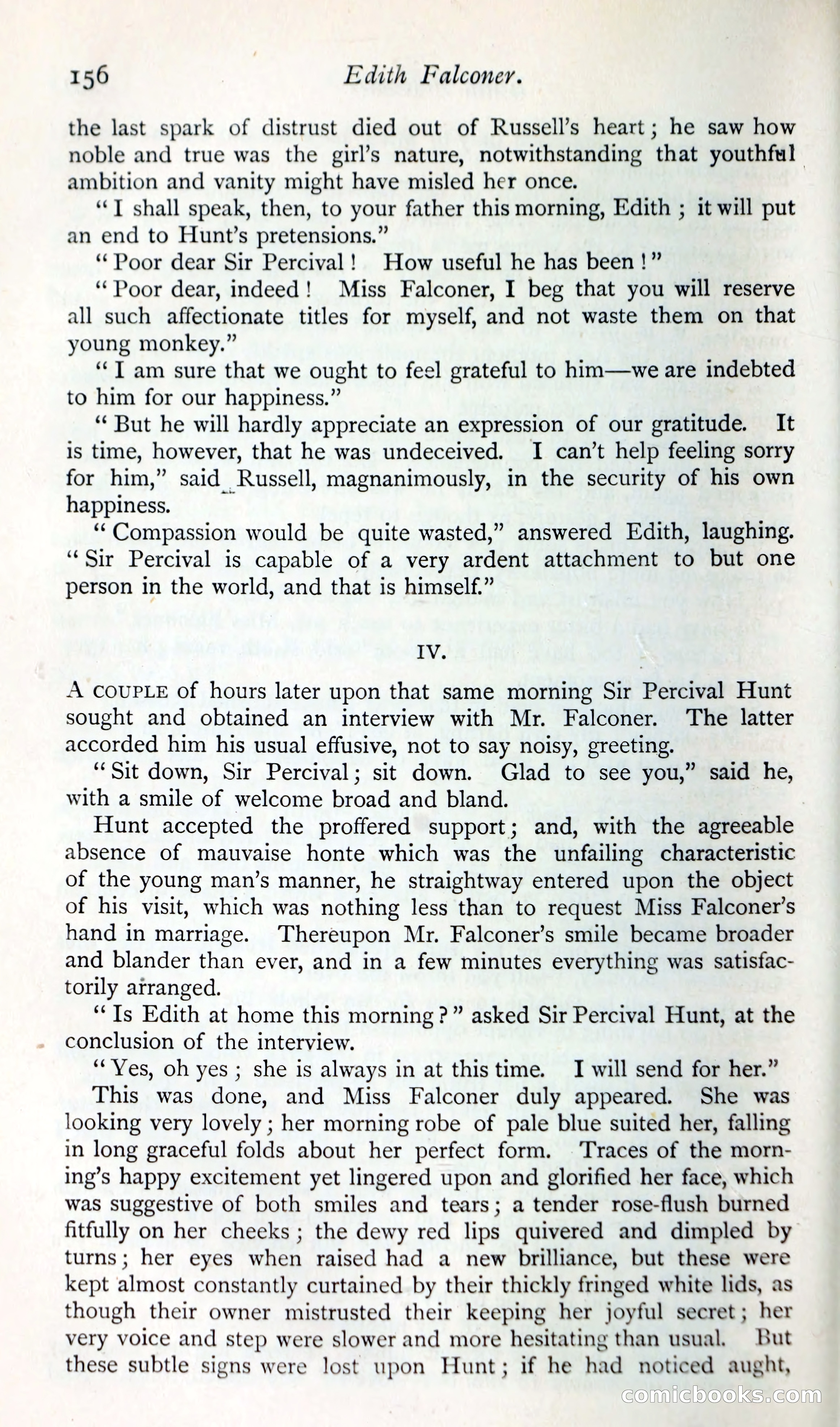
A restored page from Pulp Fiction, 1865. Page through the whole issue in the reader above.
📄 Transcribed text from this page (OCR, searchable)
Machine-transcribed from the original scan — historical spelling and the odd misread are preserved.
156 Edith Falconer. the last spark of distrust died out of Russell’s heart; he saw how noble and true was the girl’s nature, notwithstanding that youthful ambition and vanity might have misled her once. ‘‘T shall speak, then, to your father this morning, Edith ; it will put an end to Hunt’s pretensions.” ‘Poor dear Sir Percival! How useful he has been !” ‘Poor dear, indeed! Miss Falconer, I beg that you will reserve all such affectionate titles for myself, and not waste them on that young monkey.” ‘‘T am sure that we ought to feel grateful to him—we are indebted to him for our happiness.” ‘But he will hardly appreciate an expression of our gratitude. It is time, however, that he was undeceived. I can’t help feeling sorry for him,” said Russell, magnanimously, in the security of his own happiness. ‘‘Compassion would be quite wasted,” answered Edith, laughing. ‘Sir Percival is capable of a very ardent attachment to but one person in the world, and that is himself.” IV. A COUPLE of hours later upon that same morning Sir Percival Hunt sought and obtained an interview with Mr. Falconer. ‘The latter accorded him his usual effusive, not to say noisy, greeting. “Sit down, Sir Percival; sit down. Glad to see you,” said he, with a smile of welcome broad and bland. Hunt accepted the proffered support; and, with the agreeable absence of mauvaise honte which was the unfailing characteristic of the young man’s manner, he straightway entered upon the object of his visit, which was nothing less than to request Miss Falconer’s hand in marriage. Thereupon Mr. Falconer’s smile became broader and blander than ever, and in a few minutes everything was satisfac- torily arranged. ‘Ts Edith at home this morning ?” asked Sir Percival Hunt, at the conclusion of the interview. ‘Yes, oh yes ; she is always in at thistime. I will send for her.” This was done, and Miss Falconer duly appeared. She was looking very lovely ; her morning robe of pale blue suited her, falling in long graceful folds about her perfect form. Traces of the morn- ing’s happy excitement yet lingered upon and glorified her face, which was suggestive of both smiles and tears; a tender rose-flush burned fitfully on her cheeks ; the dewy red lips quivered and dimpled by turns; her eyes when raised had a new brilliance, but these were kept almost constantly curtained by their thickly fringed white lids, as though their owner mistrusted their keeping her joyful secret; her very voice and step were slower and more hesitating than usual. But these subtle signs were lost upon Hunt; if he had noticed aught, Gomichbooksico