
Pulp Fiction, 1865 · page 165 of 400
The Argosy — page 165: what you’re looking at
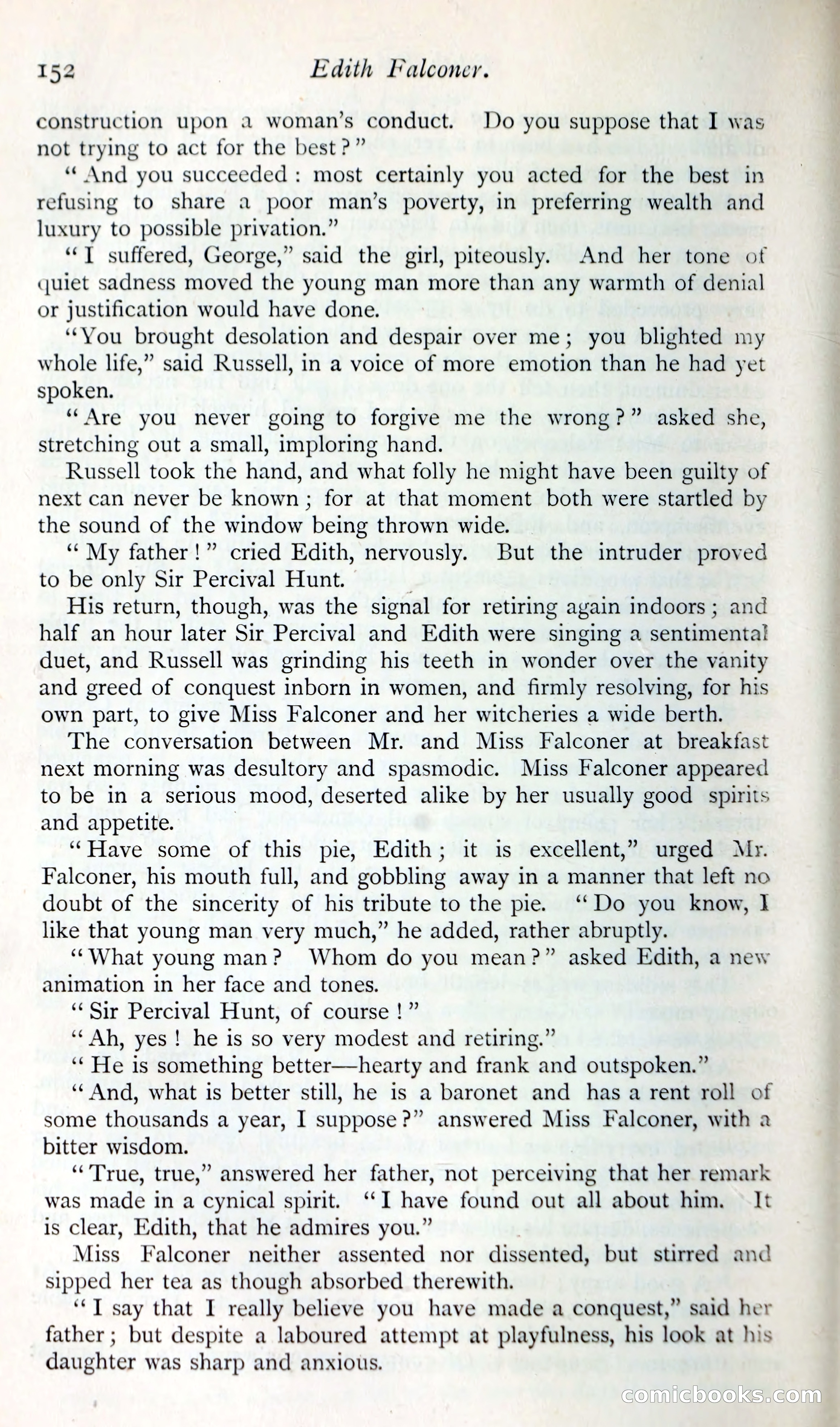
A restored page from Pulp Fiction, 1865. Page through the whole issue in the reader above.
📄 Transcribed text from this page (OCR, searchable)
Machine-transcribed from the original scan — historical spelling and the odd misread are preserved.
152 Edith Falconer. construction upon a woman’s conduct. Do you suppose that I was not trying to act for the best ?” ‘And you succeeded : most certainly you acted for the best in refusing to share a poor man’s poverty, in preferring wealth and luxury to possible privation.” ‘“T suffered, George,” said the girl, piteously. And her tone ot quiet sadness moved the young man more than any warmth of denial or justification would have done. ‘You brought desolation and despair over me; you blighted my whole life,” said Russell, in a voice of more emotion than he had yet spoken. “Are you never going to forgive me the wrong?” asked she, stretching out a small, imploring hand. Russell took the hand, and what folly he might have been guilty of next can never be known ; for at that moment both were startled by the sound of the window being thrown wide. “My father!” cried Edith, nervously. But the intruder proved to be only Sir Percival Hunt. | His return, though, was the signal for retiring again indoors ; and half an hour later Sir Percival and Edith were singing a sentimental duet, and Russell was grinding his teeth in wonder over the vanity and greed of conquest inborn in women, and firmly resolving, for his own part, to give Miss Falconer and her witcheries a wide berth. The conversation between Mr. and Miss Falconer at breakfast next morning was desultory and spasmodic. Miss Falconer appeared to be in a serious mood, deserted alike by her usually good spirits and appetite. | ‘““Have some of this pie, Edith; it is excellent,” urged Mr. Falconer, his mouth full, and gobbling away in a manner that left no doubt of the sincerity of his tribute to the pie. ‘Do you know, 1 like that young man very much,” he added, rather abruptly. “What young man? Whom do you mean?” asked Edith, a new animation in her face and tones. ‘Sir Percival Hunt, of course!” ‘‘Ah, yes! he is so very modest and retiring.” ‘‘ He is something better—hearty and frank and outspoken.” ‘And, what is better still, he is a baronet and has a rent roll of some thousands a year, I suppose?” answered Miss Falconer, with a bitter wisdom. “True, true,” answered her father, not perceiving that her remark was made in a cynical spirit. ‘“‘I have found out all about him. = It is clear, Edith, that he admires you.” | Miss Falconer neither assented nor dissented, but stirred and sipped her tea as though absorbed therewith. ‘““T say that I really believe you have made a conquest,” said her father ; but despite a laboured attempt at playfulness, his look at his daughter was sharp and anxious. EOMICELNCKO KS, (Eo)