
Pulp Fiction, 1865 · page 151 of 400
The Argosy — page 151: what you’re looking at
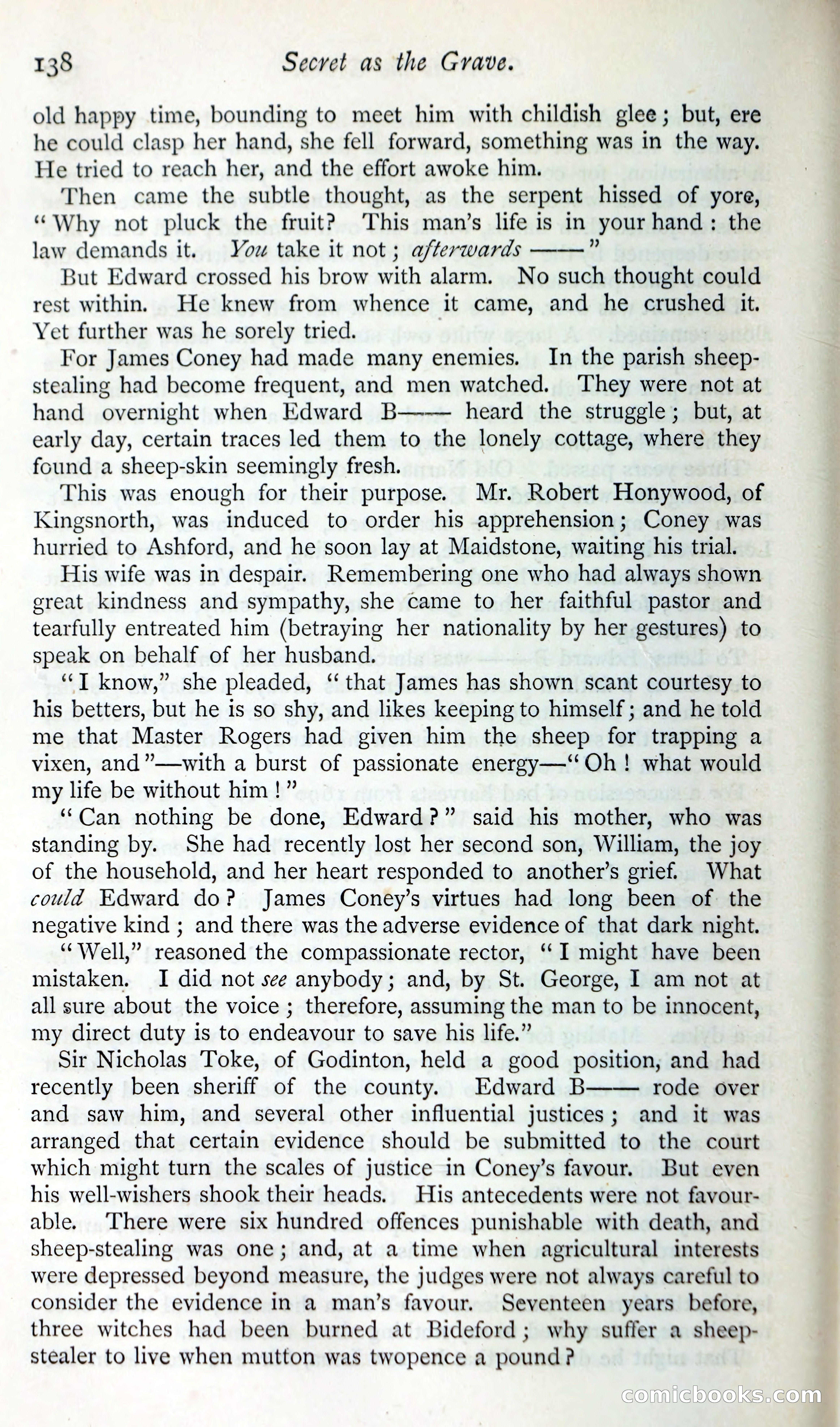
A restored page from Pulp Fiction, 1865. Page through the whole issue in the reader above.
📄 Transcribed text from this page (OCR, searchable)
Machine-transcribed from the original scan — historical spelling and the odd misread are preserved.
138 Secret as the Grave. old happy time, bounding to meet him with childish glee; but, ere he could clasp her hand, she fell forward, something was in the way. He tried to reach her, and the effort awoke him. Then came the subtle thought, as the serpent hissed of yore, ‘Why not pluck the fruit? This man’s life is in your hand: the law demands it. You take it not; afterwards ——” But Edward crossed his brow with alarm. No such thought could rest within. He knew from whence it came, and he crushed it. Yet further was he sorely tried. ; For James Coney had made many enemies. In the parish sheep- stealing had become frequent, and men watched. ‘They were not at hand overnight when Edward B—--—— heard the struggle; but, at early day, certain traces led them to the lonely cottage, where they found a sheep-skin seemingly fresh. This was enough for their purpose. Mr. Robert Honywood, of Kingsnorth, was induced to order his apprehension; Coney was hurried to Ashford, and he soon lay at Maidstone, waiting his trial. His wife was in despair. Remembering one who had always shown great kindness and sympathy, she came to her faithful pastor and tearfully entreated him (betraying her nationality by her gestures) to speak on behalf of her husband. ‘“‘T know,” she pleaded, ‘‘ that James has shown scant courtesy to his betters, but he 1s so shy, and likes keeping to himself; and he told me that Master Rogers had given him the sheep for trapping a vixen, and ”—with a burst of passionate energy—‘“‘ Oh! what would my life be without him !” ‘Can nothing be done, Edward?” said his mother, who was standing by. She had recently lost her second son, William, the joy of the household, and her heart responded to another’s grief. What could Edward do? James Coney’s virtues had long been of the negative kind ; and there was the adverse evidence of that dark night. “Well,” reasoned the compassionate rector, “I might have been mistaken. I did not see anybody; and, by St. George, I am not at all sure about the voice ; therefore, assuming the man to be innocent, my direct duty 1s to endeavour to save his life.” Sir Nicholas Toke, of Godinton, held a good position, and had recently been sheriff of the county. Edward B rode over and saw him, and several other influential justices; and it was arranged that certain evidence should be submitted to the court which might turn the scales of justice in Coney’s favour. But even his well-wishers shook their heads. His antecedents were not favour- able. ‘There were six hundred offences punishable with death, and sheep-stealing was one; and, at a time when agricultural interests were depressed beyond measure, the judges were not always careful to consider the evidence in a man’s favour. Seventeen years before, three witches had been burned at Bideford; why suffer a sheep- stealer to live when mutton was twopence a pound? CORNICE OOO KS (E(@)