
Pulp Fiction, 1865 · page 326 of 400
The Argosy — page 326: what you’re looking at
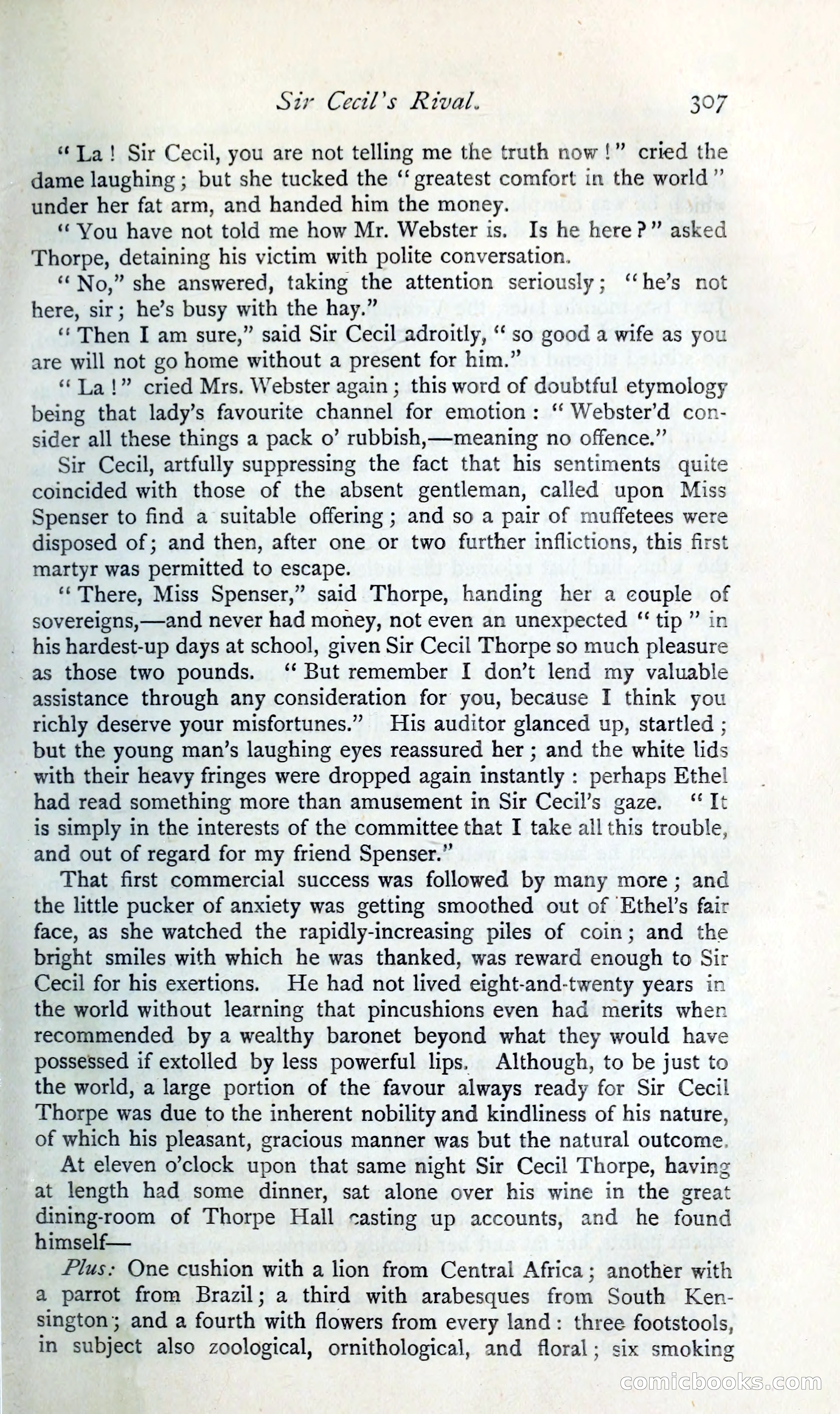
A restored page from Pulp Fiction, 1865. Page through the whole issue in the reader above.
📄 Transcribed text from this page (OCR, searchable)
Machine-transcribed from the original scan — historical spelling and the odd misread are preserved.
Sir Cecil's Rival. 307 “Ta! Sir Cecil, you are not telling me the truth now!” cried the dame laughing ; but she tucked the ‘‘ greatest comfort in the world” under her fat arm, and handed him the money. ‘You have not told me how Mr. Webster is. Is he here?” asked Thorpe, detaining his victim with polite conversation. ‘‘No,” she answered, taking the attention seriously; ‘‘he’s not here, sir; he’s busy with the hay.” ‘‘ Then I am sure,” said Sir Cecil adroitly, ‘‘ so good a wife as you are will not go home without a present for him.” “Ta!” cried Mrs. Webster again; this word of doubtful etymology being that lady’s favourite channel for emotion: “ Webster’d con- sider all these things a pack o’ rubbish,—meaning no offence.” Sir Cecil, artfully suppressing the fact that his sentiments quite coincided with those of the absent gentleman, called upon Miss Spenser to find a suitable offering ; and so a pair of muffetees were disposed of; and then, after one or two further inflictions, this first martyr was permitted to escape. ‘‘ There, Miss Spenser,” said Thorpe, handing her a couple of sovereigns,—and never had money, not even an unexpected “ tip ” in _ his hardest-up days at school, given Sir Cecil Thorpe so much pleasure as those two pounds. ‘“‘ But remember I don’t lend my valuable assistance through any consideration for you, because I think you richly deserve your misfortunes.” His auditor glanced up, startled ; but the young man’s laughing eyes reassured her ; and the white lids ' with their heavy fringes were dropped again instantly : perhaps Ethel had read something more than amusement in Sir Cecil’s gaze. ‘It is simply in the interests of the committee that I take all this trouble, and out of regard for my friend Spenser.” That first commercial success was followed by many more; and the little pucker of anxiety was getting smoothed out of Ethel’s fair face, as she watched the rapidly-increasing piles of coin; and the bright smiles with which he was thanked, was reward enough to Sir Cecil for his exertions. He had not lived eight-and-twenty years in the world without learning that pincushions even had merits when recommended by a wealthy baronet beyond what they would have possessed if extolled by less powerful lips. Although, to be just to the world, a large portion of the favour always ready for Sir Cecil Thorpe was due to the inherent nobility and kindliness of his nature, of which his pleasant, gracious manner was but the natural outcome. At eleven o’clock upon that same night Sir Cecil Thorpe, having at length had some dinner, sat alone over his wine in the great dining-room of Thorpe Hall casting up accounts, and he found himself— flus: One cushion with a lion from Central Africa; another with a parrot from Brazil; a third with arabesques from South Ken- sington; and a fourth with flowers from every land: three footstools, in subject also zoological, ornithological, and floral; six smoking CORNELO© (©) an