
Pulp Fiction, 1865 · page 300 of 400
The Argosy — page 300: what you’re looking at
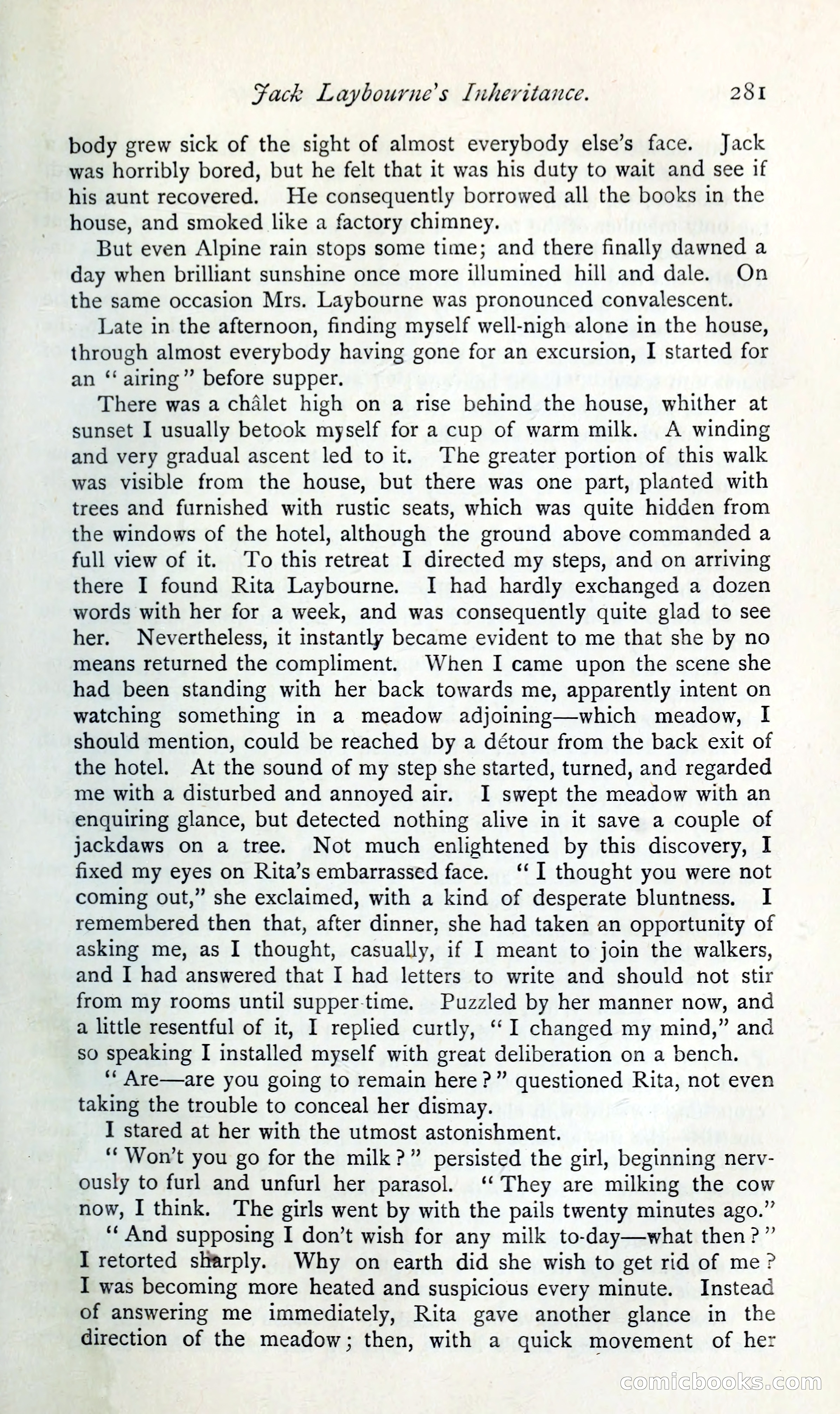
A restored page from Pulp Fiction, 1865. Page through the whole issue in the reader above.
📄 Transcribed text from this page (OCR, searchable)
Machine-transcribed from the original scan — historical spelling and the odd misread are preserved.
Fack Laybourne’s Lnheritance. 281 body grew sick of the sight of almost everybody else’s face. Jack was horribly bored, but he felt that it was his duty to wait and see if his aunt recovered. He consequently borrowed all the books in the house, and smoked like a factory chimney. But even Alpine rain stops some time; and there finally dawned a day when brilliant sunshine once more illumined hill and dale. On the same occasion Mrs. Laybourne was pronounced convalescent. Late in the afternoon, finding myself well-nigh alone in the house, through almost everybody having gone for an excursion, I started for an ‘‘ airing” before supper. There was a chalet high on a rise behind the house, whither at sunset I usually betook myself for a cup of warm milk. A winding and very gradual ascent led to it. The greater portion of this walk was visible from the house, but there was one part, planted with trees and furnished with rustic seats, which was quite hidden from the windows of the hotel, although the ground above commanded a full view of it. To this retreat I directed my steps, and on arriving there I found Rita Laybourne. I had hardly exchanged a dozen words with her for a week, and was consequently quite glad to see her. Nevertheless, it instantly became evident to me that she by no means returned the compliment. When I came upon the scene she had been standing with her back towards me, apparently intent on watching something in a meadow adjoining—which meadow, I should mention, could be reached by a détour from the back exit of the hotel. At the sound of my step she started, turned, and regarded me with a disturbed and annoyed air. I swept the meadow with an enquiring glance, but detected nothing alive in it save a couple of jackdaws on a tree. Not much enlightened by this discovery, I fixed my eyes on Rita’s embarrassed face. ‘‘ I thought you were not coming out,” she exclaimed, with a kind of desperate bluntness. I remembered then that, after dinner, she had taken an opportunity of asking me, as I thought, casually, if I meant to join the walkers, and I had answered that I had letters to write and should not stir from my rooms until supper-time. Puzzled by her manner now, and a little resentful of it, I replied curtly, ‘‘I changed my mind,” and so speaking I installed myself with great deliberation on a bench. ‘* Are—are you going to remain here ?” questioned Rita, not even taking the trouble to conceal her dismay. I stared at her with the utmost astonishment. ‘“Won’t you go for the milk?” persisted the girl, beginning nerv- ously to furl and unfurl her parasol. ‘‘ They are milking the cow now, I think. The girls went by with the pails twenty minutes ago.” ‘‘ And supposing I don’t wish for any milk to-day—what then?” I retorted sharply. Why on earth did she wish to get rid of me? I was becoming more heated and suspicious every minute. Instead of answering me immediately, Rita gave another glance in the direction of the meadow; then, with a quick movement of her ECORnNICLOOKS. EO am