
Pulp Fiction, 1865 · page 293 of 400
The Argosy — page 293: what you’re looking at
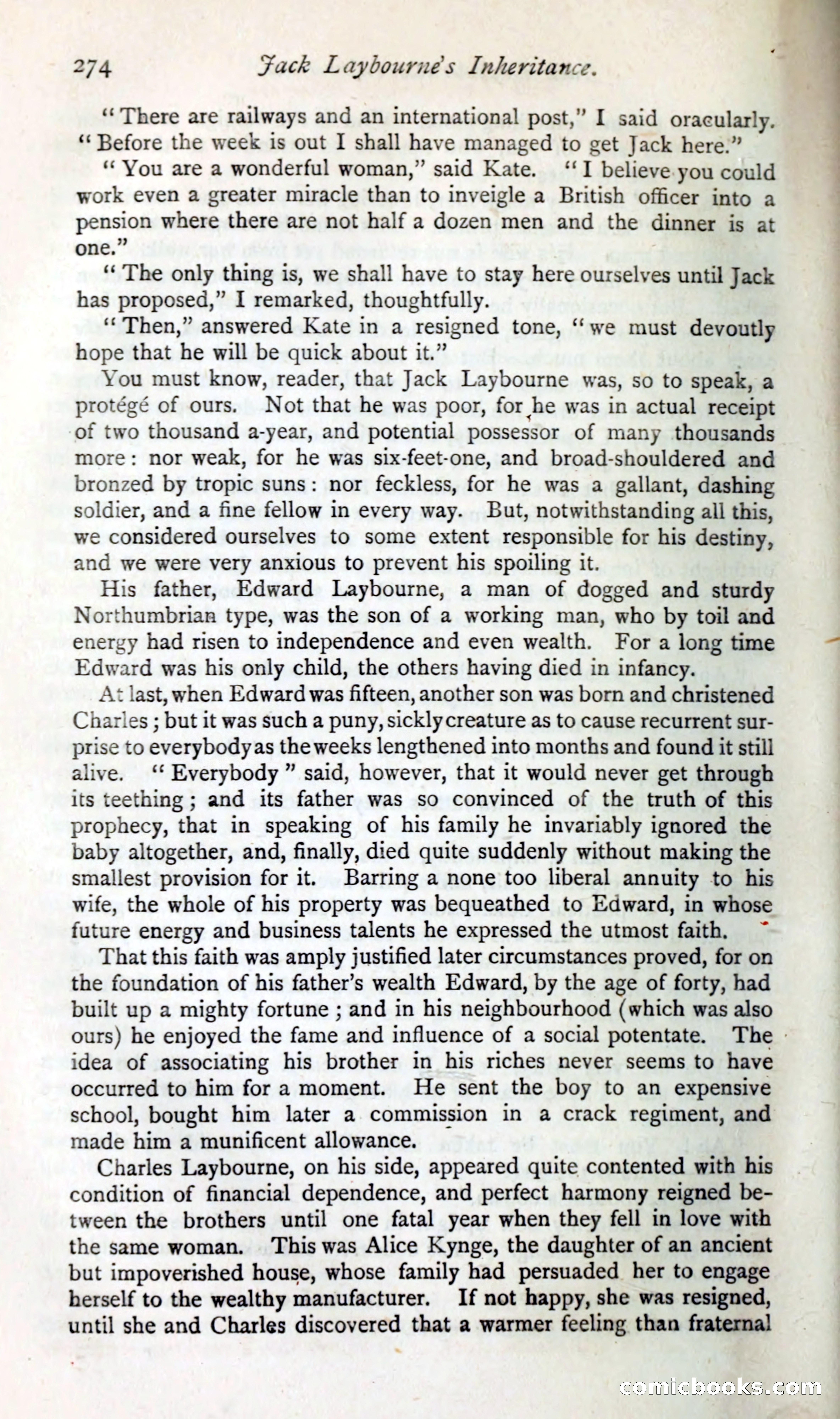
A restored page from Pulp Fiction, 1865. Page through the whole issue in the reader above.
📄 Transcribed text from this page (OCR, searchable)
Machine-transcribed from the original scan — historical spelling and the odd misread are preserved.
274 Fack Laybournes Inheritance. ‘There are railways and an international post,” I said oracularly. ‘‘ Before the week is out I shall have managed to get Jack here.” ‘You are a wonderful woman,” said Kate. ‘‘I believe. you could work even a greater miracle than to inveigle a British officer into a pension where there are not half a dozen men and the dinner is at one.” ‘The only thing is, we shall have to stay here ourselves until Jack has proposed,” I remarked, thoughtfully. ‘‘ Then,” answered Kate in a resigned tone, “we must devoutly hope that he will be quick about it.” You must know, reader, that Jack Laybourne was, so to speak, a protégé of ours. Not that he was poor, for he was in actual receipt of two thousand a-year, and potential possessor of many thousands more: nor weak, for he was six-feet-one, and broad-shouldered and bronzed by tropic suns: nor feckless, for he was a gallant, dashing soldier, and a fine fellow in every way. But, notwithstanding all this, we considered ourselves to some extent responsible for his destiny, and we were very anxious to prevent his spoiling it. His father, Edward Laybourne, a man of dogged and sturdy Northumbrian type, was the son of a working man, who by toil and energy had risen to independence and even wealth. For a long time 4 Edward was his only child, the others having died in infancy. At last, when Edward was fifteen, another son was born and christened Charles ; but it was such a puny, sickly creature as to cause recurrent sur- prise to everybody as the weeks lengthened into months and found it still alive. ‘‘ Everybody ” said, however, that it would never get through its teething ; and its father was so convinced of the truth of this prophecy, that in speaking of his family he invariably ignored the baby altogether, and, finally, died quite suddenly without making the smallest provision for it. Barring a none too liberal annuity to his wife, the whole of his property was bequeathed to Edward, in whose future energy and business talents he expressed the utmost faith, That this faith was amply justified later circumstances proved, for on the foundation of his father’s wealth Edward, by the age of forty, had built up a mighty fortune ; and in his neighbourhood (which was also ours) he enjoyed the fame and influence of a social potentate. The - idea of associating his brother in his riches never seems to have occurred to him fora moment. He sent the boy to an expensive school, bought him later a commission in a crack regiment, and made him a munificent allowance. Charles Laybourne, on his side, appeared quite contented with his condition of financial dependence, and perfect harmony reigned be- tween the brothers until one fatal year when they fell in love with the same woman. ‘This was Alice Kynge, the daughter of an ancient but impoverished house, whose family had persuaded her to engage herself to the wealthy manufacturer. If not happy, she was resigned, until she and Charles discovered that a warmer feeling than fraternal Eomichbooks.com