
Pulp Fiction, 1865 · page 275 of 400
The Argosy — page 275: what you’re looking at
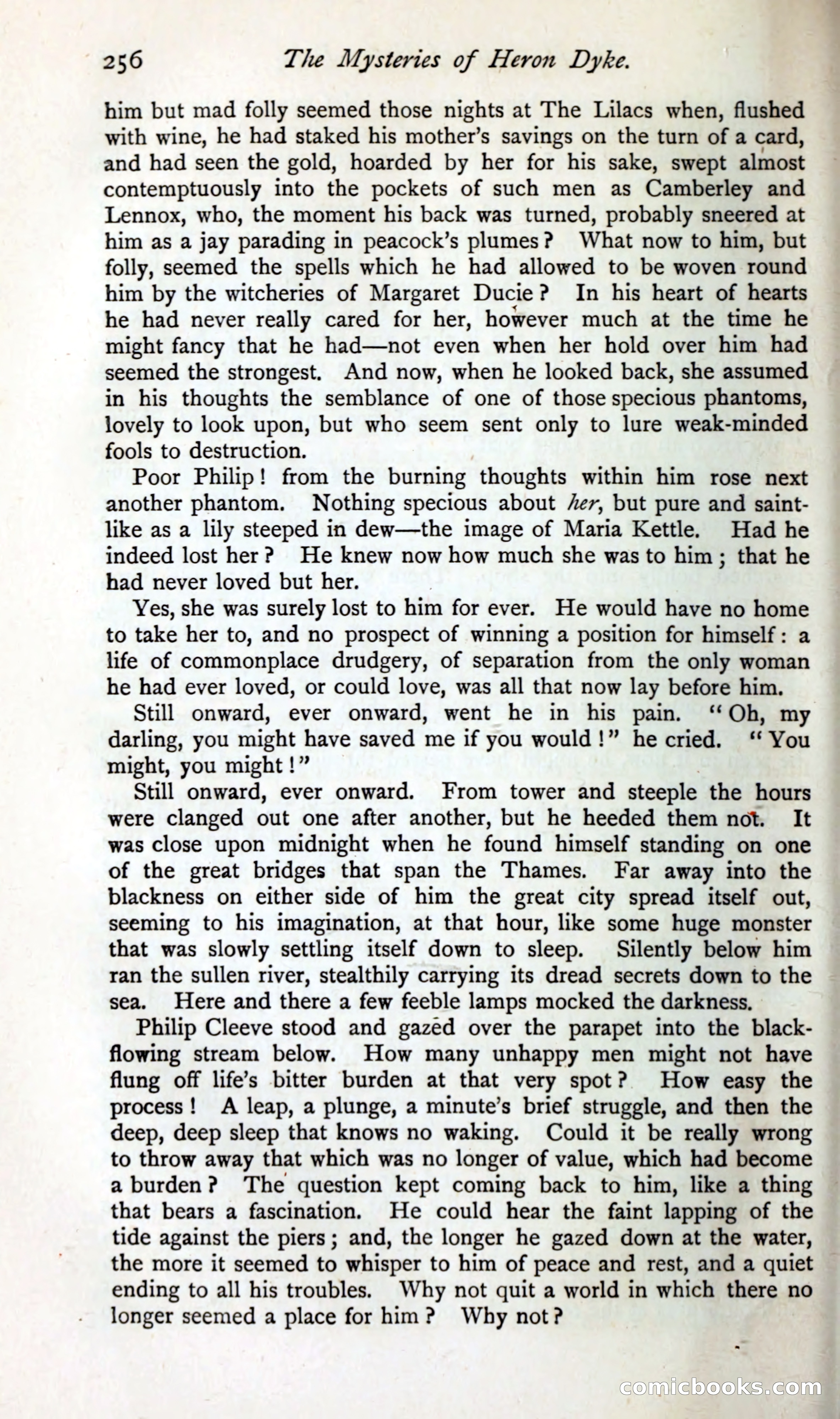
A restored page from Pulp Fiction, 1865. Page through the whole issue in the reader above.
📄 Transcribed text from this page (OCR, searchable)
Machine-transcribed from the original scan — historical spelling and the odd misread are preserved.
256 The Mysteries of Heron Dyke. him but mad folly seemed those nights at The Lilacs when, flushed with wine, he had staked his mother’s savings on the turn of a card, and had seen the gold, hoarded by her for his sake, swept almost contemptuously into the pockets of such men as Camberley and Lennox, who, the moment his back was turned, probably sneered at him as a jay parading in peacock’s plumes? What now to him, but folly, seemed the spells which he had allowed to be woven round him by the witcheries of Margaret Ducie? In his heart of hearts he had never really cared for her, however much at the time he might fancy that he had—not even when her hold over him had seemed the strongest. And now, when he looked back, she assumed in his thoughts the semblance of one of those specious phantoms, lovely to look upon, but who seem sent only to lure weak-minded fools to destruction. Poor Philip! from the burning thoughts within him rose next another phantom. Nothing specious about /erv, but pure and saint- like as a lily steeped in dew—the image of Maria Kettle. Had he indeed lost her? He knew now how much she was to him; that he had never loved but her. Yes, she was surely lost to him for ever. He would have no home to take her to, and no prospect of winning a position for himself: a life of commonplace drudgery, of separation from the only woman he had ever loved, or could love, was all that now lay before him. Still onward, ever onward, went he in his pain. ‘Oh, my darling, you might have saved me if you would!” hecried. ‘‘ You might, you might !” Still onward, ever onward. From tower and steeple the hours were clanged out one after another, but he heeded them not. It was close upon midnight when he found himself standing on one of the great bridges that span the Thames. Far away into the blackness on either side of him the great city spread itself out, seeming to his imagination, at that hour, like some huge monster that was slowly settling itself down to sleep. Silently below him ran the sullen river, stealthily carrying its dread secrets down to the sea. Here and there a few feeble lamps mocked the darkness, Philip Cleeve stood and gazed over the parapet into the black- flowing stream below. How many unhappy men might not have flung off life’s bitter burden at that very spot? How easy the process! A leap, a plunge, a minute’s brief struggle, and then the deep, deep sleep that knows no waking. Could it be really wrong to throw away that which was no longer of value, which had become a burden? The question kept coming back to him, like a thing that bears a fascination. He could hear the faint lapping of the tide against the piers; and, the longer he gazed down at the water, the more it seemed to whisper to him of peace and rest, and a quiet — ending to all his troubles. Why not quit a world in which there no longer seemed a place for him? Why not? Gomichbooks.com