
Pulp Fiction, 1865 · page 254 of 400
The Argosy — page 254: what you’re looking at
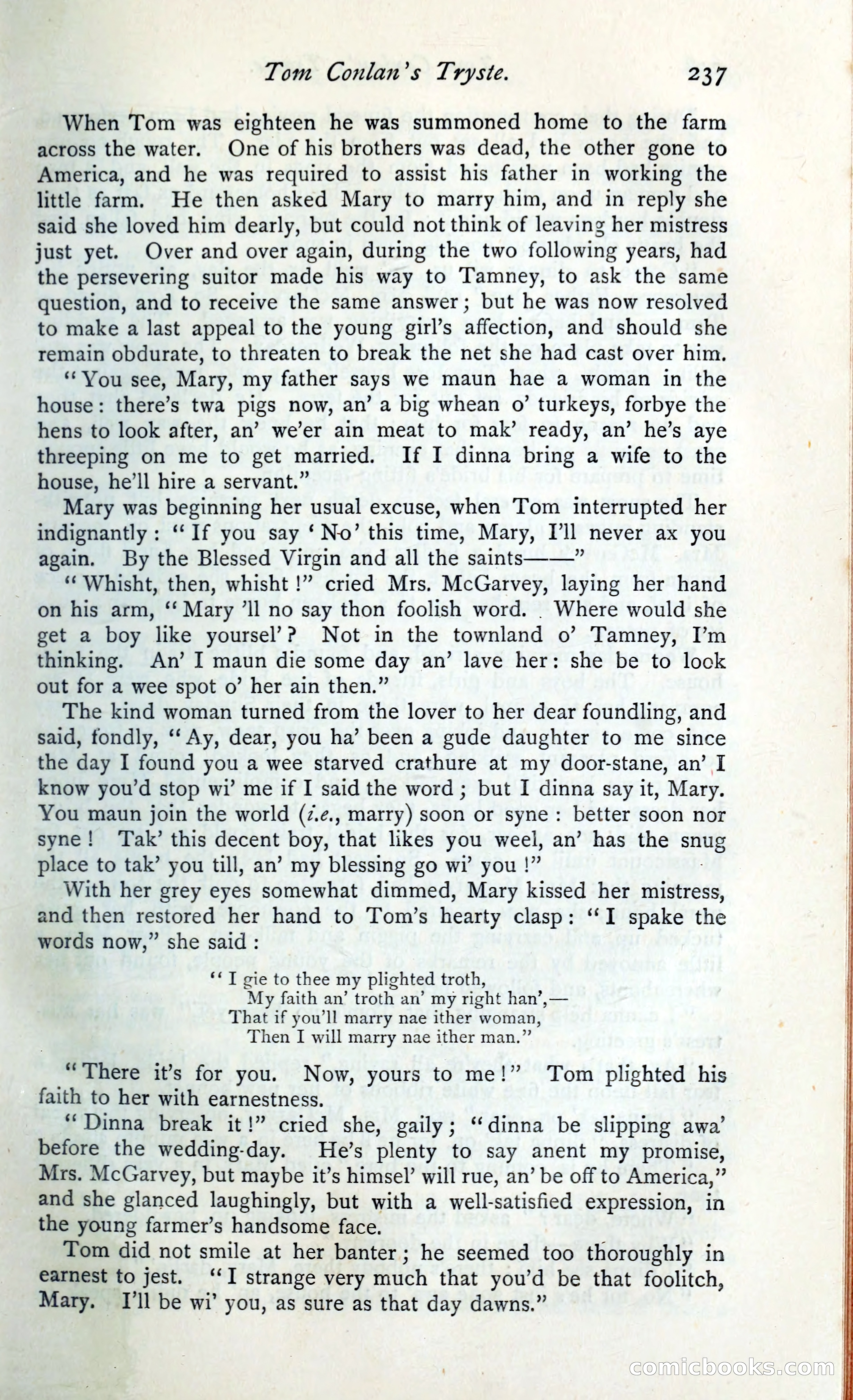
A restored page from Pulp Fiction, 1865. Page through the whole issue in the reader above.
📄 Transcribed text from this page (OCR, searchable)
Machine-transcribed from the original scan — historical spelling and the odd misread are preserved.
Tom Conlan’s Tryste. 237 When Tom was eighteen he was summoned home to the farm across the water. One of his brothers was dead, the other gone to America, and he was required to assist his father in working the little farm. He then asked Mary to marry him, and in reply she said she loved him dearly, but could not think of leaving her mistress just yet. Over and over again, during the two following years, had the persevering suitor made his way to Tamney, to ask the same question, and to receive the same answer; but he was now resolved to make a last appeal to the young girl’s affection, and should she remain obdurate, to threaten to break the net she had cast over him. “You see, Mary, my father says we maun hae a woman in the house: there’s twa pigs now, an’ a big whean o’ turkeys, forbye the hens to look after, an’ we’er ain meat to mak’ ready, an’ he’s aye threeping on me to get married. If I dinna bring a wife to the house, he’ll hire a servant.” Mary was beginning her usual excuse, when Tom interrupted her indignantly : “‘ If you say ‘ No’ this time, Mary, I’ll never ax you again. By the Blessed Virgin and all the saints—-—” ‘ Whisht, then, whisht !” cried Mrs. McGarvey, laying her hand on his arm, ‘‘ Mary ’Il no say thon foolish word. . Where would she get a boy like yoursel’? Not in the townland o’ Tamney, I’m thinking. An’ I maun die some day an’ lave her: she be to lock out for a wee spot o’ her ain then.” The kind woman turned from the lover to her dear foundling, and said, fondly, ‘‘ Ay, dear, you ha’ been a gude daughter to me since the day I found you a wee starved crathure at my door-stane, an’ I know you’d stop wi’ me if I said the word ; but I dinna say it, Mary. You maun join the world (z.e., marry) soon or syne: better soon nor syne! ‘Tak’ this decent boy, that likes you weel, an’ has the _— place to tak’ you till, an’ my blessing go wi’ you !” With her grey eyes somewhat dimmed, Mary kissed her mistress, and then restored her hand to Tom’s hearty clasp: ‘‘I spake the words now,” she said: **T gie to thee my plighted troth, My faith an’ troth an’ my right han’,— That if you'll marry nae ither woman, Then I will marry nae ither man.” “There it’s for you. Now, yours to me!” Tom plighted his faith to her with earnestness. “Dinna break it!” cried she, gaily; “dinna be slipping awa’ before the wedding-day. He’s plenty to say anent my promise, Mrs. McGarvey, but maybe it’s himsel’ will rue, an’ be off to America,” and she glanced laughingly, but with a well- satisfied expression, in the young farmer’s handsome face. Tom did not smile at her banter; he seemed too thoroughly in earnest to jest. ‘<I strange very much that you’d be that foolitch, Mary. [I'll be wi’ you, as sure as that day dawns.” ECOMIClOOOKS.C®