
Pulp Fiction, 1865 · page 252 of 400
The Argosy — page 252: what you’re looking at
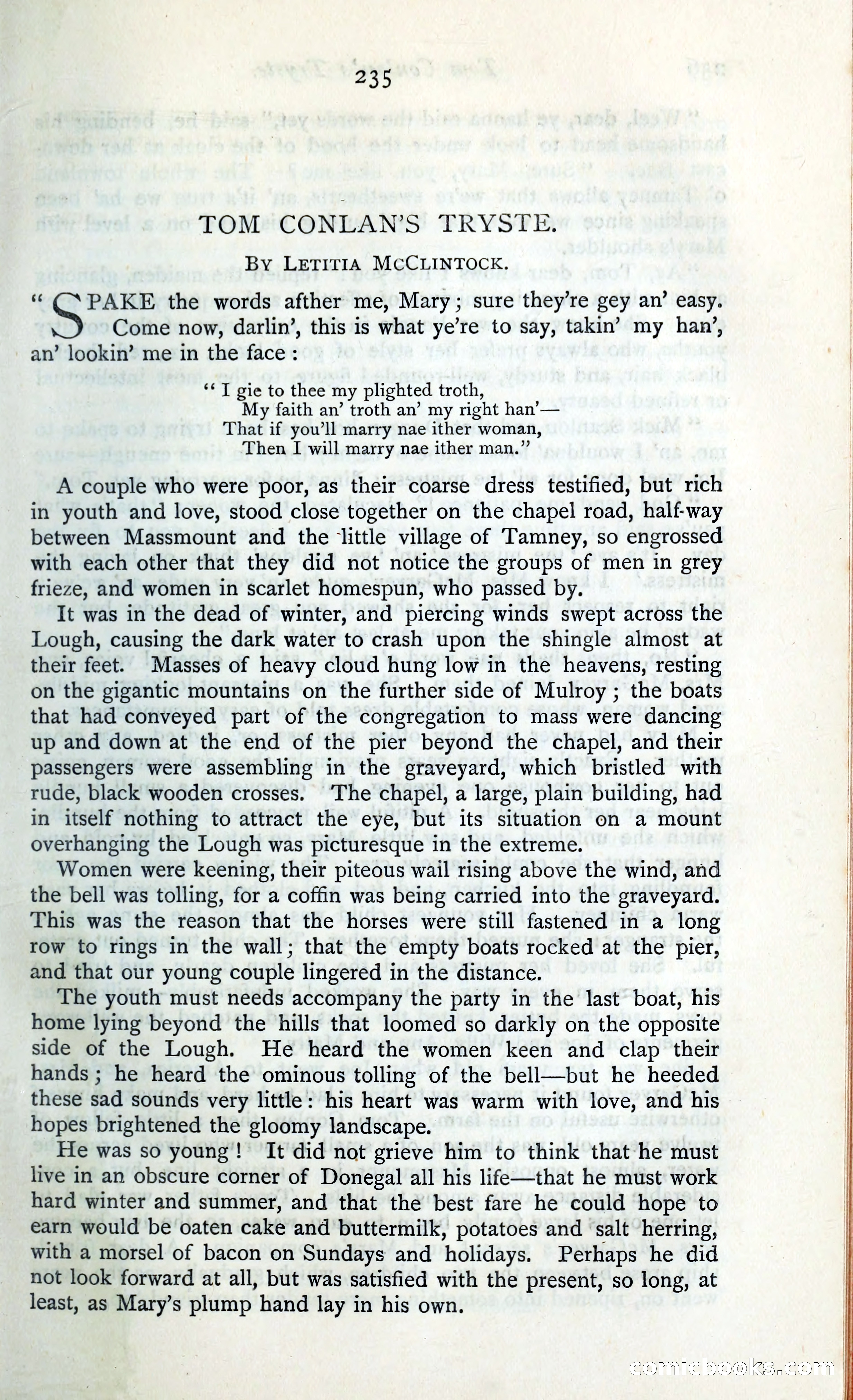
A restored page from Pulp Fiction, 1865. Page through the whole issue in the reader above.
📄 Transcribed text from this page (OCR, searchable)
Machine-transcribed from the original scan — historical spelling and the odd misread are preserved.
235 TOM CONLAN’S TRYSTE. BY LETITIA MCCLINTOCK. ‘“ C*PAKE the words afther me, Mary; sure they’re gey an’ easy. Come now, darlin’, this is what ye’re to say, takin’ my han’, an’ lookin’ me in the face: ‘** I gie to thee my plighted troth, My faith an’ troth an’ my right han’— That if you’ll marry nae ither woman, Then I will marry nae ither man.” A couple who were poor, as their coarse dress testified, but rich in youth and love, stood close together on the chapel road, half-way between Massmount and the ‘little village of Tamney, so engrossed with each other that they did not notice the groups of men in grey _ frieze, and women in scarlet homespun, who passed by. It was in the dead of winter, and piercing winds swept across the Lough, causing the dark water to crash upon the shingle almost at their feet. Masses of heavy cloud hung low in the heavens, resting on the gigantic mountains on the further side of Mulroy ; the boats that had conveyed part of the congregation to mass were dancing up and down at the end of the pier beyond the chapel, and their passengers were assembling in the graveyard, which bristled with rude, black wooden crosses. ‘The chapel, a large, plain building, had in itself nothing to attract the eye, but its situation on a mount overhanging the Lough was picturesque in the extreme. Women were keening, their piteous wail rising above the wind, and the bell was tolling, for a coffin was being carried into the graveyard. This was the reason that the horses were still fastened in a long row to rings in the wall; that the empty boats rocked at the pier, and that our young couple lingered in the distance. The youth must needs accompany the party in the last boat, his home lying beyond the hills that loomed so darkly on the opposite side of the Lough. He heard the women keen and clap their hands ; he heard the ominous tolling of the bell—but he heeded these sad sounds very little: his heart was warm with love, and his hopes brightened the gloomy landscape. He was so young! It did not grieve him to think that he must live in an obscure corner of Donegal all his life—that he must work hard winter and summer, and that the best fare he could hope to earn would be oaten cake and buttermilk, potatoes and salt herring, with a morsel of bacon on Sundays and holidays. Perhaps he did not look forward at all, but was satisfied with the present, so long, at least, as Mary’s plump hand lay in his own. CONNIClOO© SS (CO)