
Pulp Fiction, 1865 · page 241 of 400
The Argosy — page 241: what you’re looking at
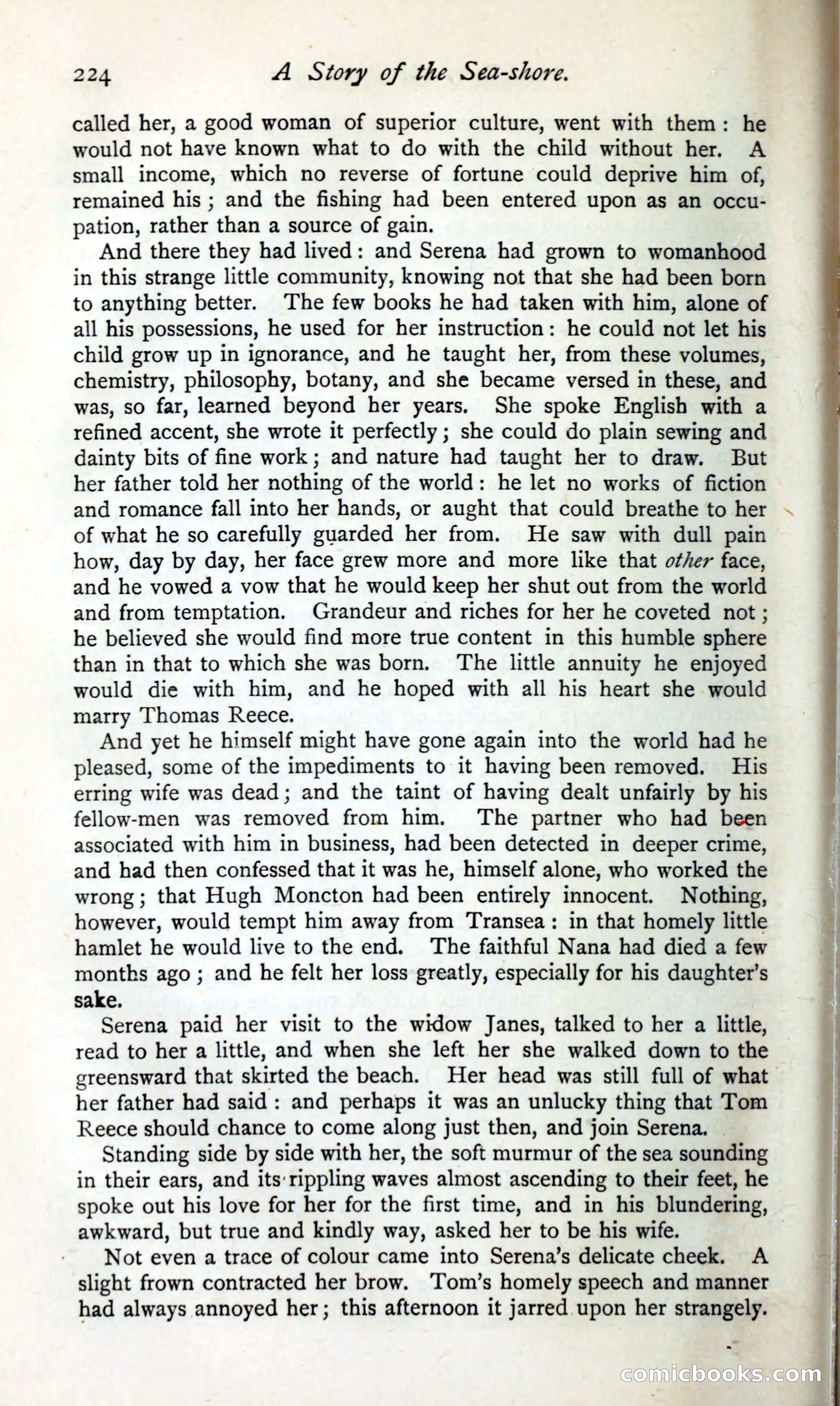
A restored page from Pulp Fiction, 1865. Page through the whole issue in the reader above.
📄 Transcribed text from this page (OCR, searchable)
Machine-transcribed from the original scan — historical spelling and the odd misread are preserved.
224 A Story of the Sea-shore. called her, a good woman of superior culture, went with them: he would not have known what to do with the child without her. A small income, which no reverse of fortune could deprive him of, remained his ; and the fishing had been entered upon as an occu- pation, rather than a source of gain. And there they had lived: and Serena had grown to womanhood in this strange little community, knowing not that she had been born to anything better. The few books he had taken with him, alone of all his possessions, he used for her instruction: he could not let his child grow up in ignorance, and he taught her, from these volumes, chemistry, philosophy, botany, and she became versed in these, and was, so far, learned beyond her years. She spoke English with a refined accent, she wrote it perfectly ; she could do plain sewing and dainty bits of fine work; and nature had taught her to draw. But her father told her nothing of the world: he let no works of fiction and romance fall into her hands, or aught that could breathe to her of what he so carefully guarded her from. He saw with dull pain how, day by day, her face grew more and more like that other face, and he vowed a vow that he would keep her shut out from the world and from temptation. Grandeur and riches for her he coveted not ; he believed she would find more true content in this humble sphere than in that to which she was born. The little annuity he enjoyed would die with him, and he hoped with all his heart she would marry Thomas Reece. And yet he himself might have gone again into the world had he pleased, some of the impediments to it having been removed. His erring wife was dead; and the taint of having dealt unfairly by his fellow-men was removed from him. The partner who had been associated with him in business, had been detected in deeper crime, and had then confessed that it was he, himself alone, who worked the wrong ; that Hugh Moncton had been entirely innocent. Nothing, however, would tempt him away from Transea: in that homely little hamlet he would live to the end. The faithful Nana had died a few months ago; and he felt her loss greatly, especially for his daughter’s sake. Serena paid her visit to the widow Janes, talked to her a little, read to her a little, and when she left her she walked down to the ereensward that skirted the beach. Her head was still full of what her father had said: and perhaps it was an unlucky thing that Tom Reece should chance to come along just then, and join Serena, — Standing side by side with her, the soft murmur of the sea sounding in their ears, and its rippling waves almost ascending to their feet, he spoke out his love for her for the first time, and in his blundering, — awkward, but true and kindly way, asked her to be his wife. Not even a trace of colour came into Serena’s delicate cheek. <A slight frown contracted her brow. Tom’s homely speech and manner had always annoyed her; this afternoon it jarred upon her strangely. Gomicbooks (E(o) ” |