
Pulp Fiction, 1865 · page 218 of 400
The Argosy — page 218: what you’re looking at
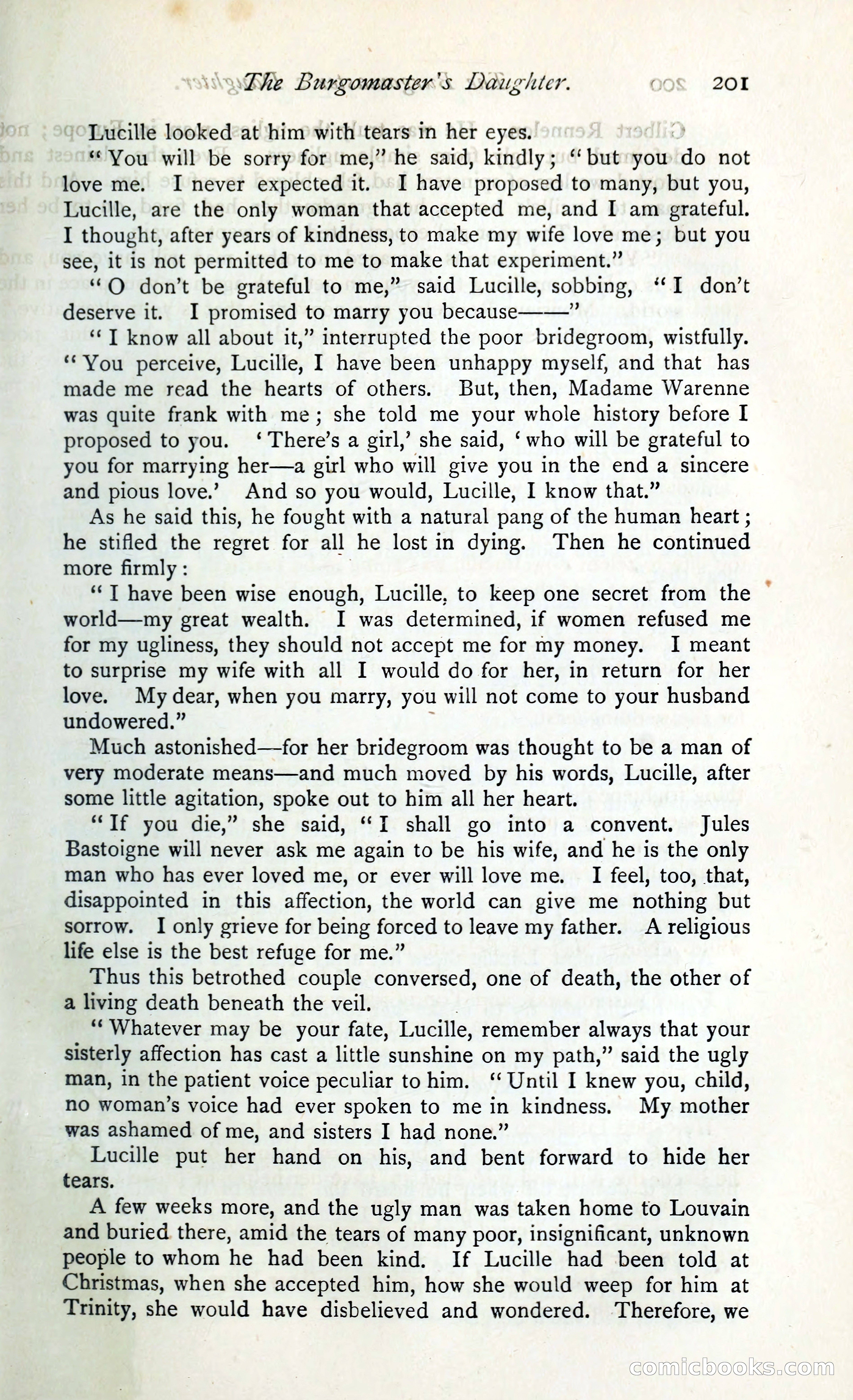
A restored page from Pulp Fiction, 1865. Page through the whole issue in the reader above.
📄 Transcribed text from this page (OCR, searchable)
Machine-transcribed from the original scan — historical spelling and the odd misread are preserved.
whe Burgomaster's Daughter. 00s 201 Lucille looked at him with tears in her eyes. : ) “You will be sorry for me,” he said, kindly; ‘‘ but you ido not love me. I never expected it. I have ‘proposed to many, but you, Lucille, are the only woman that accepted me, and I am grateful. I thought, after years of kindness, to make my wife love me; but you see, it is not permitted to me to make that experiment.” ‘OQ don’t be grateful to me,” said Lucille, sobbing, “‘I don’t deserve it. I promised to marry you because——” ‘T know all about it,” interrupted the poor bridegroom, wistfully. “You perceive, Lucille, I have been unhappy myself, and that has made me read the hearts of others. But, then, Madame Warenne was quite frank with me; she told me your whole history before I proposed to you. ‘ There’s a girl,’ she said, ‘who will be grateful to you for marrying her—a girl who will give you in the end a sincere and pious love.’ And so you would, Lucille, I know that.” As he said this, he fought with a natural pang of the human heart ; he stifled the regret for all he lost in dying. Then he continued more firmly : ‘‘T have been wise enough, Lucille, to keep one secret from the world—my great wealth. I was determined, if women refused me for my ugliness, they should not accept me for my money. I meant to surprise my wife with all I would do for her, in return for her love. My dear, when you marry, you will not come to your husband undowered.” Much astonished—for her bridegroom was thought to be a man of very moderate means—and much moved by his words, Lucille, after some little agitation, spoke out to him all her heart. “If you die,” she said, “I shall go into a convent. Jules Bastoigne will never ask me again to be his wife, and he is the only man who has ever loved me, or ever will love me. I feel, too, that, disappointed in this affection, the world can give me nothing but sorrow. I only grieve for being forced to leave my father. A religious life else is the best refuge for me.” Thus this betrothed couple conversed, one of death, the other of a living death beneath the veil. ‘Whatever may be your fate, Lucille, remember always that your sisterly affection has cast a little sunshine on my path,” said the ugly _ man, in the patient voice peculiar to him. ‘“ Until I knew you, child, no yoman’s voice had ever spoken to mein kindness. My mother was ashamed of me, and sisters I had none.” Lucille put her hand on his, and bent forward to hide her tears. A few weeks more, and the ugly man was taken home to Louvain and buried there, amid the tears of many poor, insignificant, unknown people to whom he had been kind. If Lucille had been told at Christmas, when she accepted him, how she would weep for him at Trinity, she would have disbelieved and wondered. Therefore, we CONiIClOO© SS CO