
Pulp Fiction, 1865 · page 205 of 400
The Argosy — page 205: what you’re looking at
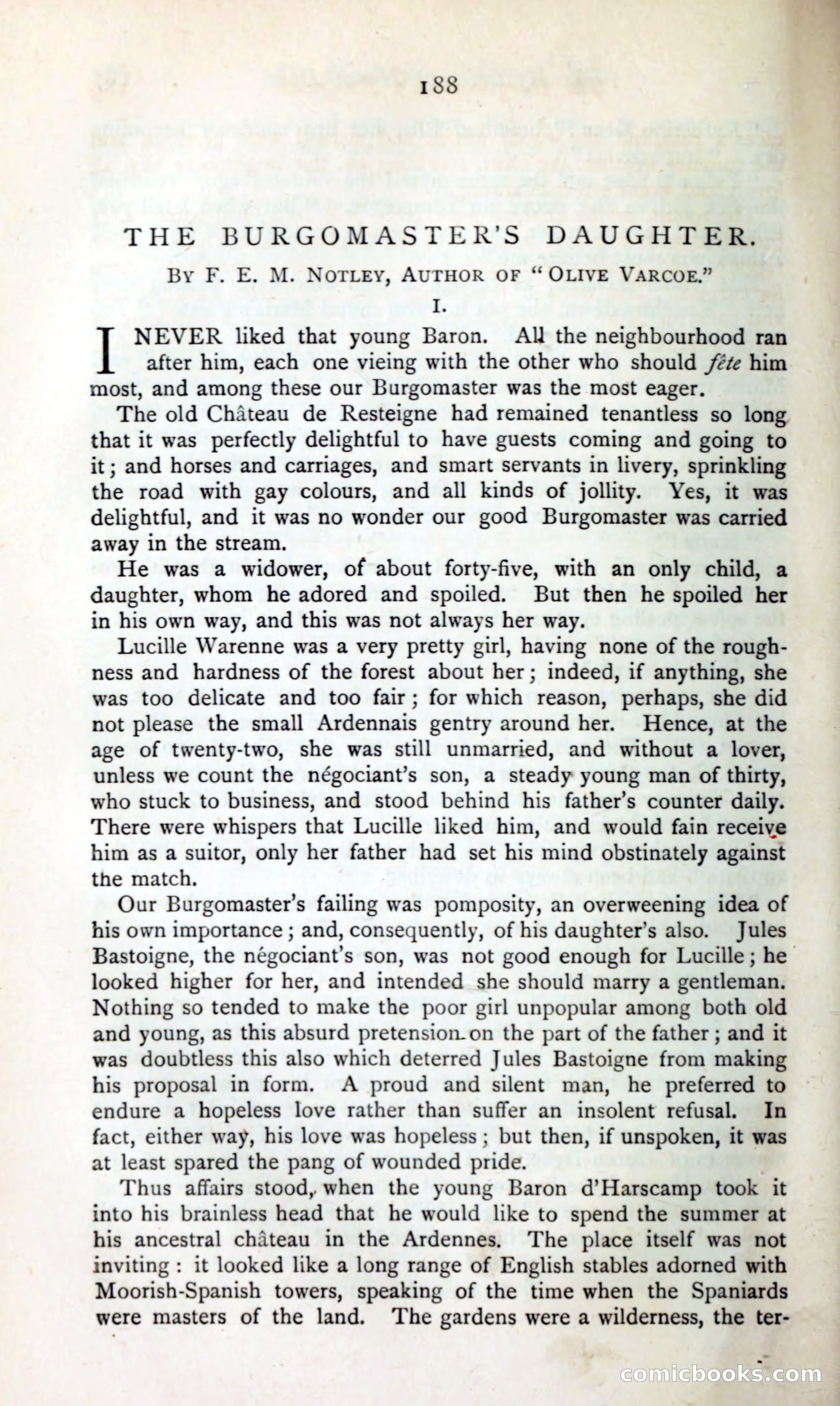
A restored page from Pulp Fiction, 1865. Page through the whole issue in the reader above.
📄 Transcribed text from this page (OCR, searchable)
Machine-transcribed from the original scan — historical spelling and the odd misread are preserved.
188 THE BURGOMASTER’S DAUGHTER. By F. E. M. NOTLEY, AUTHOR OF “ OLIVE VARCOE,” I. NEVER liked that young Baron. Al the neighbourhood ran after him, each one vieing with the other who should /éz him most, and among these our Burgomaster was the most eager. The old Chateau de Resteigne had remained tenantless so long that it was perfectly delightful to have guests coming and going to it; and horses and carriages, and smart servants in livery, sprinkling the road with gay colours, and all kinds of jollity. Yes, it was delightful, and it was no wonder our good Burgomaster was carried away in the stream. He was a widower, of about forty-five, with an only child, a daughter, whom he adored and spoiled. But then he spoiled her in his own way, and this was not always her way. Lucille Warenne was a very pretty girl, having none of the rough- ness and hardness of the forest about her; indeed, if anything, she was too delicate and too fair; for which reason, perhaps, she did not please the small Ardennais gentry around her. Hence, at the age of twenty-two, she was still unmarried, and without a lover, unless we count the négociant’s son, a steady young man of thirty, who stuck to business, and stood behind his father’s counter daily. There were whispers that Lucille liked him, and would fain receive him as a suitor, only her father had set his mind obstinately against the match. Our Burgomaster’s failing was pomposity, an overweening idea of his own importance ; and, consequently, of his daughter’s also. Jules Bastoigne, the négociant’s son, was not good enough for Lucille; he looked higher for her, and intended she should marry a gentleman. Nothing so tended to make the poor girl unpopular among both old and young, as this absurd pretension.on the part of the father ; and it was doubtless this also which deterred Jules Bastoigne from making his proposal in form. A proud and silent man, he preferred to endure a hopeless love rather than suffer an insolent refusal. In fact, either way, his love was hopeless ; but then, if unspoken, it was at least spared the pang of wounded pride. Thus affairs stood, when the young Baron d’Harscamp took it into his brainless head that he would like to spend the summer at his ancestral chateau in the Ardennes, The place itself was not inviting : it looked like a long range of English stables adorned with Moorish-Spanish towers, speaking of the time when the Spaniards were masters of the land. The gardens were a wilderness, the ter- Eomicbooks: co m