
Pulp Fiction, 1865 · page 173 of 400
The Argosy — page 173: what you’re looking at
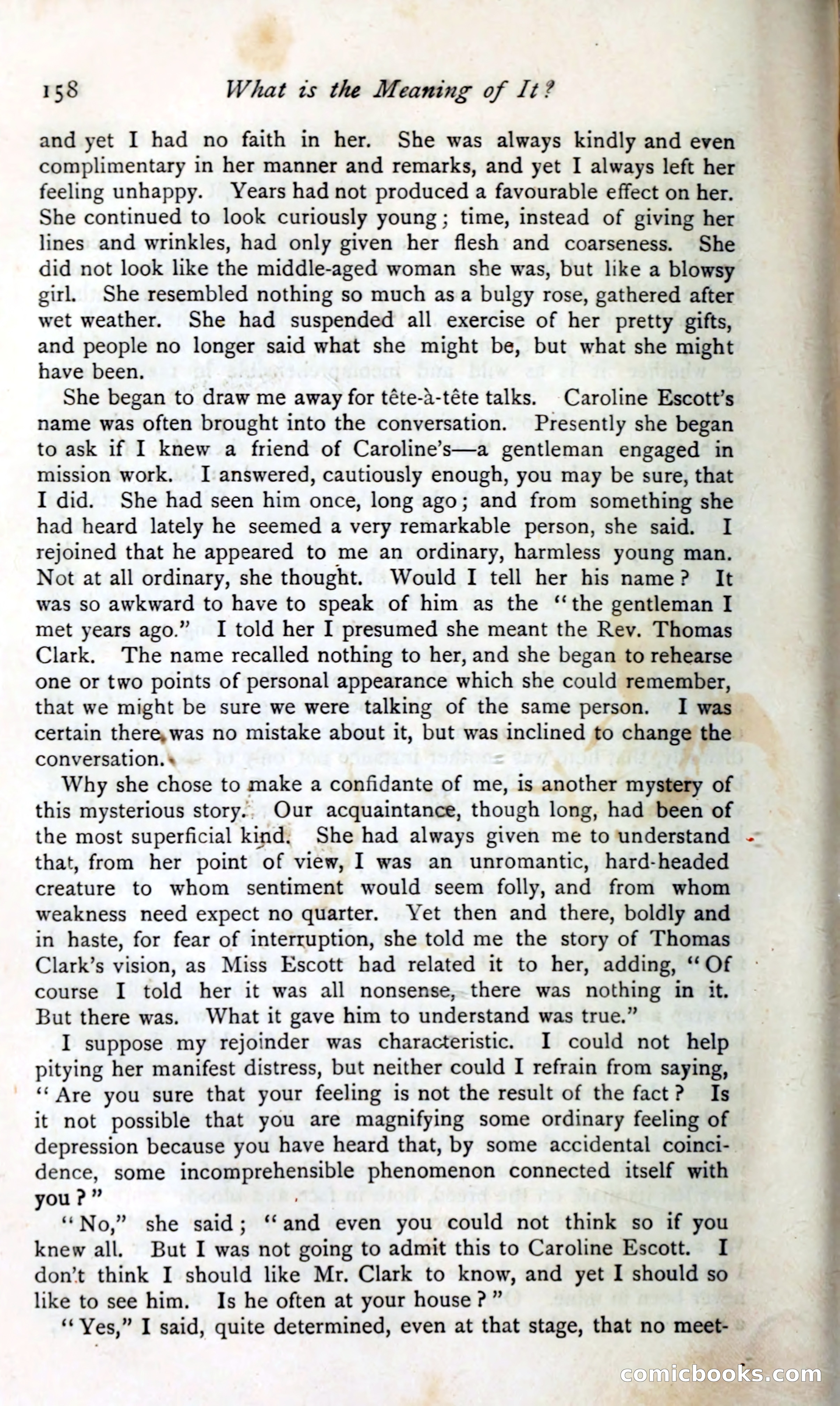
A restored page from Pulp Fiction, 1865. Page through the whole issue in the reader above.
📄 Transcribed text from this page (OCR, searchable)
Machine-transcribed from the original scan — historical spelling and the odd misread are preserved.
» 158 What ts the Meaning of lt? and yet I had no faith in her. She was always kindly and even complimentary in her manner and remarks, and yet I always left her feeling unhappy. Years had not produced a favourable effect on her. She continued to look curiously young ; time, instead of giving her lines and wrinkles, had only given her flesh and coarseness. did not look like the middle-aged woman she was, but like a blowsy girl, She resembled nothing so much asa bulgy rose, gathered after wet weather. She had suspended all exercise of her pretty gifts, and people no longer said what she might be, but what she might have been. She She began to draw me away for téte-a-téte talks. Caroline Escott’s name was often brought into the conversation. Presently she began to ask if I knew a friend of Caroline’s—a gentleman engaged in mission work. I answered, cautiously enough, you may be sure, that I did. She had seen him once, long ago; and from something she had heard lately he seemed a very remarkable person, she said. rejoined that he appeared to me an ordinary, harmless young man. Not at all ordinary, she thought. Would I tell her his name? It was so awkward to have to speak of him as the ‘‘the gentleman I met years ago.” I told her I presumed she meant the Rev. Thomas Clark. The name recalled nothing to her, and she began to rehearse one or two points of personal appearance which she could remember, that we might be sure we were talking of the same person. certain there,was no mistake about it, but was inclined to chang conversation. * Why she chose to make a confidante of me, is another mys this mysterious story.. Our acquaintance, though long, had I I — was — < > of n of the most superficial kind. She had always given me to understand — that, from her point of view, I was an unromantic, hard-headed creature to whom sentiment would seem folly, and from whom weakness need expect no quarter. Yet then and there, boldly and in haste, for fear of interruption, she told me the story of Thomas Clark’s vision, as Miss Escott had related it to her, adding, “ Of course I told her it was all nonsense, there was nothing in it, But there was. What it gave him to understand was true.” I suppose my rejoinder was characteristic. I could not help pitying her manifest distress, but neither could I refrain from saying, ‘Are you sure that your feeling is not the result of the fact? Is it not possible that you are magnifying some ordinary feeling of depression because you have heard that, by some accidental coinci- dence, some incomprehensible phenomenon connected itself with you ?” “No,” she said; ‘‘and even you could not think so if you knew all. But I was not going to admit this to Caroline Escott. don’t think I should like Mr. Clark to know, and yet I should so like to see him. Is he often at your house ?” I $ Yes, ” I said, quite determined, even at that stage, that no meet: » (E(0) ml} G books a i