
Pulp Fiction, 1865 · page 390 of 400
The Argosy — page 390: what you’re looking at
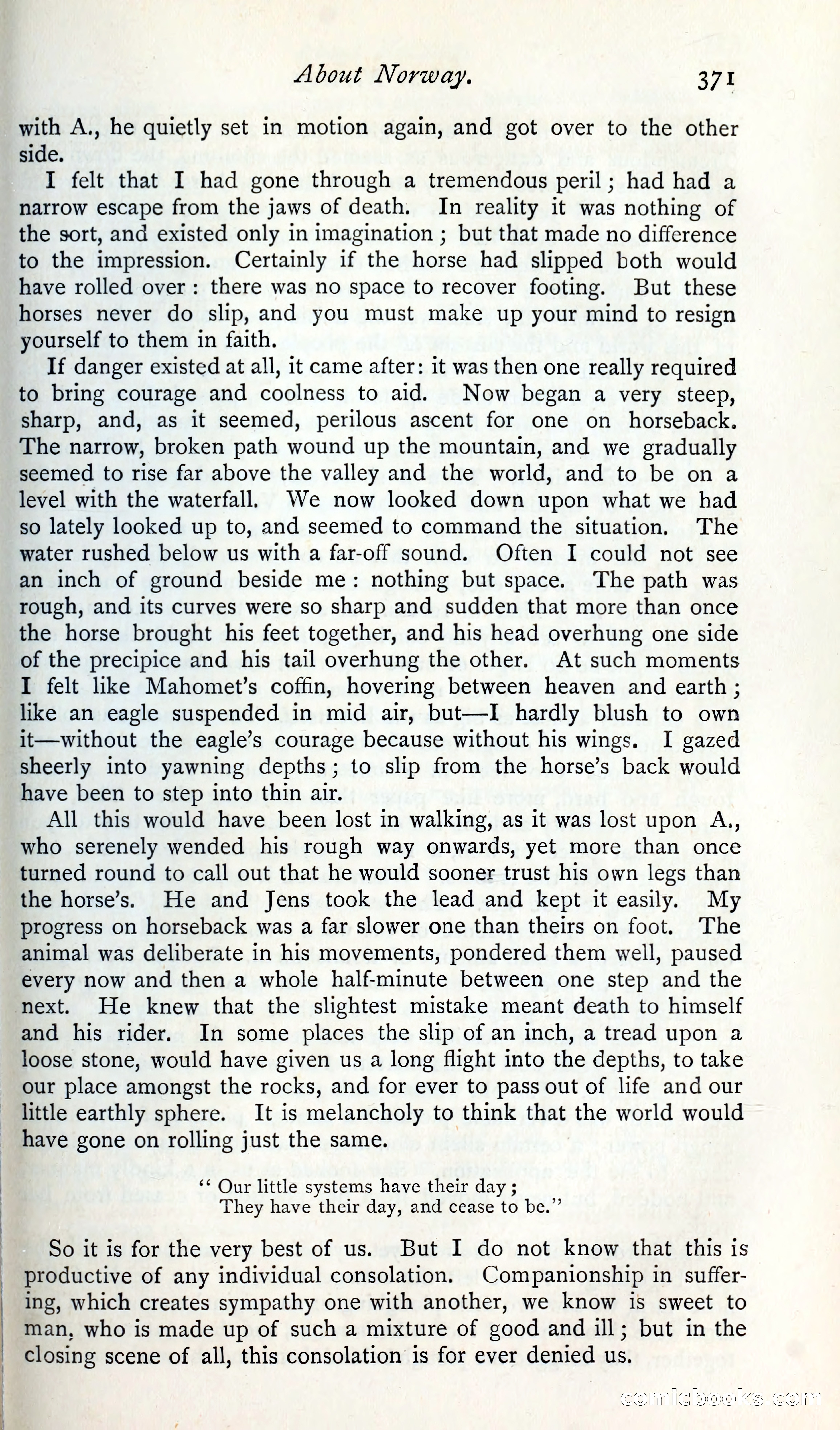
A restored page from Pulp Fiction, 1865. Page through the whole issue in the reader above.
📄 Transcribed text from this page (OCR, searchable)
Machine-transcribed from the original scan — historical spelling and the odd misread are preserved.
Sa - ee ee About Norway, 371 with A., he quietly set in motion again, and got over to the other side. I felt that I had gone through a tremendous peril; had had a narrow escape from the jaws of death. In reality it was nothing of the sort, and existed only in imagination ; but that made no difference to the impression. Certainly if the horse had slipped both would have rolled over: there was no space to recover footing. But these horses never do slip, and you must make up your mind to resign yourself to them in faith. If danger existed at all, it came after: it was then one really required to bring courage and coolness to aid. Now began a very steep, sharp, and, as it seemed, perilous ascent for one on horseback. The narrow, broken path wound up the mountain, and we gradually seemed to rise far above the valley and the world, and to be on a level with the waterfall. We now looked down upon what we had so lately looked up to, and seemed to command the situation. The water rushed below us with a far-off sound. Often I could not see an inch of ground beside me: nothing but space. The path was rough, and its curves were so sharp and sudden that more than once the horse brought his feet together, and his head overhung one side of the precipice and his tail overhung the other. At such moments I felt like Mahomet’s coffin, hovering between heaven and earth ; like an eagle suspended in mid air, but—I hardly blush to own it—without the eagle’s courage because without his wings. I gazed sheerly into yawning depths; to slip from the horse’s back would have been to step into thin air. All this would have been lost in walking, as it was lost upon A,, who serenely wended his rough way onwards, yet more than once turned round to call out that he would sooner trust his own legs than the horse’s. He and Jens took the lead and kept it easily. My progress on horseback was a far slower one than theirs on foot. The animal was deliberate in his movements, pondered them well, paused every now and then a whole half-minute between one step and the next. He knew that the slightest mistake meant death to himself and his rider. In some places the slip of an inch, a tread upon a loose stone, would have given us a long flight into the depths, to take our place amongst the rocks, and for ever to pass out of life and our little earthly sphere. It is melancholy to think that the world would have gone on rolling just the same. ‘* Our little systems have their day ; They have their day, and cease to be.” So it is for the very best of us. But I do not know that this is productive of any individual consolation. Companionship in suffer- ing, which creates sympathy one with another, we know is sweet to man, who is made up of such a mixture of good and ill; but in the Closing scene of all, this consolation is for ever denied us. ECORnniclooOoks (CO