
Pulp Fiction, 1865 · page 349 of 400
The Argosy — page 349: what you’re looking at
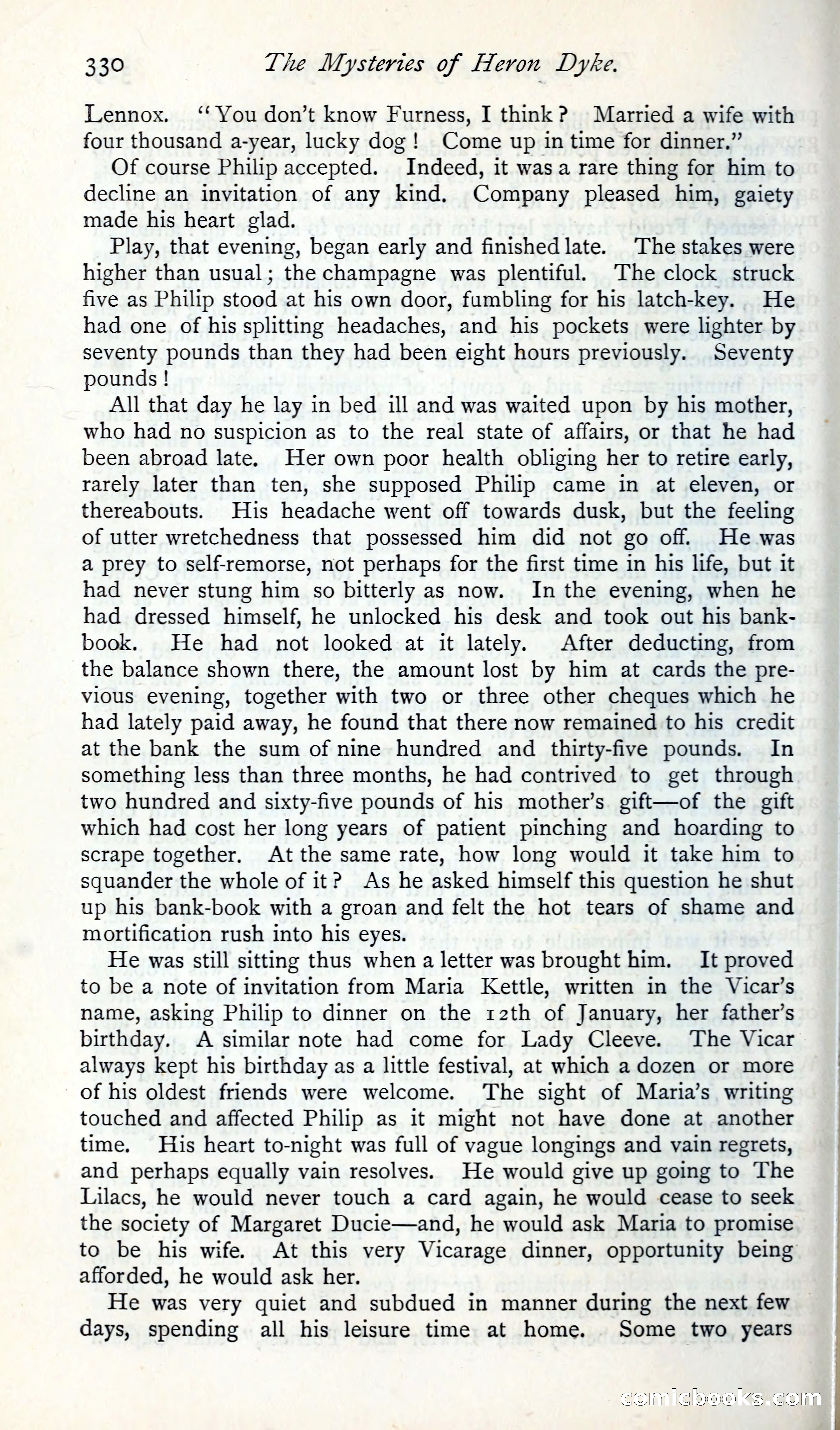
A restored page from Pulp Fiction, 1865. Page through the whole issue in the reader above.
📄 Transcribed text from this page (OCR, searchable)
Machine-transcribed from the original scan — historical spelling and the odd misread are preserved.
330 Lhe Mysteries of feron Dyke. Lennox. ‘' You don’t know Furness, I think? Married a wife with four thousand a-year, lucky dog! Come up in time for dinner.” Of course Philip accepted. Indeed, it wasa rare thing for him to decline an invitation of any kind. Company pleased him, gaiety made his heart glad. Play, that evening, began early and finished late. The stakes were higher than usual; the champagne was plentiful. The clock struck five as Philip stood at his own door, fumbling for his latch-key. He had one of his splitting headaches, and his pockets were lighter by seventy pounds than they had been eight hours previously. Seventy pounds! All that day he lay in bed ill and was waited upon by his mother, who had no suspicion as to the real state of affairs, or that he had been abroad late. Her own poor health obliging her to retire early, rarely later than ten, she supposed Philip came in at eleven, or thereabouts. His headache went off towards dusk, but the feeling of utter wretchedness that possessed him did not go off. He was a prey to self-remorse, not perhaps for the first time in his life, but it had never stung him so bitterly as now. Inthe evening, when he had dressed himself, he unlocked his desk and took out his bank- book. He had not looked at it lately. After deducting, from the balance shown there, the amount lost by him at cards the pre- vious evening, together with two or three other cheques which he had lately paid away, he found that there now remained to his credit at the bank the sum of nine hundred and thirty-five pounds. In something less than three months, he had contrived to get through two hundred and sixty-five pounds of his mother’s gift—of the gift which had cost her long years of patient pinching and hoarding to scrape together. At the same rate, how long would it take him to squander the whole of it? As he asked himself this question he shut up his bank-book with a groan and felt the hot tears of shame and mortification rush into his eyes. He was still sitting thus when a letter was brought him. It proved to be a note of invitation from Maria Kettle, written in the Vicar’s name, asking Philip to dinner on the 12th of January, her father’s birthday. A similar note had come for Lady Cleeve. The Vicar always kept his birthday as a little festival, at which a dozen or more of his oldest friends were welcome. The sight of Maria’s writing touched and affected Philip as it might not have done at another time. His heart to-night was full of vague longings and vain regrets, and perhaps equally vain resolves. He would give up going to The Lilacs, he would never touch a card again, he would cease to seek the society of Margaret Ducie—and, he would ask Maria to promise to be his wife. At this very Vicarage dinner, opportunity being afforded, he would ask her. He was very quiet and subdued in manner during the next few days, spending all his leisure time at home. Some two years ECOMMICLOOKS, EO) m