
Pulp Fiction, 1865 · page 346 of 400
The Argosy — page 346: what you’re looking at
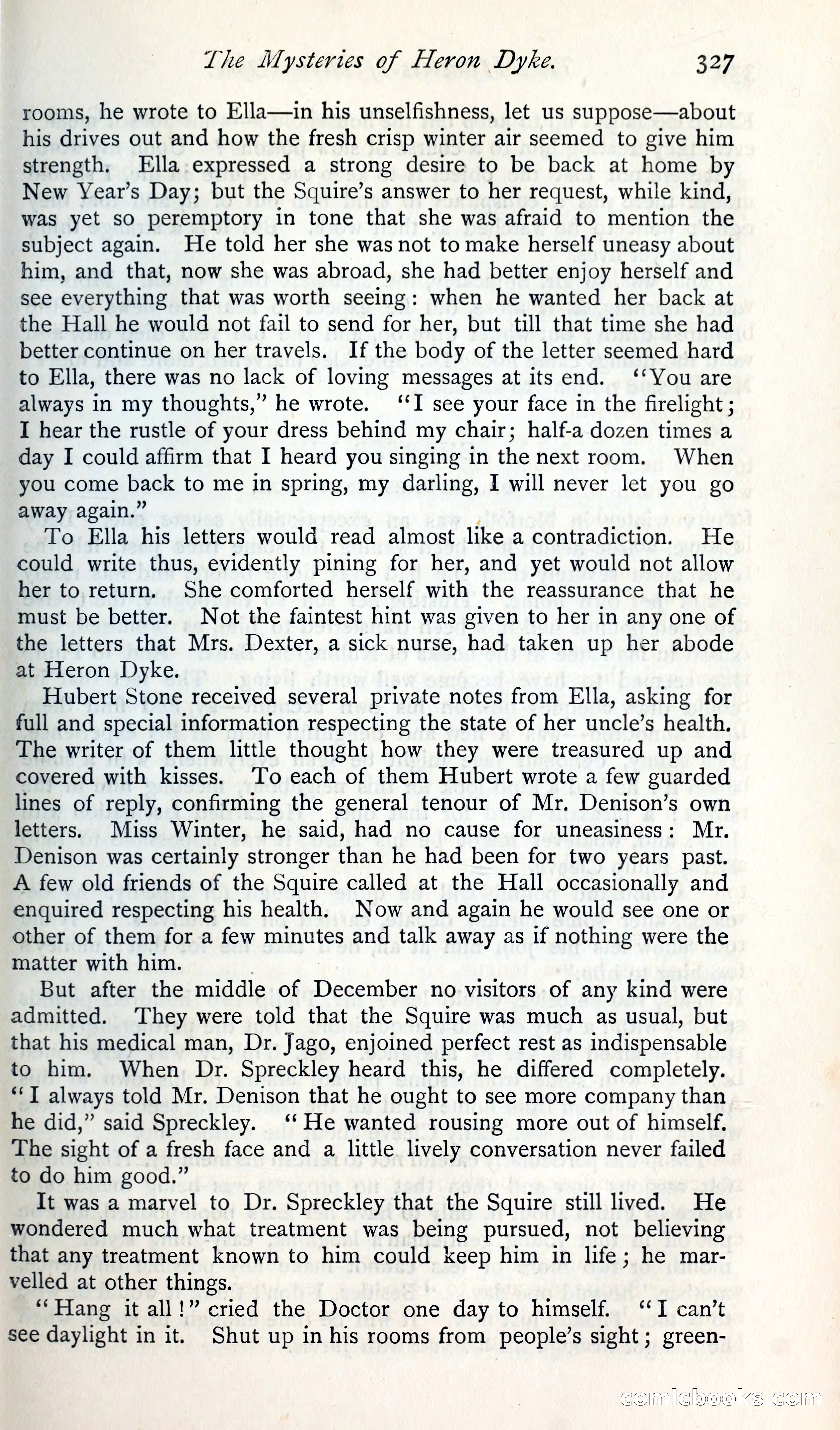
A restored page from Pulp Fiction, 1865. Page through the whole issue in the reader above.
📄 Transcribed text from this page (OCR, searchable)
Machine-transcribed from the original scan — historical spelling and the odd misread are preserved.
The Mysteries of Heron Dyke. 32%, rooms, he wrote to Ella—in his unselfishness, let us suppose—about his drives out and how the fresh crisp winter air seemed to give him strength. Ella expressed a strong desire to be back at home by New Year’s Day; but the Squire’s answer to her request, while kind, was yet so peremptory in tone that she was afraid to mention the subject again. He told her she was not to make herself uneasy about him, and that, now she was abroad, she had better enjoy herself and see everything that was worth seeing: when he wanted her back at the Hall he would not fail to send for her, but till that time she had better continue on her travels. If the body of the letter seemed hard to Ella, there was no lack of loving messages at its end. ‘‘You are always in my thoughts,” he wrote. ‘‘I see your face in the firelight ; I hear the rustle of your dress behind my chair; half-a dozen times a day I could affirm that I heard you singing in the next room. When you come pack to me in spring, my darling, I will never let you go away again.” To Ella his letters would read almost like a contradiction. He could write thus, evidently pining for her, and yet would not allow her to return. She comforted herself with the reassurance that he must be better. Not the faintest hint was given to her in any one of the letters that Mrs. Dexter, a sick nurse, had taken up her abode at Heron Dyke. Hubert Stone received several private notes from Ella, asking for full and special information respecting the state of her uncle’s health. The writer of them little thought how they were treasured up and covered with kisses. ‘To each of them Hubert wrote a few guarded lines of reply, confirming the general tenour of Mr. Denison’s own letters. Miss Winter, he said, had no cause for uneasiness: Mr. Denison was certainly stronger than he had been for two years past. A few old friends of the Squire called at the Hall occasionally and enquired respecting his health. Now and again he would see one or other of them for a few minutes and talk away as if nothing were the matter with him. But after the middle of vena no visitors of any kind were admitted. They were told that the Squire was much as usual, but that his medical man, Dr. Jago, enjoined perfect rest as indispensable to him. When Dr. Spreckley heard this, he differed completely. *‘I always told Mr. Denison that he ought to see more company than he did,” said Spreckley. ‘‘ He wanted rousing more out of himself. The sight of a fresh face and a little lively conversation never failed to do him good.” It was a marvel to Dr. Spreckley that the Squire still lived. He wondered much what treatment was being pursued, not believing that any treatment known to him could keep him in life; he mar- velled at other things. “Hang it all!” cried the Doctor one day to himself. ‘I can’t see daylight in it. Shut up in his rooms from people’s sight; green- COMIC OOO SS (S©) mn