
Pulp Fiction, 1865 · page 333 of 400
The Argosy — page 333: what you’re looking at
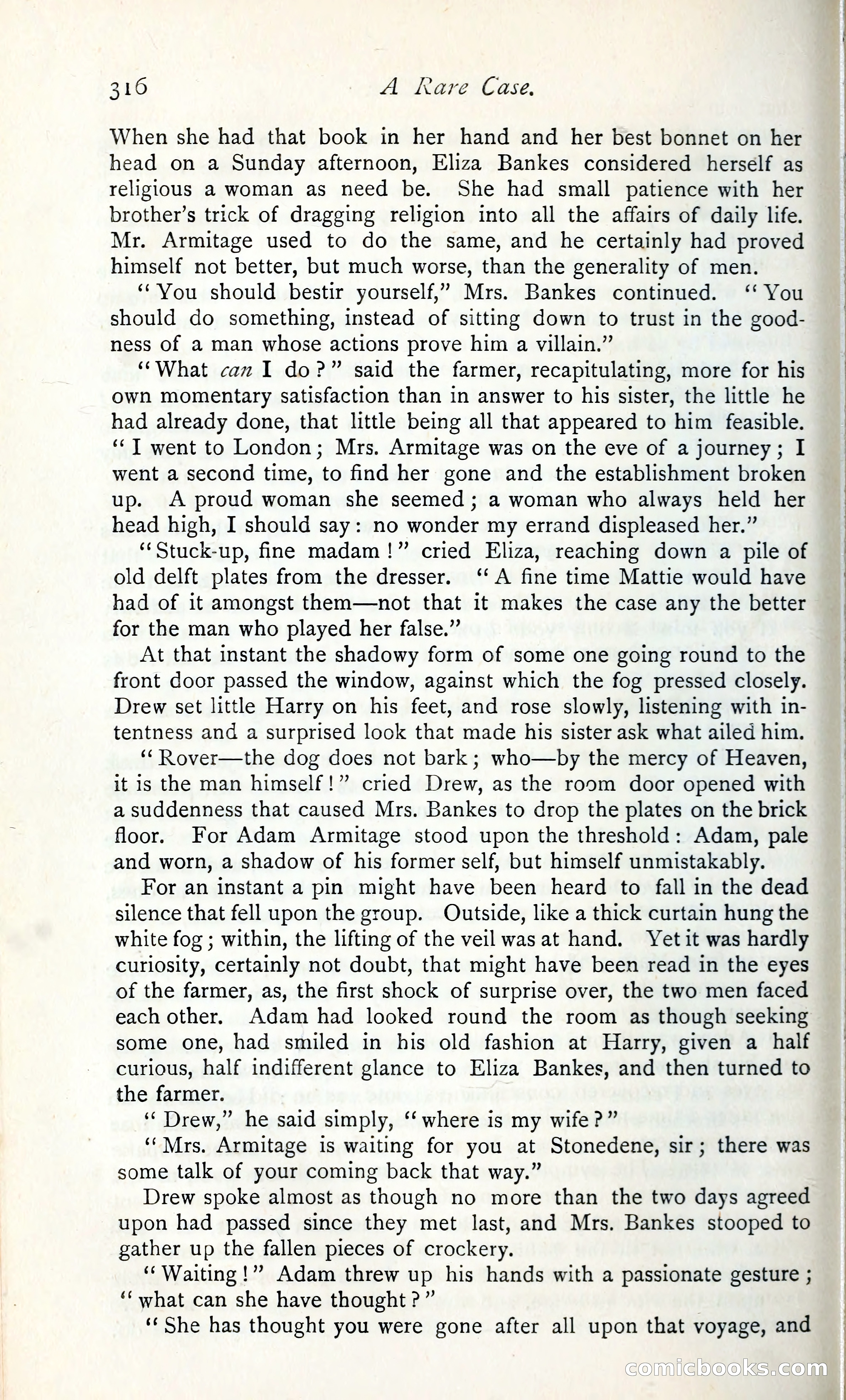
A restored page from Pulp Fiction, 1865. Page through the whole issue in the reader above.
📄 Transcribed text from this page (OCR, searchable)
Machine-transcribed from the original scan — historical spelling and the odd misread are preserved.
316 A Rare Case. When she had that book in her hand and her best bonnet on her head on a Sunday afternoon, Eliza Bankes considered herself as religious a woman as need be. She had small patience with her brother’s trick of dragging religion into all the affairs of daily life. Mr. Armitage used to do the same, and he certainly had proved himself not better, but much worse, than the generality of men. ‘You should bestir yourself,” Mrs. Bankes continued. ‘‘ You should do something, instead of sitting down to trust in the good- ness of a man whose actions prove him a villain.” ‘What caz I do?” said the farmer, recapitulating, more for his own momentary satisfaction than in answer to his sister, the little he had already done, that little being all that appeared to him feasible. ‘“T went to London; Mrs. Armitage was on the eve of a journey; I went a second time, to find her gone and the establishment broken up. A proud woman she seemed ; a woman who always held her head high, I should say: no wonder my errand displeased her.” ‘‘Stuck-up, fine madam!” cried Eliza, reaching down a pile of old delft plates from the dresser. ‘‘A fine time Mattie would have had of it amongst them—not that it makes the case any the better for the man who played her false.” At that instant the shadowy form of some one going round to the front door passed the window, against which the fog pressed closely. Drew set little Harry on his feet, and rose slowly, listening with in- tentness and a surprised look that made his sister ask what ailed him. ‘“Rover—the dog does not bark; who—by the mercy of Heaven, it is the man himself!” cried Drew, as the room door opened with a suddenness that caused Mrs. Bankes to drop the plates on the brick floor. For Adam Armitage stood upon the threshold: Adam, pale and worn, a shadow of his former self, but himself unmistakably. For an instant a pin might have been heard to fall in the dead silence that fell upon the group. Outside, like a thick curtain hung the white fog ; within, the lifting of the veil was at hand. Yetit was hardly curlosity, certainly not doubt, that might have been read in the eyes of the farmer, as, the first shock of surprise over, the two men faced each other. Adam had looked round the room as though seeking some one, had smiled in his old fashion at Harry, given a half curious, half indifferent glance to Eliza Bankes, and then turned to the farmer. ‘‘ Drew,” he said simply, ‘‘ where is my wife?” ‘‘Mrs. Armitage 1s waiting for you at Stonedene, sir; there was some talk of your coming back that way.” Drew spoke almost as though no more than the two days agreed upon had passed since they met last, and Mrs. Bankes stooped to gather up the fallen pieces of crockery. ‘‘ Waiting!” Adam threw up his hands with a passionate gesture ; ‘‘ what can she have thought ?” | ‘¢ She has thought you were gone after all upon that voyage, and CONMMICLOOLK<Ss EC)