
Pulp Fiction, 1865 · page 315 of 400
The Argosy — page 315: what you’re looking at
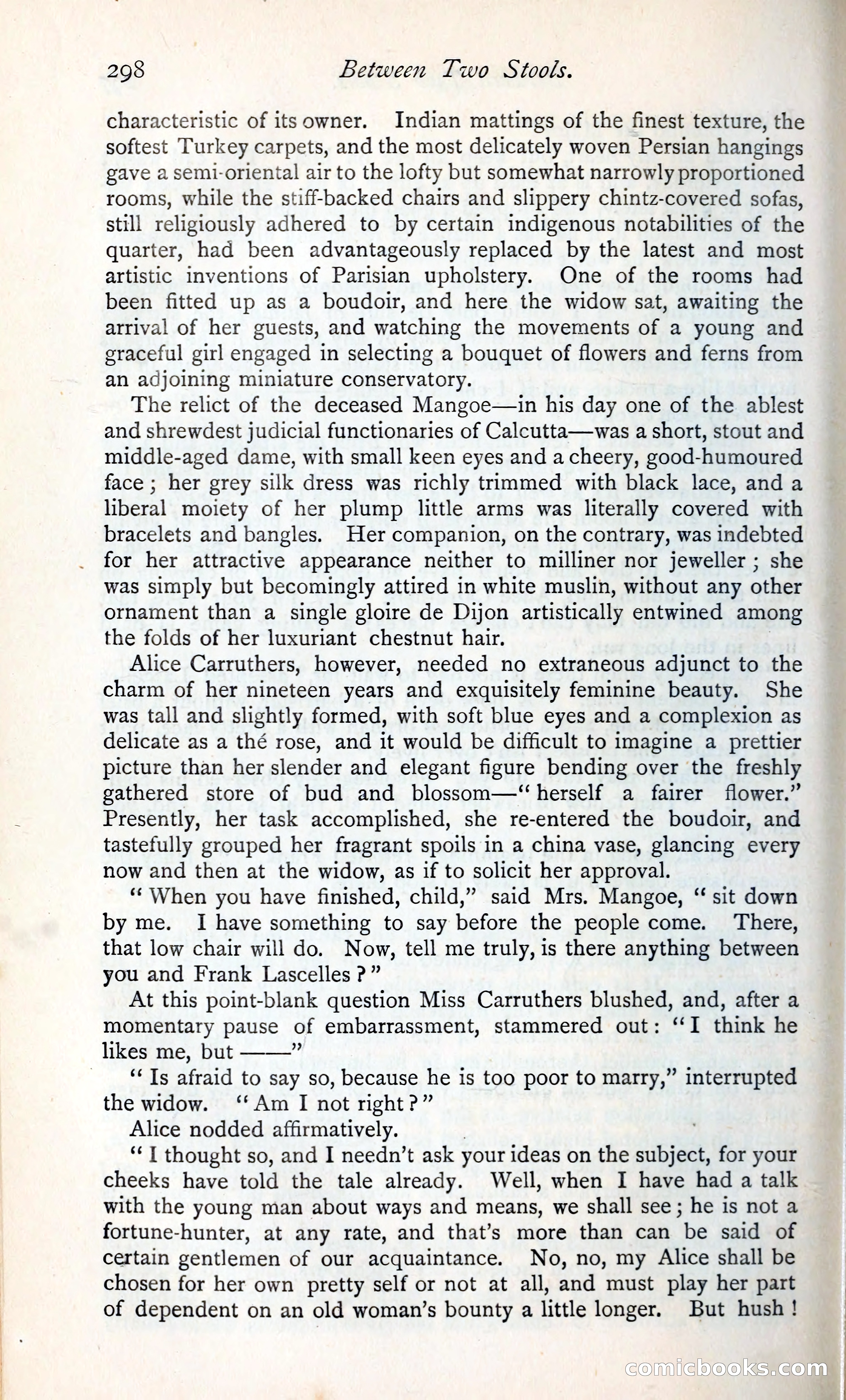
A restored page from Pulp Fiction, 1865. Page through the whole issue in the reader above.
📄 Transcribed text from this page (OCR, searchable)
Machine-transcribed from the original scan — historical spelling and the odd misread are preserved.
298 Between Two Stools. characteristic of itsowner. Indian mattings of the finest texture, the softest Turkey carpets, and the most delicately woven Persian hangings gave a semi-oriental air to the lofty but somewhat narrowly proportioned rooms, while the stiff-backed chairs and slippery chintz-covered sofas, still religiously adhered to by certain indigenous notabilities of the quarter, had been advantageously replaced by the latest and most artistic inventions of Parisian upholstery. One of the rooms had been fitted up as a boudoir, and here the widow sat, awaiting the arrival of her guests, and watching the movements of a young and sraceful girl engaged in selecting a bouquet of flowers and ferns from an adjoining miniature conservatory. The relict of the deceased Mangoe—in his day one of the ablest and shrewdest judicial functionaries of Calcutta—was a short, stout and middle-aged dame, with small keen eyes and a cheery, good-humoured face ; her grey silk dress was richly trimmed with black lace, and a liberal moiety of her plump little arms was literally covered with bracelets and bangles. Her companion, on the contrary, was indebted for her attractive appearance neither to milliner nor jeweller ; she was simply but becomingly attired in white muslin, without any other ornament than a single gloire de Dijon artistically entwined among the folds of her luxuriant chestnut hair. Alice Carruthers, however, needed no extraneous adjunct to the charm of her nineteen years and exquisitely feminine beauty. She was tall and slightly formed, with soft blue eyes and a complexion as delicate as a thé rose, and it would be difficult to imagine a prettier picture than her slender and elegant figure bending over the freshly gathered store of bud and blossom—‘“ herself a fairer flower.” Presently, her task accomplished, she re-entered the boudoir, and tastefully grouped her fragrant spoils in a china vase, glancing every now and then at the widow, as if to solicit her approval. “When you have finished, child,” said Mrs. Mangoe, “ sit down by me. I have something to say before the people come. ‘There, that low chair will do. Now, tell me truly, is there anything between you and Frank Lascelles ?” At this point-blank question Miss Carruthers blushed, and, after a momentary pause of embarrassment, stammered out: ‘‘I think he likes me, but ——” ‘‘ Is afraid to say so, because he is too poor to marry,” interrupted the widow. ‘Am I not right?” Alice nodded affirmatively. ‘“‘ I thought so, and I needn’t ask your ideas on the subject, for your cheeks have told the tale already. Well, when I have had a talk with the young man about ways and means, we shall see; he is not a fortune-hunter, at any rate, and that’s more than can be said of certain gentlemen of our acquaintance. No, no, my Alice shall be chosen for her own pretty self or not at all, and must play her part of dependent on an old woman’s bounty a little longer. But hush! ECORNIELIOO_K<KSErEvo)