
Pulp Fiction, 1865 · page 313 of 400
The Argosy — page 313: what you’re looking at
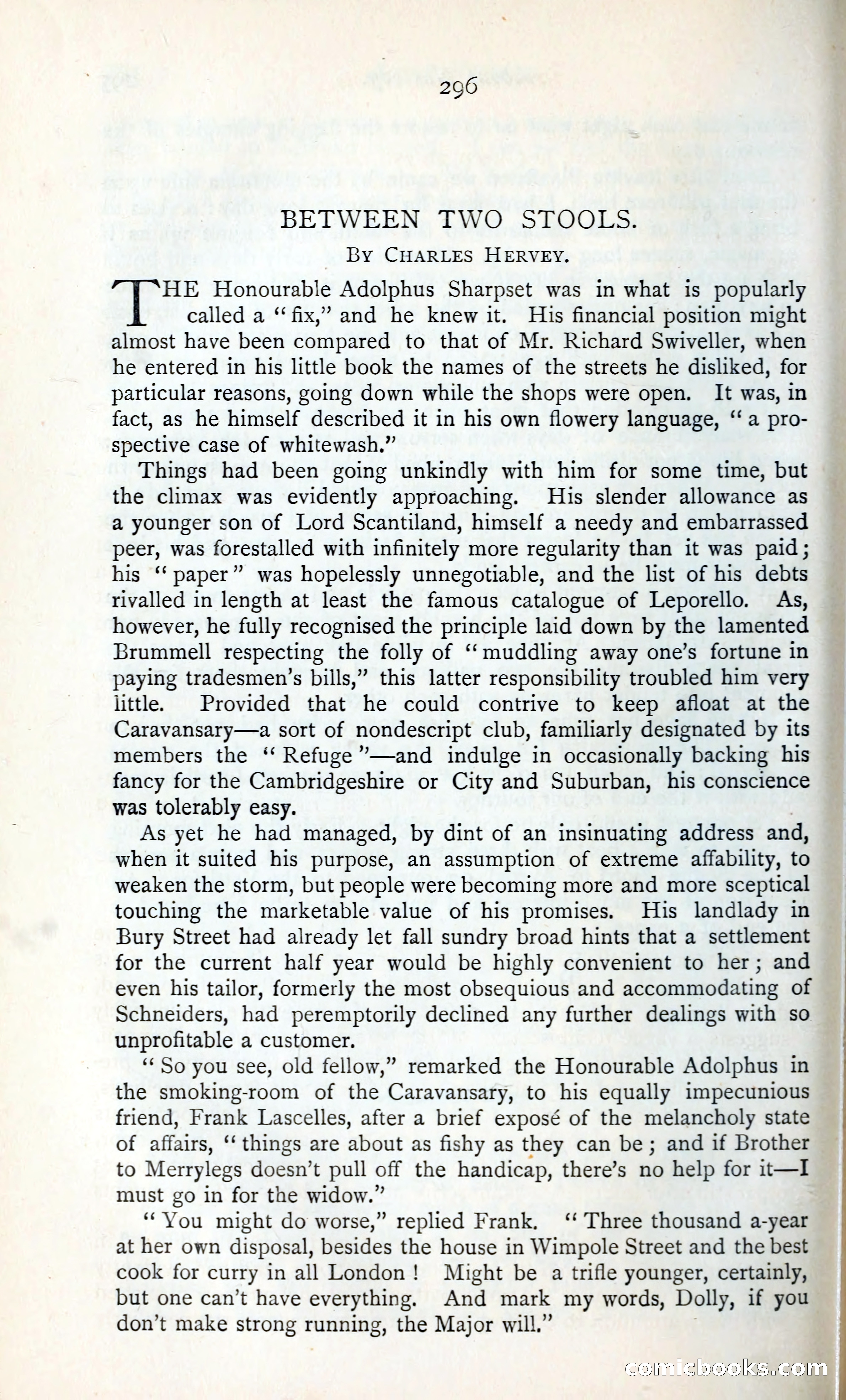
A restored page from Pulp Fiction, 1865. Page through the whole issue in the reader above.
📄 Transcribed text from this page (OCR, searchable)
Machine-transcribed from the original scan — historical spelling and the odd misread are preserved.
296 BETWEEN TWO STOOLS. By CHARLES HERVEY. HE Honourable Adolphus Sharpset was in what is popularly called a ‘ fix,” and he knew it. Huis financial position might almost have been compared to that of Mr. Richard Swiveller, when he entered in his little book the names of the streets he disliked, for particular reasons, going down while the shops were open. It was, in fact, as he himself described it in his own flowery language, “a pro- spective case of whitewash.” Things had been going unkindly with him for some time, but the climax was evidently approaching. Huis slender allowance as a younger son of Lord Scantiland, himself a needy and embarrassed peer, was forestalled with infinitely more regularity than it was paid; his ‘‘ paper” was hopelessly unnegotiable, and the list of his debts rivalled in length at least the famous catalogue of Leporello. As, however, he fully recognised the principle laid down by the lamented Brummell respecting the folly of ‘“‘muddling away one’s fortune in paying tradesmen’s bills,” this latter responsibility troubled him very little. Provided that he could contrive to keep afloat at the Caravansary—a sort of nondescript club, familiarly designated by its members the ‘ Refuge ’—and indulge in occasionally backing his fancy for the Cambridgeshire or City and Suburban, his conscience was tolerably easy. As yet he had managed, by dint of an insinuating address and, when it suited his purpose, an assumption of extreme affability, to weaken the storm, but people were becoming more and more sceptical touching the marketable value of his promises. His landlady in Bury Street had already let fall sundry broad hints that a settlement for the current half year would be highly convenient to her; and even his tailor, formerly the most obsequious and accommodating of Schneiders, had peremptorily declined any further dealings with so unprofitable a customer. ‘¢ So you see, old fellow,” remarked the Honourable Adolphus in the smoking-room of the Caravansary, to his equally impecunious friend, Frank Lascelles, after a brief exposé of the melancholy state of affairs, ‘‘ things are about as fishy as they can be; and if Brother to Merrylegs doesn’t pull off the handicap, there’s no help for it—I must go in for the widow.” ‘You might do worse,” replied Frank. ‘‘ Three thousand a-year at her own disposal, besides the house in Wimpole Street and the best cook for curry in all London! Might be a trifle younger, certainly, but one can’t have everything. And mark my words, Dolly, if you don’t make strong running, the Major will.” ECORNIECLIOOOKSaeCy ial