
Pulp Fiction, 1865 · page 307 of 400
The Argosy — page 307: what you’re looking at
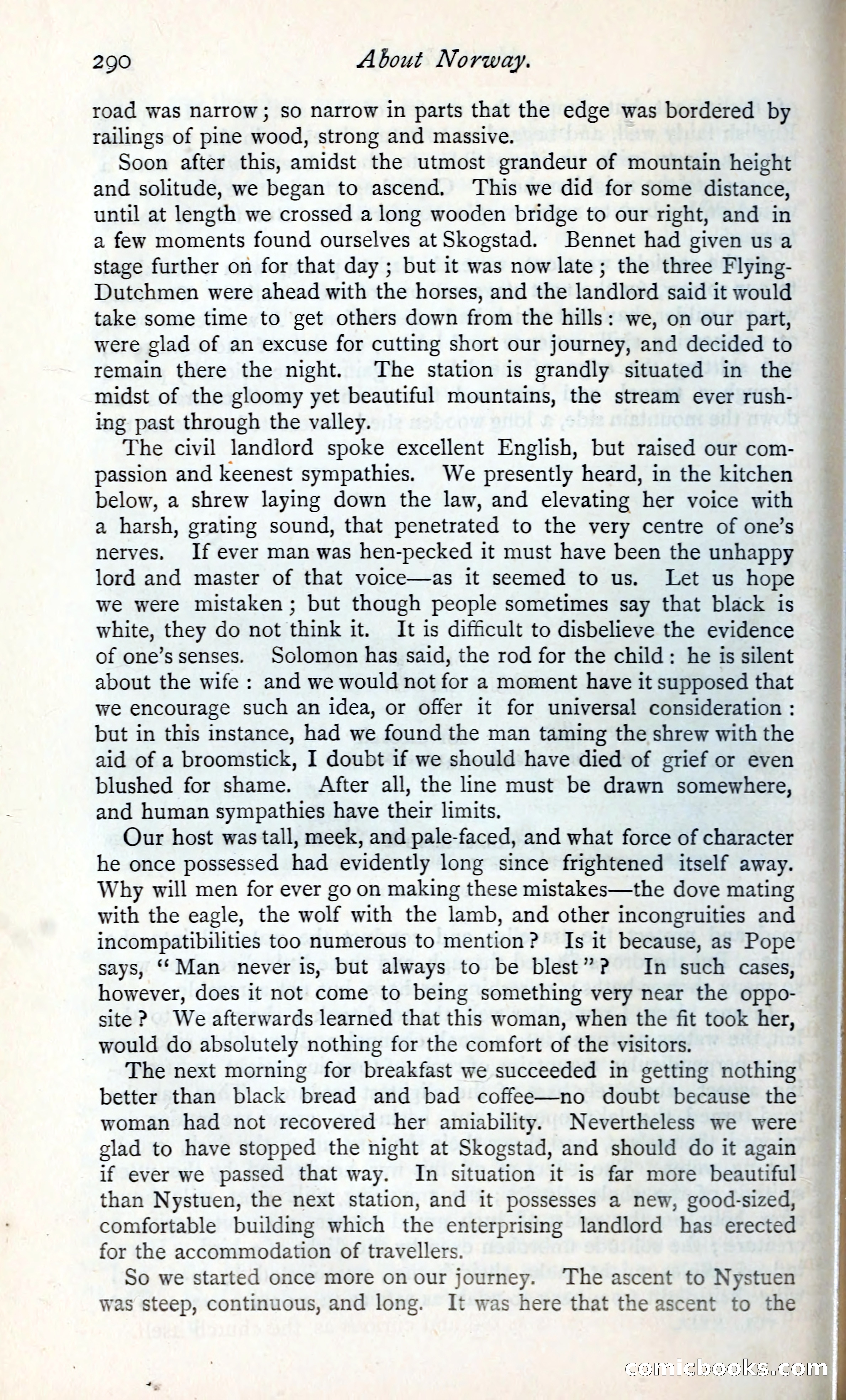
A restored page from Pulp Fiction, 1865. Page through the whole issue in the reader above.
📄 Transcribed text from this page (OCR, searchable)
Machine-transcribed from the original scan — historical spelling and the odd misread are preserved.
290 About Norway. road was narrow; so narrow in parts that the edge was bordered by railings of pine wood, strong and massive. Soon after this, amidst the utmost grandeur of mountain height and solitude, we began to ascend. ‘This we did for some distance, until at length we crossed a long wooden bridge to our right, and in a few moments found ourselves at Skogstad. Bennet had given us a stage further on for that day ; but it was now late; the three Flying- Dutchmen were ahead with the horses, and the landlord said it would take some time to get others down from the hills: we, on our part, were glad of an excuse for cutting short our journey, and decided to remain there the night. The station is grandly situated in the midst of the gloomy yet beautiful mountains, the stream ever rush- ing past through the valley. The civil landlord spoke excellent English, but raised our com- passion and keenest sympathies. We presently heard, in the kitchen below, a shrew laying down the law, and elevating her voice with a harsh, grating sound, that penetrated to the very centre of one’s nerves. If ever man was hen-pecked it must have been the unhappy lord and master of that voice—as it seemed to us. Let us hope we were mistaken; but though people sometimes say that black is white, they do not think it. It is difficult to disbelieve the evidence of one’ssenses. Solomon has said, the rod for the child: he is silent about the wife : and we would not for a moment have it supposed that we encourage such an idea, or offer it for universal consideration : but in this instance, had we found the man taming the shrew with the aid of a broomstick, I doubt if we should have died of grief or even blushed for shame. After all, the line must be drawn somewhere, and human sympathies have their limits. Our host was tall, meek, and pale-faced, and what force of character he once possessed had evidently long since frightened itself away. Why will men for ever go on making these mistakes—the dove mating with the eagle, the wolf with the lamb, and other incongruities and incompatibilities too numerous to mention? Is it because, as Pope says, ‘‘Man never is, but always to be blest”? In such cases, however, does it not come to being something very near the oppo- site? We afterwards learned that this woman, when the fit took her, would do absolutely nothing for the comfort of the visitors. _ The next morning for breakfast we succeeded in getting nothing better than black bread and bad coffee—no doubt because the woman had not recovered her amiability. Nevertheless we were glad to have stopped the night at Skogstad, and should do it again if ever we passed that way. In situation it is far more beautiful than Nystuen, the next station, and it possesses a new, good-sized, comfortable building which the enterprising landlord has erected for the accommodation of travellers. So we started once more on our journey. The ascent to Nystuen was steep, continuous, and long. It was here that the ascent to the ECORNIELIOO KS, (E00) —"*. .