
Pulp Fiction, 1865 · page 185 of 400
The Argosy — page 185: what you’re looking at
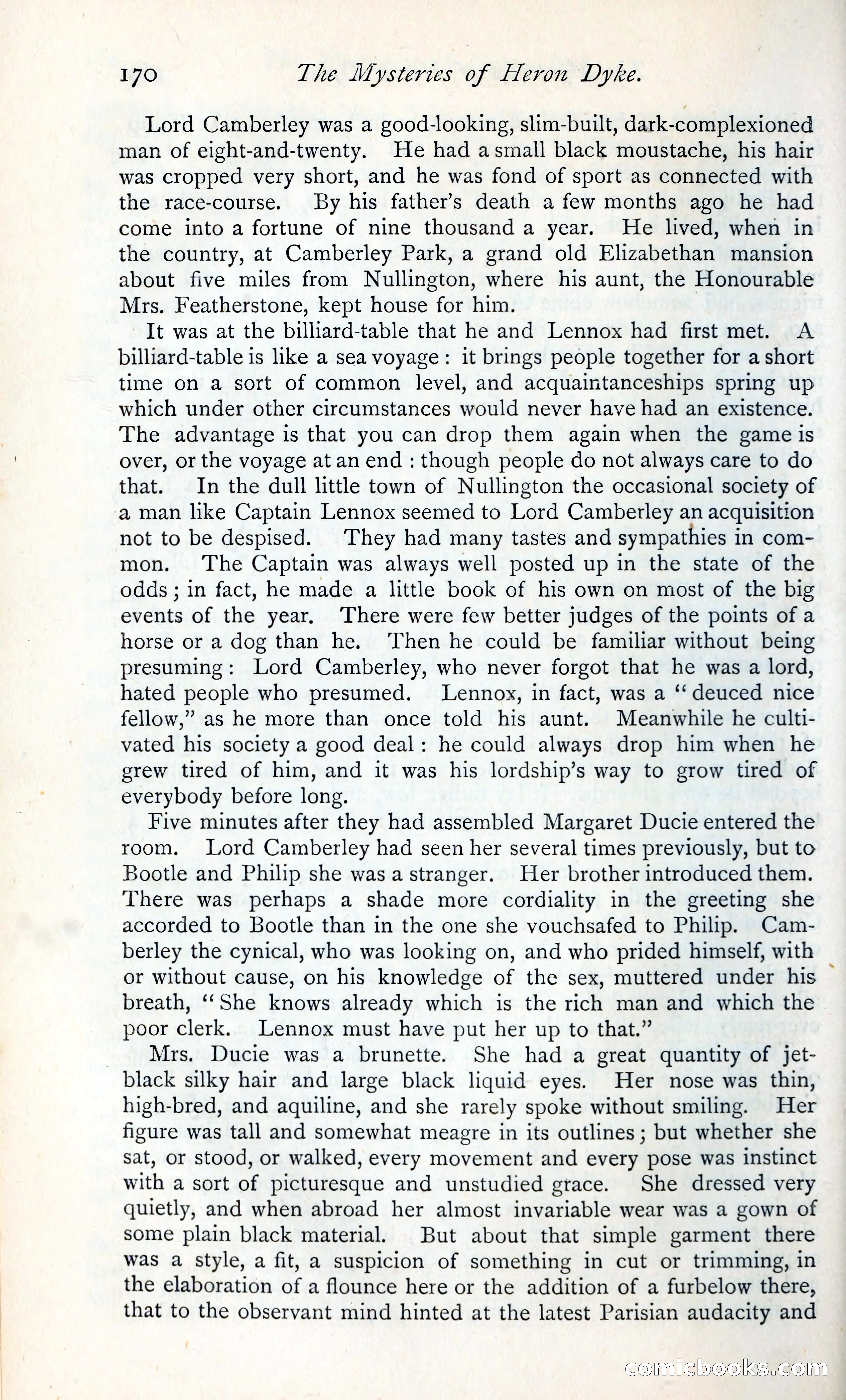
A restored page from Pulp Fiction, 1865. Page through the whole issue in the reader above.
📄 Transcribed text from this page (OCR, searchable)
Machine-transcribed from the original scan — historical spelling and the odd misread are preserved.
170 The Mysteries of Heron Dyke. Lord Camberley was a good-looking, slim-built, dark-complexioned man of eight-and-twenty. He had asmall black moustache, his hair was cropped very short, and he was fond of sport as connected with the race-course. By his father’s death a few months ago he had come into a fortune of nine thousand a year. He lived, when in the country, at Camberley Park, a grand old Elizabethan mansion about five miles from Nullington, where his aunt, the Honourable Mrs. Featherstone, kept house for him. It was at the billiard-table that he and Lennox had first met. A billiard-table is like a sea voyage: it brings people together for a short time on a sort of common level, and acquaintanceships spring up which under other circumstances would never have had an existence. The advantage is that you can drop them again when the game is over, or the voyage at an end : though people do not always care to do that. In the dull little town of Nullington the occasional society of a man like Captain Lennox seemed to Lord Camberley an acquisition not to be despised. They had many tastes and sympathies in com- mon. The Captain was always well posted up in the state of the odds ; in fact, he made a little book of his own on most of the big events of the year. ‘There were few better judges of the points of a horse or a dog than he. Then he could be familiar without being presuming: Lord Camberley, who never forgot that he was a lord, hated people who presumed. Lennox, in fact, was a ‘‘ deuced nice fellow,” as he more than once told his aunt. Meanwhile he culti- vated his society a good deal: he could always drop him when he grew tired of him, and it was his lordship’s way to grow tired of everybody before long. Five minutes after they had assembled Margaret Ducie entered the room. Lord Camberley had seen her several times previously, but to Bootle and Philip she wasa stranger. Her brother introduced them. There was perhaps a shade more cordiality in the greeting she accorded to Bootle than in the one she vouchsafed to Philip. Cam- berley the cynical, who was looking on, and who prided himself, with or without cause, on his knowledge of the sex, muttered under his © breath, ‘‘She knows already which is the rich man and which the poor clerk. Lennox must have put her up to that.” Mrs. Ducie was a brunette. She had a great quantity of jet- black silky hair and large black liquid eyes. Her nose was thin, high-bred, and aquiline, and she rarely spoke without smiling. Her figure was tall and somewhat meagre in its outlines ; but whether she sat, or stood, or walked, every movement and every pose was instinct with a sort of picturesque and unstudied grace. She dressed very quietly, and when abroad her almost invariable wear was a gown of some plain black material. But about that simple garment there was a style, a fit, a suspicion of something in cut or trimming, in the elaboration of a flounce here or the addition of a furbelow there, that to the observant mind hinted at the latest Parisian audacity and ECORNICLIOOKS CORN