
Pulp Fiction, 1865 · page 183 of 400
The Argosy — page 183: what you’re looking at
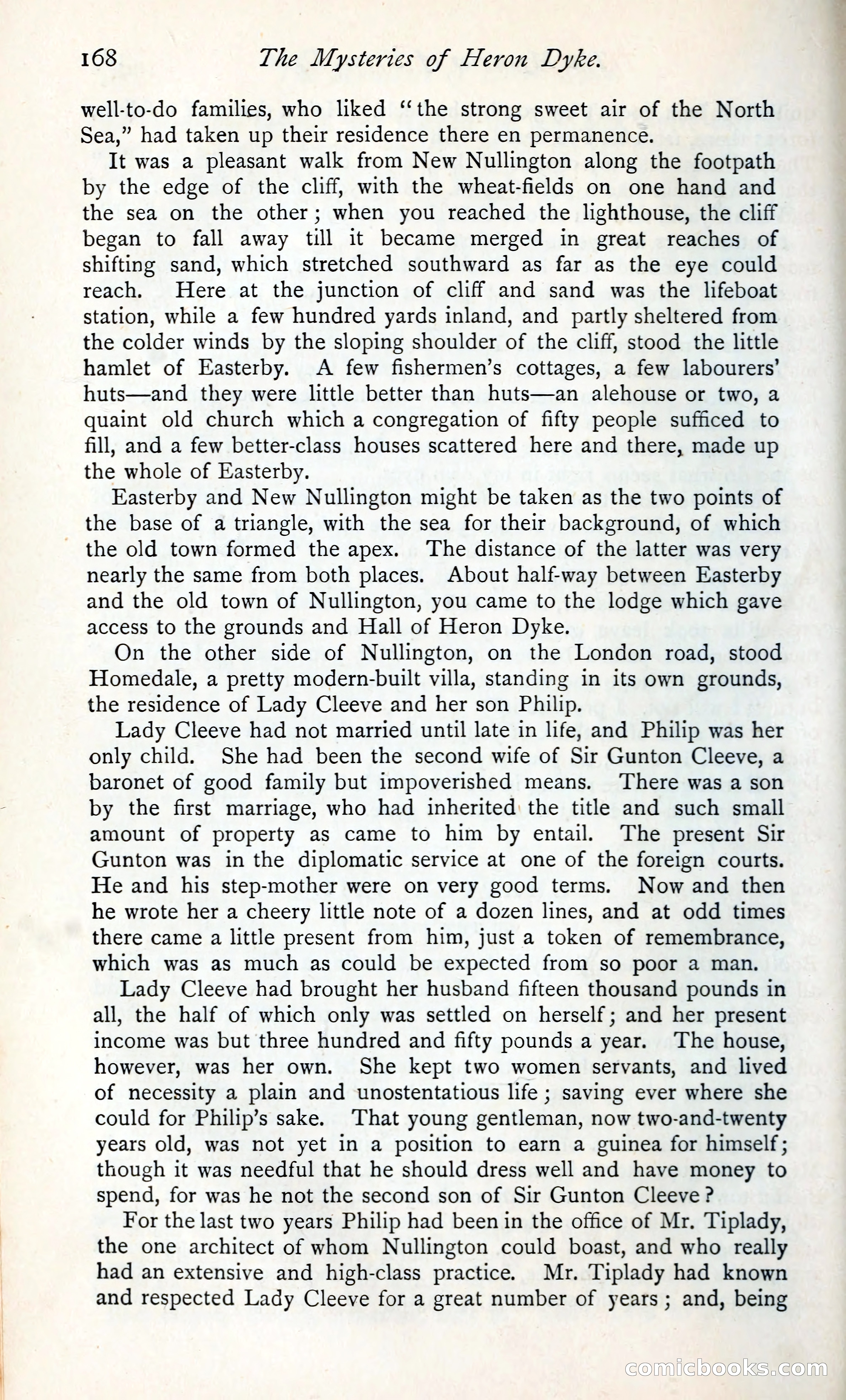
A restored page from Pulp Fiction, 1865. Page through the whole issue in the reader above.
📄 Transcribed text from this page (OCR, searchable)
Machine-transcribed from the original scan — historical spelling and the odd misread are preserved.
168 The Mysteries of Heron Dyke. well-to-do families, who liked ‘‘the strong sweet air of the North Sea,” had taken up their residence there en permanence. It was a pleasant walk from New Nullington along the footpath by the edge of the cliff, with the wheat-fields on one hand and the sea on the other; when you reached the lghthouse, the cliff began to fall away till it became merged in great reaches of shifting sand, which stretched southward as far as the eye could reach. Here at the junction of cliff and sand was the lifeboat station, while a few hundred yards inland, and partly sheltered from the colder winds by the sloping shoulder of the cliff, stood the little hamlet of Easterby. A few fishermen’s cottages, a few labourers’ huts—and they were little better than huts—an alehouse or two, a quaint old church which a congregation of fifty people sufficed to fill, and a few better-class houses scattered here and there, made up the whole of Easterby. Easterby and New Nullington might be taken as the two points of the base of a triangle, with the sea for their background, of which - the old town formed the apex. The distance of the latter was very nearly the same from both places. About half-way between Easterby and the old town of Nullington, you came to the lodge which gave access to the grounds and Hall of Heron Dyke. On the other side of Nullington, on the London road, stood Homedale, a pretty modern-built villa, standing in its own grounds, the residence of Lady Cleeve and her son Philip. Lady Cleeve had not married until late in life, and Philip was her only child. She had been the second wife of Sir Gunton Cleeve, a baronet of good family but impoverished means. There was a son by the first marriage, who had inherited the title and such small amount of property as came to him by entail. The present Sir Gunton was in the diplomatic service at one of the foreign courts. He and his step-mother were on very good terms. Now and then he wrote her a cheery little note of a dozen lines, and at odd times there came a little present from him, just a token of remembrance, which was as much as could be expected from so poor a man. Lady Cleeve had brought her husband fifteen thousand pounds in all, the half of which only was settled on herself ; and her present income was but three hundred and fifty pounds a year. ‘The house, however, was her own. She kept two women servants, and lived of necessity a plain and unostentatious life ; saving ever where she could for Philip’s sake. ‘That young gentleman, now two-and-twenty years old, was not yet in a position to earn a guinea for himself; though it was needful that he should dress well and have money to spend, for was he not the second son of Sir Gunton Cleeve ? For the last two years Philip had been in the office of Mr. Tiplady, the one architect of whom Nullington could boast, and who really had an extensive and high-class practice. Mr. Tiplady had known and respected Lady Cleeve for a great number of years; and, being COMICOOoOKS. EO)