
Pulp Fiction, 1865 · page 147 of 400
The Argosy — page 147: what you’re looking at
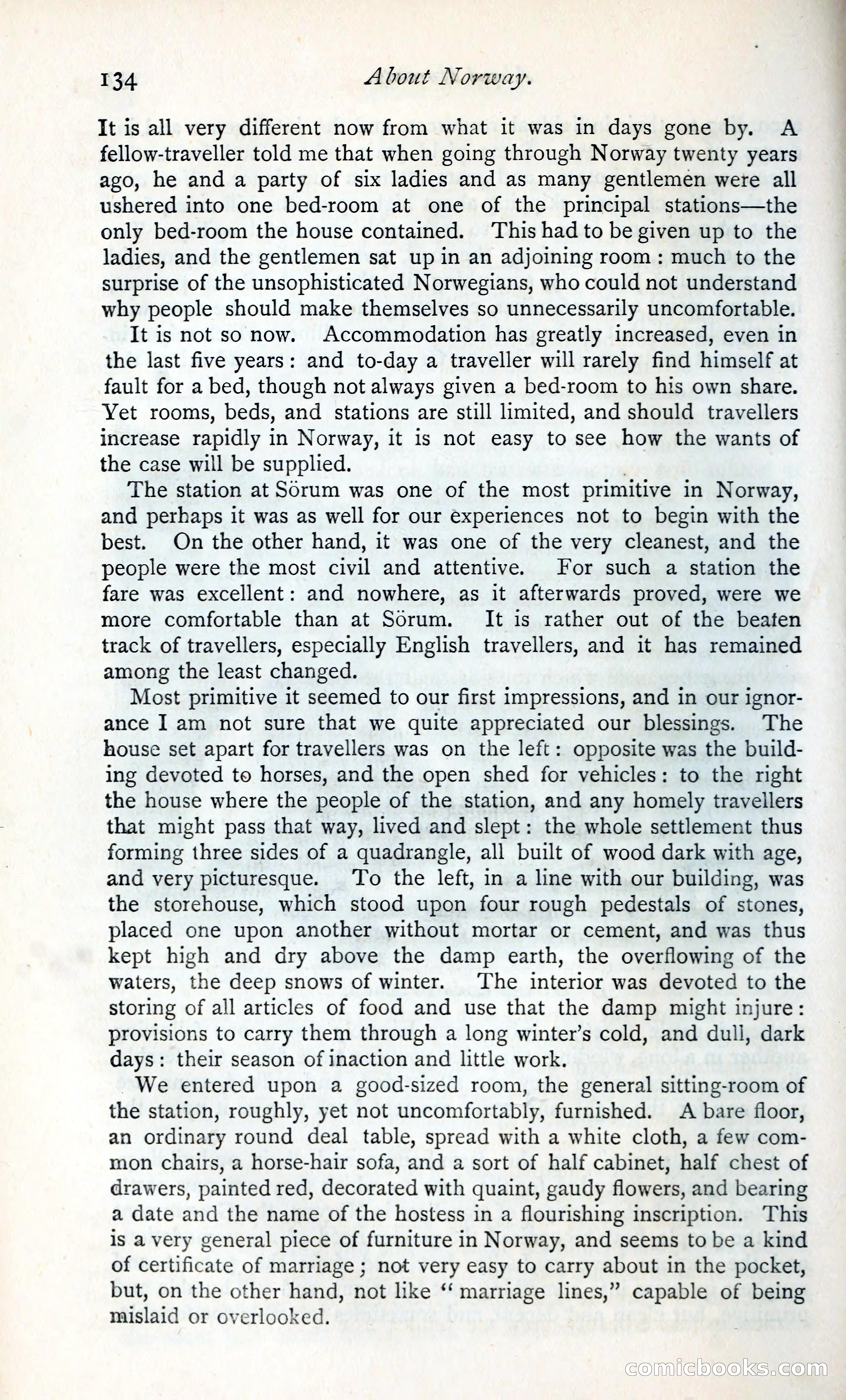
A restored page from Pulp Fiction, 1865. Page through the whole issue in the reader above.
📄 Transcribed text from this page (OCR, searchable)
Machine-transcribed from the original scan — historical spelling and the odd misread are preserved.
134 About Norway. It is all very different now from what it was in days gone by. A fellow-traveller told me that when going through Norway twenty years ago, he and a party of six ladies and as many gentlemen were all ushered into one bed-room at one of the principal stations—the only bed-room the house contained. ‘This had to be given up to the ladies, and the gentlemen sat up in an adjoining room: much to the surprise of the unsophisticated Norwegians, who could not understand why people should make themselves so unnecessarily uncomfortable. It is not so now. Accommodation has greatly increased, even in the last five years: and to-day a traveller will rarely find himself at fault for a bed, though not always given a bed-room to his own share. Yet rooms, beds, and stations are still limited, and should travellers increase rapidly in Norway, it is not easy to see how the wants of the case will be supplied. : The station at Sorum was one of the most primitive in Norway, and perhaps it was as well for our experiences not to begin with the best. On the other hand, it was one of the very cleanest, and the people were the most civil and attentive. For such a station the fare was excellent: and nowhere, as it afterwards proved, were we more comfortable than at Sorum. It is rather out of the beaten track of travellers, especially English travellers, and it has remained among the least changed. Most primitive it seemed to our first impressions, and in our ignor- ance I am not sure that we quite appreciated our blessings. The house set apart for travellers was on the left: opposite was the build- ing devoted to horses, and the open shed for vehicles: to the right the house where the people of the station, and any homely travellers that might pass that way, lived and slept: the whole settlement thus forming three sides of a quadrangle, all built of wood dark with age, and very picturesque. To the left, in a line with our building, was the storehouse, which stood upon four rough pedestals of stones, placed one upon another without mortar or cement, and was thus kept high and dry above the damp earth, the overflowing of the waters, the deep snows of winter. The interior was devoted to the storing of all articles of food and use that the damp might injure: provisions to carry them through a long winter’s cold, and duli, dark days: their season of inaction and little work. We entered upon a good-sized room, the general sitting-room of the station, roughly, yet not uncomfortably, furnished. A bare floor, an ordinary round deal table, spread with a white cloth, a few com- mon chairs, a horse-hair sofa, and a sort of half cabinet, half chest of drawers, painted red, decorated with quaint, gaudy flowers, and bearing a date and the name of the hostess in a flourishing inscription. This is a very general piece of furniture in Norway, and seems to be a kind of certificate of marriage ; not very easy to carry about in the pocket, but, on the other hand, not like ‘‘ marriage lines,” capable of being mislaid or overlooked. ECORNICLIOOKS.EO) m