
Pulp Fiction, 1865 · page 140 of 400
The Argosy — page 140: what you’re looking at
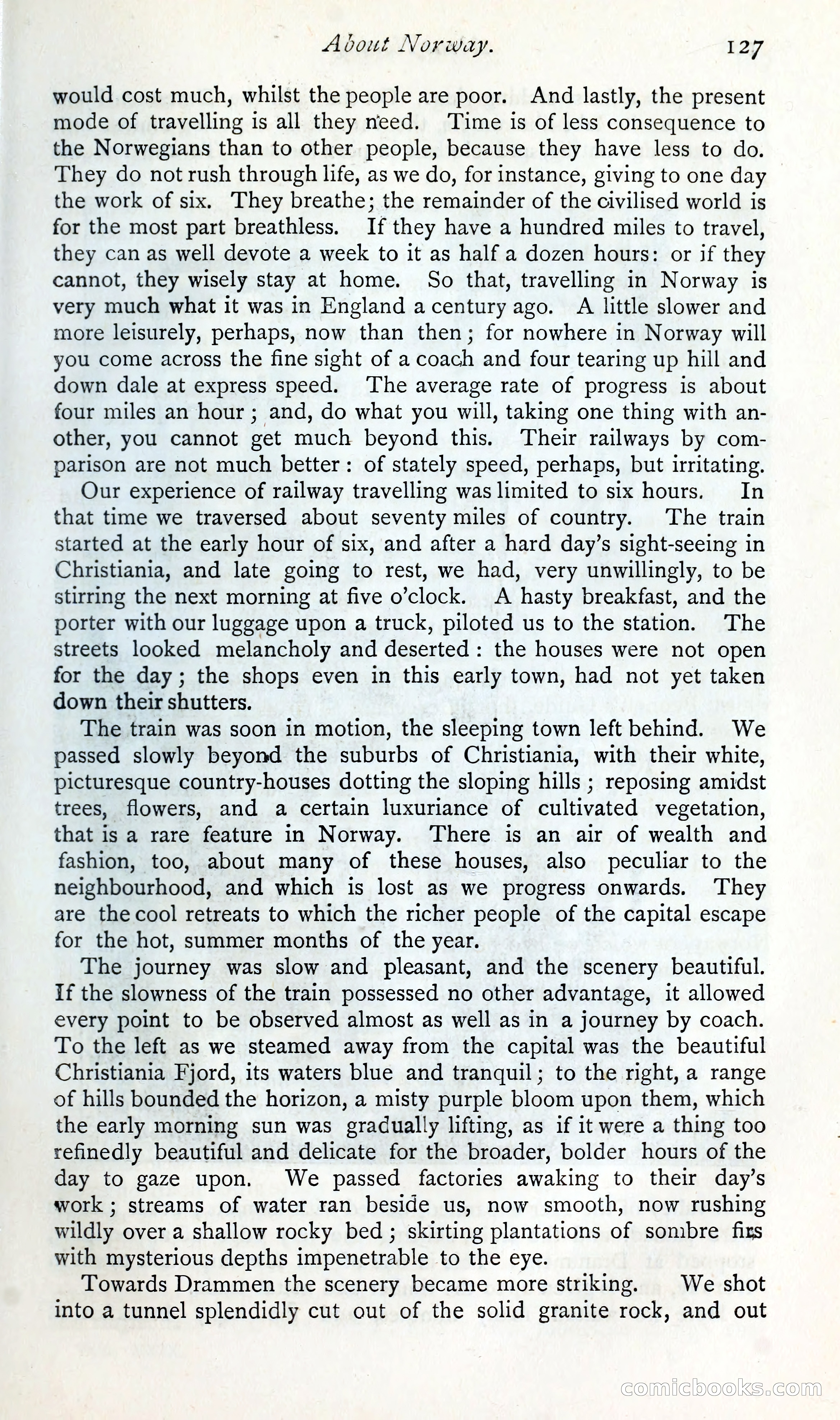
A restored page from Pulp Fiction, 1865. Page through the whole issue in the reader above.
📄 Transcribed text from this page (OCR, searchable)
Machine-transcribed from the original scan — historical spelling and the odd misread are preserved.
Avout Norway. 127 would cost much, whilst the people are poor. And lastly, the present mode of travelling is all they need. Time is of less consequence to the Norwegians than to other people, because they have less to do. They do not rush through life, as we do, for instance, giving to one day the work of six. They breathe; the remainder of the civilised world is for the most part breathless. If they have a hundred miles to travel, they can as well devote a week to it as half a dozen hours: or if they cannot, they wisely stay at home. So that, travelling in Norway is very much what it was in England acentury ago. A little slower and more leisurely, perhaps, now than then; for nowhere in Norway will you come across the fine sight of a coach and four tearing up hill and down dale at express speed. ‘The average rate of progress is about four miles an hour ; and, do what you will, taking one thing with an- other, you cannot get much beyond this. Their railways by com- parison are not much better: of stately speed, perhaps, but irritating. Our experience of railway travelling was limited to six hours. In that time we traversed about seventy miles of country. ‘The train started at the early hour of six, and after a hard day’s sight-seeing in Christiania, and late going to rest, we had, very unwillingly, to be stirring the next morning at five o’clock. A hasty breakfast, and the porter with our luggage upon a truck, piloted us to the station. The streets looked melancholy and deserted: the houses were not open for the day; the shops even in this early town, had not yet taken down their shutters. The train was soon in motion, the sleeping town left behind. We passed slowly beyond the suburbs of Christiania, with their white, picturesque country-houses dotting the sloping hills ; reposing amidst trees, flowers, and a certain luxuriance of cultivated vegetation, that is a rare feature in Norway. ‘There is an air of wealth and fashion, too, about many of these houses, also peculiar to the neighbourhood, and which is lost as we progress onwards. They are the cool retreats to which the richer people of the capital escape for the hot, summer months of the year. The journey was slow and pleasant, and the scenery beautiful. If the slowness of the train possessed no other advantage, it allowed every point to be observed almost as well as in a journey by coach. To the left as we steamed away from the capital was the beautiful Christiania Fjord, its waters blue and tranquil; to the right, a range of hills bounded the horizon, a misty purple bloom upon them, which the early morning sun was gradually lifting, as if it were a thing too refinedly beautiful and delicate for the broader, bolder hours of the day to gaze upon. We passed factories awaking to their day’s work ; streams of water ran beside us, now smooth, now rushing wildly over a shallow rocky bed; skirting plantations of sombre firs with mysterious depths impenetrable to the eye. Towards Drammen the scenery became more striking. | We shot into a tunnel splendidly cut out of the solid granite rock, and out COnnicoooks (CO