
Pulp Fiction, 1865 · page 135 of 400
The Argosy — page 135: what you’re looking at
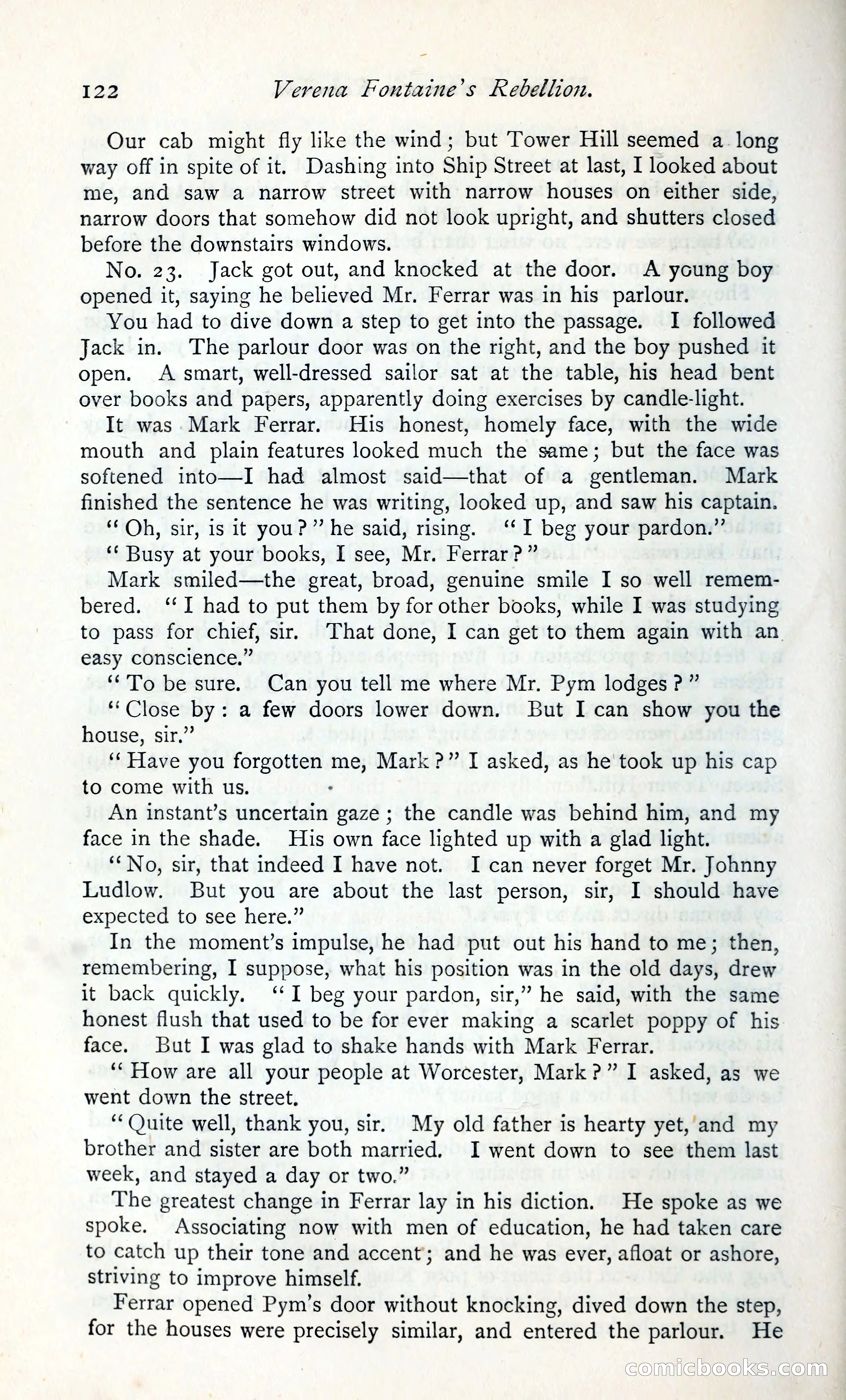
A restored page from Pulp Fiction, 1865. Page through the whole issue in the reader above.
📄 Transcribed text from this page (OCR, searchable)
Machine-transcribed from the original scan — historical spelling and the odd misread are preserved.
—_ 122 Verena Fontaine's Rebellion. Our cab might fly like the wind; but Tower Hill seemed a long way off in spite of it. Dashing into Ship Street at last, I looked about me, and saw a narrow street with narrow houses on either side, narrow doors that somehow did not look upright, and shutters closed before the downstairs windows. No. 23. Jack got out, and knocked at the door. A young boy opened it, saying he believed Mr. Ferrar was in his parlour. You had to dive down a step to get into the passage. I followed Jack in. The parlour door was on the right, and the boy pushed it open. A smart, well-dressed sailor sat at the table, his head bent over books and papers, apparently doing exercises by candle-light. It was Mark Ferrar. His honest, homely face, with the wide mouth and plain features looked much the same; but the face was softened into—I had almost said—that of a gentleman. Mark finished the sentence he was writing, looked up, and saw his captain. ‘Oh, sir, is it you?” he said, rising. ‘‘ I beg your pardon.” ‘Busy at your books, I see, Mr. Ferrar?” Mark smiled—the great, broad, genuine smile I so well remem- bered. ‘‘I had to put them by for other books, while I was studying to pass for chief, sir. That done, I can get to them again with an. easy conscience.” ‘To be sure. Can you tell me where Mr. Pym lodges ? ” ‘Close by: a few doors lower down. But I can show you the house, sir.” ‘Have you forgotten me, Mark ?” I asked, as he took up his cap to come with us. An instant’s uncertain gaze; the candle was behind him, and my face in the shade. His own face lighted up with a glad light. ‘No, sir, that indeed I have not. I can never forget Mr. Johnny Ludlow. But you are about the last person, sir, I should have expected to see here.” In the moment’s impulse, he had put out his hand to me; then, remembering, I suppose, what his position was in the old days, drew it back quickly. ‘I beg your pardon, sir,” he said, with the same honest flush that used to be for ever making a scarlet poppy of his face. But I was glad to shake hands with Mark Ferrar. ‘* How are all your people at Worcester, Mark?” I asked, as we went down the street. ‘Quite well, thank you, sir. My old father is hearty yet,'and my brother and sister are both married. I went down to see them last week, and stayed a day or two.” The greatest change in Ferrar lay in his diction. He spoke as we spoke. Associating now with men of education, he had taken care to catch up their tone and accent; and he was ever, afloat or ashore, striving to improve himself. Ferrar opened Pym’s door without knocking, dived down the step, for the houses were precisely similar, and entered the parlour. He CORNIELOOKS.E©