
Pulp Fiction, 1865 · page 120 of 400
The Argosy — page 120: what you’re looking at
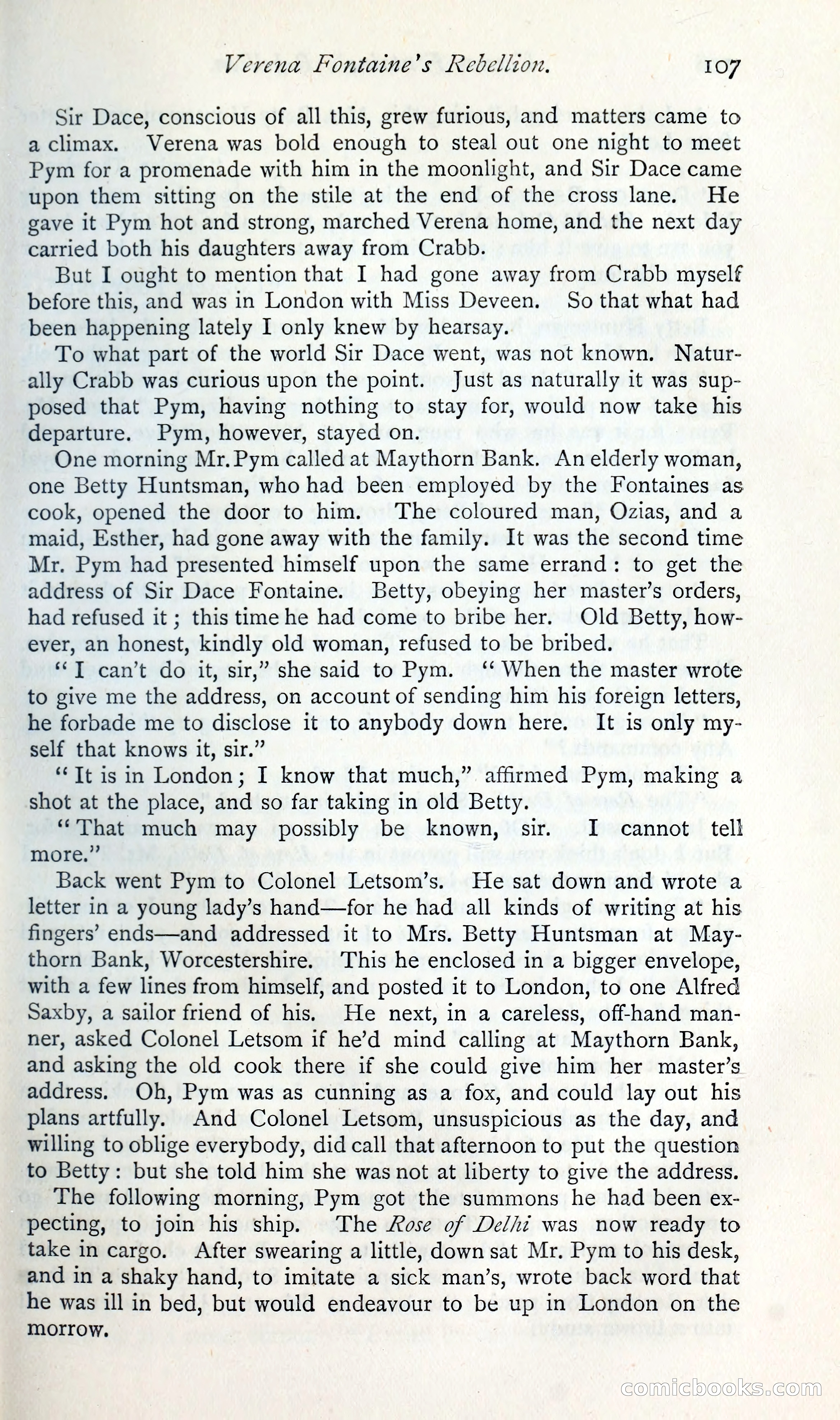
A restored page from Pulp Fiction, 1865. Page through the whole issue in the reader above.
📄 Transcribed text from this page (OCR, searchable)
Machine-transcribed from the original scan — historical spelling and the odd misread are preserved.
Verena Lontaine’s Rebellion. 107 Sir Dace, conscious of all this, grew furious, and matters came to a climax. Verena was bold enough to steal out one night to meet Pym for a promenade with him in the moonlight, and Sir Dace came upon them sitting on the stile at the end of the cross lane. He gave it Pym hot and strong, marched Verena home, and the next day carried both his daughters away from Crabb. But I ought to mention that I had gone away from Crabb myself before this, and was in London with Miss Deveen. So that what had been happening lately I only knew by hearsay. To what part of the world Sir Dace went, was not known. Natur- ally Crabb was curious upon the point. Just as naturally it was sup- posed that Pym, having nothing to stay for, would now take his departure. Pym, however, stayed on. One morning Mr. Pym called at Maythorn Bank. An elderly woman, one Betty Huntsman, who had been employed by the Fontaines as cook, opened the door to him. The coloured man, Ozias, and a maid, Esther, had gone away with the family. It was the second time Mr. Pym had presented himself upon the same errand: to get the address of Sir Dace Fontaine. Betty, obeying her master’s orders, had refused it ; this ttme he had come to bribe her. Old Betty, how- ever, an honest, kindly old woman, refused to be bribed. “TI can’t do it, sir,” she said to Pym. ‘‘ When the master wrote to give me the address, on account of sending him his foreign letters, he forbade me to disclose it to anybody down here. It is only my- self that knows it, sir.” ‘Tt is in London; I know that much,” affirmed Pym, making a shot at the place, and so far taking in old Betty. “That much may possibly be known, sir. I cannot tell more.” Back went Pym to Colonel Letsom’s. He sat down and wrote a letter in a young lady’s hand—for he had all kinds of writing at his fingers’ ends—and addressed it to Mrs. Betty Huntsman at May- thorn Bank, Worcestershire. This he enclosed in a bigger envelope, with a few lines from himself, and posted it to London, to one Alfred Saxby, a sailor friend of his. He next, in a careless, off-hand man- ner, asked Colonel Letsom if he’d mind calling at Maythorn Bank, and asking the old cook there if she could give him her master’s address. Oh, Pym was as cunning as a fox, and could lay out his plans artfully. And Colonel Letsom, unsuspicious as the day, and willing to oblige everybody, did call that afternoon to put the question to Betty: but she told him she was not at liberty to give the address. The following morning, Pym got the summons he had been ex- pecting, to join his ship. The Rose of Delhi was now ready to take in cargo. After swearing a little, down sat Mr. Pym to his desk, and in a shaky hand, to imitate a sick man’s, wrote back word that he was ill in bed, but would endeavour to be up in London on the morrow. COMIC OOO <S) (S©) im