
Pulp Fiction, 1865 · page 101 of 400
The Argosy — page 101: what you’re looking at
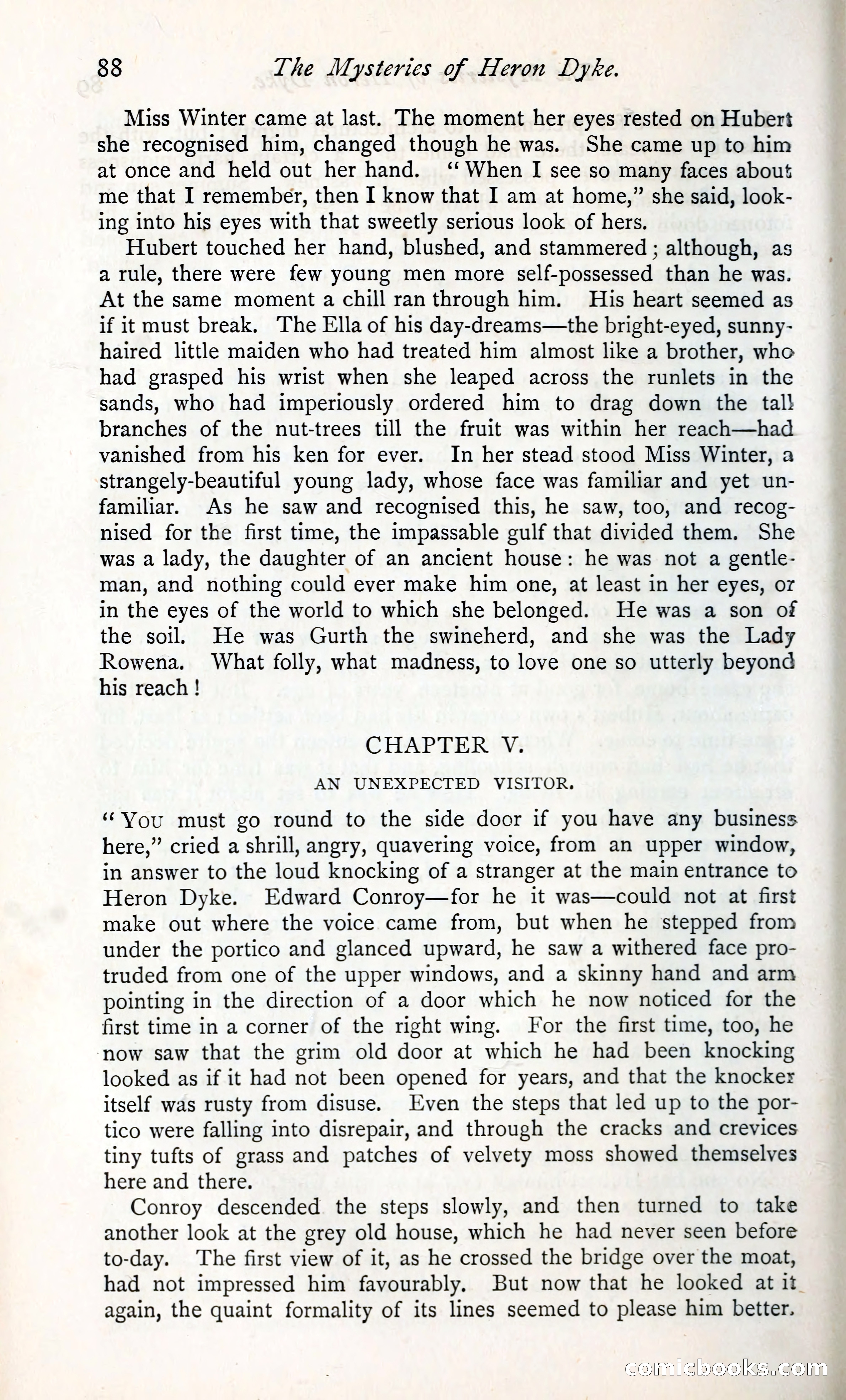
A restored page from Pulp Fiction, 1865. Page through the whole issue in the reader above.
📄 Transcribed text from this page (OCR, searchable)
Machine-transcribed from the original scan — historical spelling and the odd misread are preserved.
83 The Mysteries of FHleron Dyke. Miss Winter came at last. The moment her eyes rested on Hubert she recognised him, changed though he was. She came up to him at once and held out her hand. ‘‘ When I see so many faces about me that I remember, then I know that I am at home,” she said, look- ing into his eyes with that sweetly serious look of hers. Hubert touched her hand, blushed, and stammered ; although, as a rule, there were few young men more self-possessed than he was. At the same moment a chill ran through him. His heart seemed as if it must break. The Ella of his day-dreams—the bright-eyed, sunny- haired littlhe maiden who had treated him almost like a brother, who had grasped his wrist when she leaped across the runlets in the sands, who had imperiously ordered him to drag down the tall branches of the nut-trees till the fruit was within her reach—had vanished from his ken for ever. In her stead stood Miss Winter, a strangely-beautiful young lady, whose face was familiar and yet un- familiar. As he saw and recognised this, he saw, too, and recog- nised for the first time, the impassable gulf that divided them. She was a lady, the daughter of an ancient house: he was not a gentle- man, and nothing could ever make him one, at least in her eyes, o7 in the eyes of the world to which she belonged. He was a son of the soil. He was Gurth the swineherd, and she was the Lady Rowena. What folly, what madness, to love one so utterly beyond his reach ! CHAPTER V. AN UNEXPECTED VISITOR. ‘You must go round to the side door if you have any business here,” cried a shrill, angry, quavering voice, from an upper window, in answer to the loud knocking of a stranger at the main entrance to Heron Dyke. Edward Conroy—for he it was—could not at first make out where the voice came from, but when he stepped from under the portico and glanced upward, he saw a withered face pro- truded from one of the upper windows, and a skinny hand and arm pointing in the direction of a door which he now noticed for the first time in a corner of the right wing. For the first time, too, he now saw that the grim old door at which he had been knocking looked as if it had not been opened for years, and that the knocker itself was rusty from disuse. Even the steps that led up to the por- tico were falling into disrepair, and through the cracks and crevices tiny tufts of grass and patches of velvety moss showed themselves here and there. Conroy descended the steps slowly, and then turned to take another look at the grey old house, which he had never seen before to-day. The first view of it, as he crossed the bridge over the moat, had not impressed him favourably. But now that he looked at it again, the quaint formality of its lines seemed to please him better. COMMICLOOKSs (EC) m