
Pulp Fiction, 1865 · page 74 of 400
The Argosy — page 74: what you’re looking at
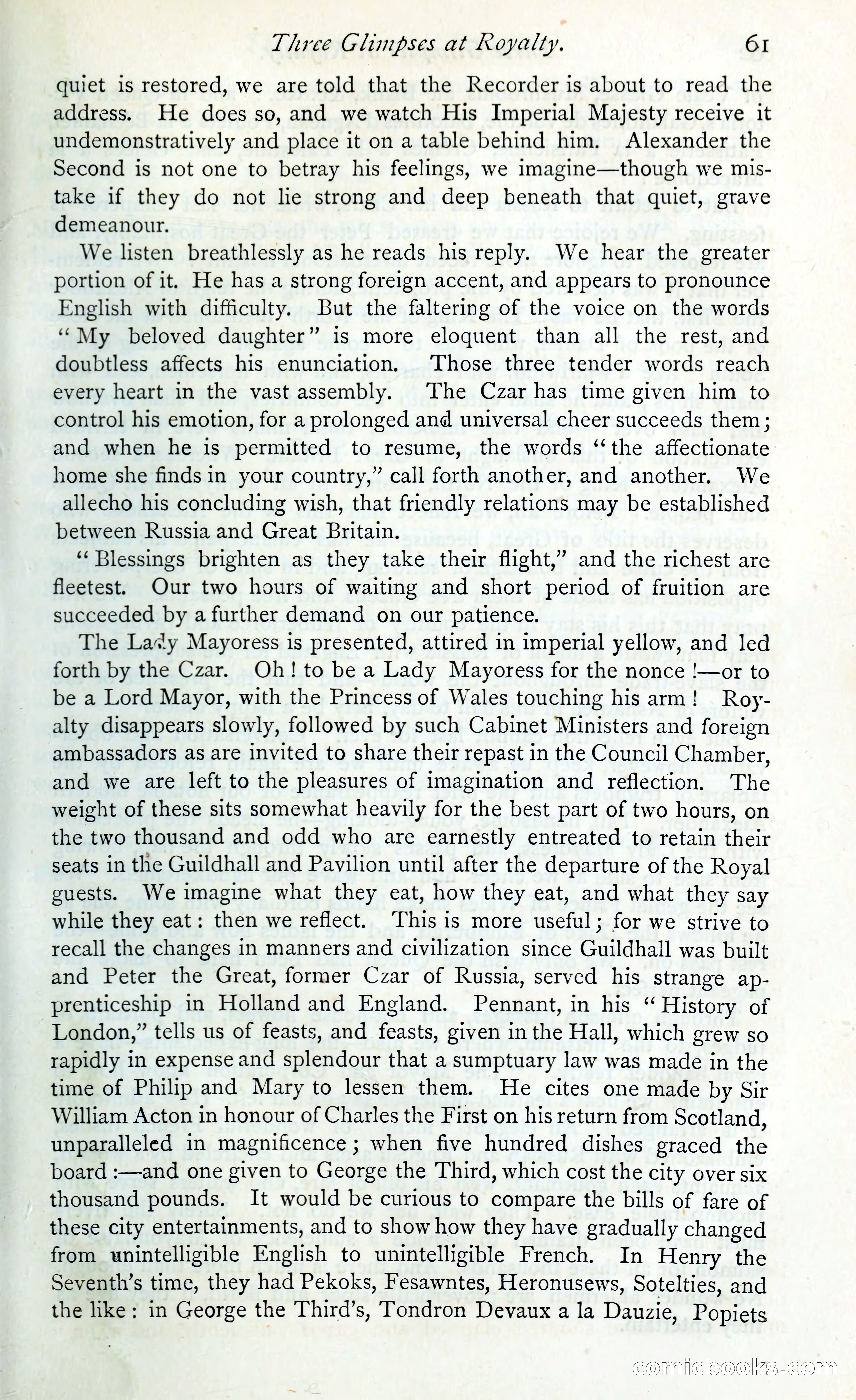
A restored page from Pulp Fiction, 1865. Page through the whole issue in the reader above.
📄 Transcribed text from this page (OCR, searchable)
Machine-transcribed from the original scan — historical spelling and the odd misread are preserved.
Three Glimpses at Royalty. 61 quiet is restored, we are told that the Recorder is about to read the address. He does so, and we watch His Imperial Majesty receive it undemonstratively and place it on a table behind him. Alexander the Second is not one to betray his feelings, we imagine—though we mis- take if they do not lie strong and deep beneath that quiet, grave demeanour. We listen breathlessly as he reads his reply. We hear the greater portion of it. He has a strong foreign accent, and appears to pronounce English with difficulty. But the faltering of the voice on the words ‘““My beloved daughter” is more eloquent than all the rest, and doubtless affects his enunciation. Those three tender words reach every heart in the vast assembly. The Czar has time given him to control his emotion, for a prolonged and universal cheer succeeds them; and when he is permitted to resume, the words “‘the affectionate home she finds in your country,” call forth another, and another. We allecho his concluding wish, that friendly relations may be established between Russia and Great Britain. | ‘“‘ Blessings brighten as they take their flight,’ and the richest are fleetest. Our two hours of waiting and short period of fruition are succeeded by a further demand on our patience. The Lasly Mayoress is presented, attired in imperial yellow, and led forth by the Czar. Oh! to be a Lady Mayoress for the nonce !—or to be a Lord Mayor, with the Princess of Wales touching his arm! Roy- alty disappears slowly, followed by such Cabinet Ministers and foreign ambassadors as are invited to share their repast in the Council Chamber, and we are left to the pleasures of imagination and reflection. The weight of these sits somewhat heavily for the best part of two hours, on the two thousand and odd who are earnestly entreated to retain their seats in the Guildhall and Pavilion until after the departure of the Royal guests. We imagine what they eat, how they eat, and what they say while they eat: then we reflect. This is more useful; for we strive to recall the changes in manners and civilization since Guildhall was built and Peter the Great, former Czar of Russia, served his strange ap- prenticeship in Holland and England. Pennant, in his “ History of London,” tells us of feasts, and feasts, given in the Hall, which grew so rapidly in expense and splendour that a sumptuary law was made in the time of Philip and Mary to lessen them. He cites one made by Sir William Acton in honour of Charles the First on his return from Scotland, unparalleled in magnificence ; when five hundred dishes graced the board :—and one given to George the Third, which cost the city over six thousand pounds. It would be curious to compare the bills of fare of these city entertainments, and to show how they have gradually changed from unintelligible English to unintelligible French. In Henry the Seventh’s time, they had Pekoks, Fesawntes, Heronusews, Sotelties, and the like: in George the Third’s, Tondron Devaux a la Dauzie, Popiets COnniiclooolks (CO)