
Pulp Fiction, 1865 · page 72 of 400
The Argosy — page 72: what you’re looking at
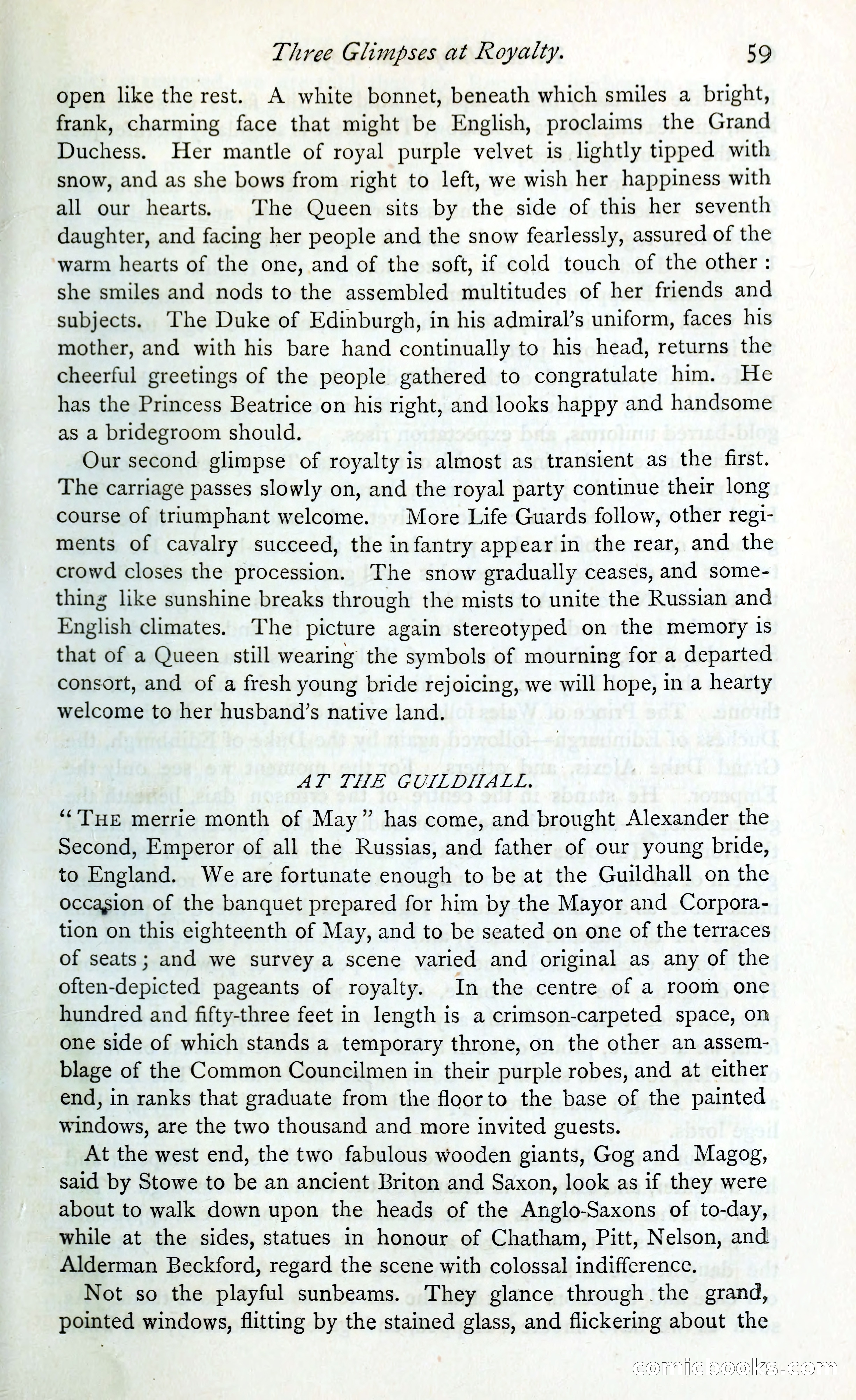
A restored page from Pulp Fiction, 1865. Page through the whole issue in the reader above.
📄 Transcribed text from this page (OCR, searchable)
Machine-transcribed from the original scan — historical spelling and the odd misread are preserved.
Three Glimpses at Royalty. 59 open like the rest. A white bonnet, beneath which smiles a bright, frank, charming face that might be English, proclaims the Grand Duchess. Her mantle of royal purple velvet is lightly tipped with snow, and as she bows from right to left, we wish her happiness with all our hearts. The Queen sits by the side of this her seventh daughter, and facing her people and the snow fearlessly, assured of the warm hearts of the one, and of the soft, if cold touch of the other: she smiles and nods to the assembled multitudes of her friends and subjects. The Duke of Edinburgh, in his admiral’s uniform, faces his mother, and with his bare hand continually to his head, returns the cheerful greetings of the people gathered to congratulate him. He has the Princess Beatrice on his right, and looks happy and handsome as a bridegroom should. Our second glimpse of royalty is almost as transient as the first. The carriage passes slowly on, and the royal party continue their long course of triumphant welcome. More Life Guards follow, other regi- ments of cavalry succeed, the infantry appear in the rear, and the crowd closes the procession. The snow gradually ceases, and some- thing like sunshine breaks through the mists to unite the Russian and English climates. The picture again stereotyped on the memory is that of a Queen still wearing the symbols of mourning for a departed consort, and of a fresh young bride rejoicing, we will hope, in a hearty welcome to her husband’s native land. Be THE GUILDIUALA., “THE merrie month of May” has come, and brought Alexander the Second, Emperor of all the Russias, and father of our young bride, to England. We are fortunate enough to be at the Guildhall on the occasion of the banquet prepared for him by the Mayor and Corpora- tion on this eighteenth of May, and to be seated on one of the terraces of seats; and we survey a scene varied and original as any of the often-depicted pageants of royalty. In the centre of a room one hundred and fifty-three feet in length is a crimson-carpeted space, on one side of which stands a temporary throne, on the other an assem- blage of the Common Councilmen in their purple robes, and at either end, in ranks that graduate from the floorto the base of the painted windows, are the two thousand and more invited guests. _ At the west end, the two fabulous wooden giants, Gog and Magog, said by Stowe to be an ancient Briton and Saxon, look as if they were about to walk down upon the heads of the Anglo-Saxons of to-day, while at the sides, statues in honour of Chatham, Pitt, Nelson, and Alderman Beckford, regard the scene with colossal indifference. Not so the playful sunbeams. They glance through the grand, pointed windows, flitting by the stained glass, and flickering about the CcoOnniclooolxs (CO) mn