
Pulp Fiction, 1865 · page 62 of 400
The Argosy — page 62: what you’re looking at
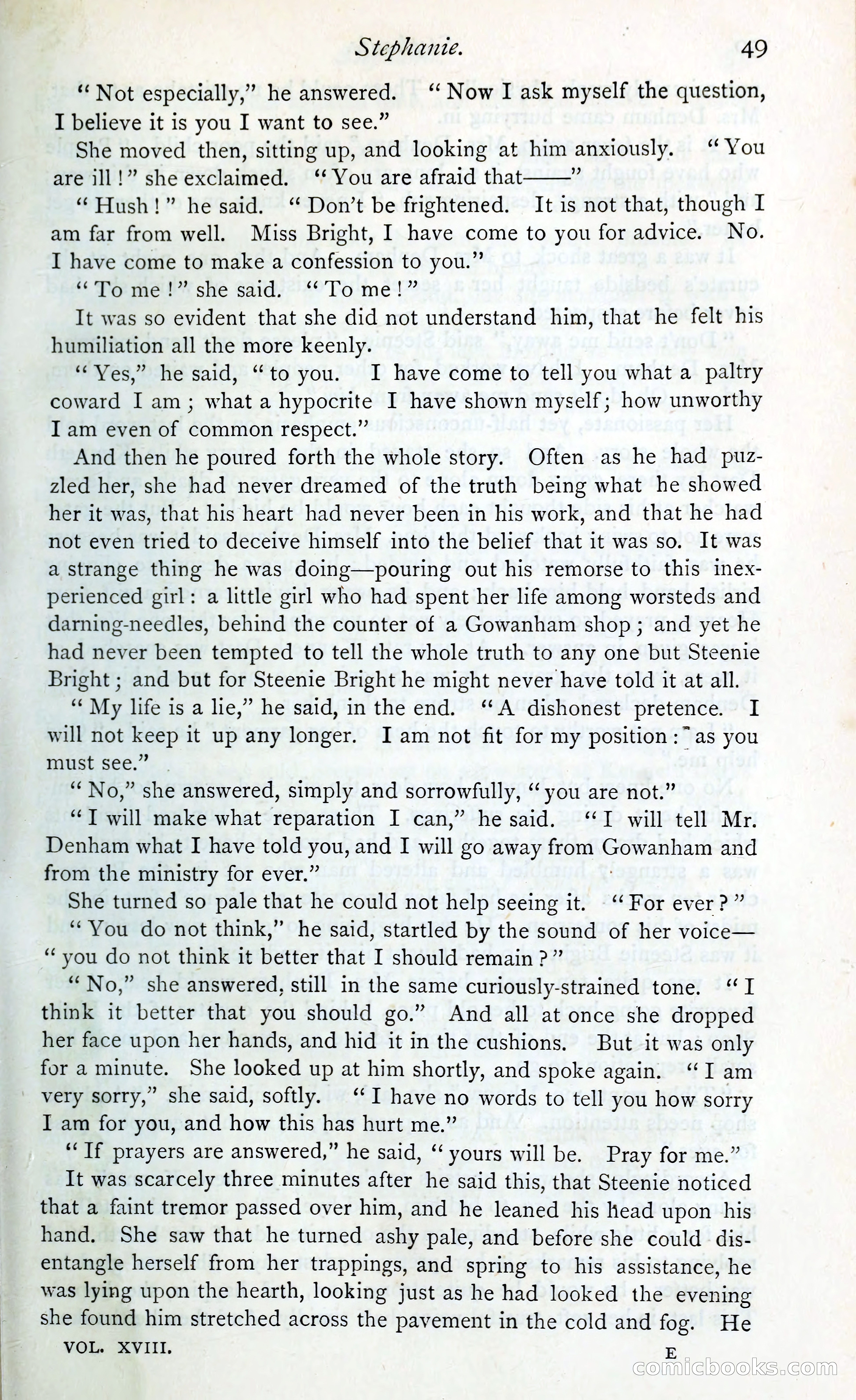
A restored page from Pulp Fiction, 1865. Page through the whole issue in the reader above.
📄 Transcribed text from this page (OCR, searchable)
Machine-transcribed from the original scan — historical spelling and the odd misread are preserved.
Stephante. 49 ‘Not especially,” he answered. ‘‘ Now I ask myself the question, I believe it is you I want to see.” She moved then, sitting up, and looking at him anxiously. ‘ You are ill!” she exclaimed. ‘‘ You are afraid that se “Hush!” he said. ‘“ Don’t be frightened. It is not that, though I am far from well. Miss Bright, I have come to you for advice. No. I have come to make a confession to you.” ‘To me!” she said. ‘‘ Tome!” It was so evident that she did not understand him, that he felt his humiliation all the more keenly. “Ves,” he said, “to you. I have come to tell you what a paltry coward I am; what a hypocrite I have shown myself; how unworthy I am even of common respect.” And then he poured forth the whole story. Often as he had puz- zled her, she had never dreamed of the truth being what he showed her it was, that his heart had never been in his work, and that he had not even tried to deceive himself into the belief that it was so. It was a strange thing he was doing—pouring out his remorse to this inex- perienced girl: a little girl who had spent her life among worsteds and darning-needles, behind the counter of a Gowanham shop; and yet he had never been tempted to tell the whole truth to any one but Steenie Bright ; and but for Steenie Bright he might never have told it at all. ‘‘ My life is a lie,” he said, in the end. ‘‘A dishonest pretence. I will not keep it up any longer. Iam not fit for my position:” as you must see.” “No,” she answered, simply and sorrowfully, “‘ you are not.” “T will make what reparation I can,” he said. ‘I will tell Mr. Denham what I have told yeu, and I will go away from smoecigam and from the ministry for ever.’ She turned so pale that he could not help seeing it. ‘‘ For ever ?” “You do not think,” he said, startled by the sound of her voice— ‘you do not think it better that I should remain ?”’ “No,” she answered, still in the same curiously-strained tone. “I think it better that you should go.” And all at once she dropped her face upon her hands, and hid it in the cushions. But it was only fora minute. She looked up at him shortly, and spoke again. “Iam very sorry,” she said, softly. ‘I have no words to tell you how sorry I am for you, and how this has hurt me.” ‘“If prayers are answered,” he said, ‘‘ yours will be. Pray for me.” It was scarcely three minutes after he said this, that Steenie noticed that a faint tremor passed over him, and he leaned his head upon his hand. She saw that he turned ashy pale, and before she could dis- entangle herself from her trappings, and spring to his assistance, he was lying upon the hearth, looking just as he had looked the evening she found him stretched across the pavement in the cold and fog. He VOL. XVIII. E COnniclooo SS) (Cl O)