
Pulp Fiction, 1865 · page 377 of 400
The Argosy — page 377: what you’re looking at
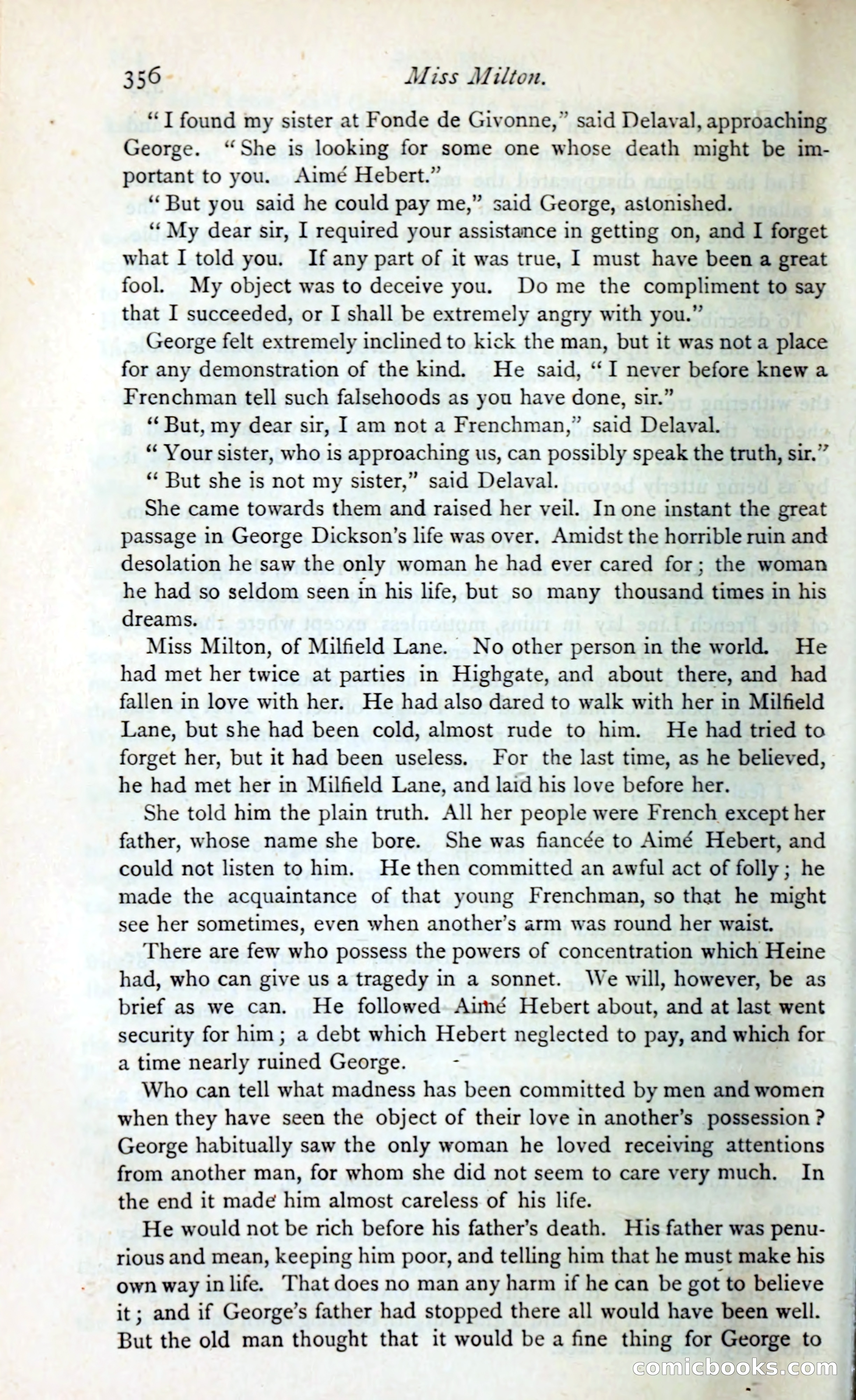
A restored page from Pulp Fiction, 1865. Page through the whole issue in the reader above.
📄 Transcribed text from this page (OCR, searchable)
Machine-transcribed from the original scan — historical spelling and the odd misread are preserved.
350. Miss Milton. “T found my sister at Fonde de Givonne,” said Delaval, approaching George. “She is looking for some one whose death might be im- portant to you. Aimé Hebert.” ‘But you said he could pay me,” said George, astonished. ‘“‘ My dear sir, I required your assistance in getting on, and I forget what I told you. If any part of it was true, I must have been a great fool. My object was to deceive you. Dome the compliment to say that I succeeded, or I shall be extremely angry with you.” George felt extremely inclined to kick the man, but it was not a place for any demonstration of the kind. He said, “I never before knew a Frenchman tell such falsehoods as you have done, sir.” ‘But, my dear sir, I am not a Frenchman,” said Delaval. “Your sister, who is approaching us, can possibly speak the truth, sir.” “‘ But she is not my sister,” said Delaval. She came towards them and raised her veil. In one instant the great passage in George Dickson’s life was over. Amidst the horrible ruin and desolation he saw the only woman he had ever cared for; the woman he had so seldom seen in his life, but so many thousand times in his dreams. Miss Milton, of Milfield Lane. No other person in the world. He had met her twice at parties in Highgate, and about there, and had fallen in love with her. He had also dared to walk with her in Milfield Lane, but she had been cold, almost rude to him. He had tried to forget her, but it had been useless. For the last time, as he believed, he had met her in Milfield Lane, and laid his love before her. She told him the plain truth. All her people were French except her father, whose name she bore. She was fiancée to Aimé Hebert, and could not listen to him. Hethen committed an awful act of folly; he made the acquaintance of that young Frenchman, so that he might see her sometimes, even when another’s arm was round her waist. There are few who possess the powers of concentration which Heine had, who can give us a tragedy in a sonnet. We will, however, be as brief as we can. He followed Aimé Hebert about, and at last went security for him; a debt which Hebert neglected to pay, and which for a time nearly ruined George. : Who can tell what madness has been committed by men and women when they have seen the object of their love in another’s possession ? George habitually saw the only woman he loved receiving attentions from another man, for whom she did not seem to care very much. In the end it made him almost careless of his life. He would not be rich before his father’s death. His father was penu- rious and mean, keeping him poor, and telling him that he must make his own way in life. That does no man any harm if he can be got to believe it; and if George’s father had stopped there all would have been well. But the old man thought that it would be a fine thing for George to cGomicbooks.com