
Pulp Fiction, 1865 · page 368 of 400
The Argosy — page 368: what you’re looking at
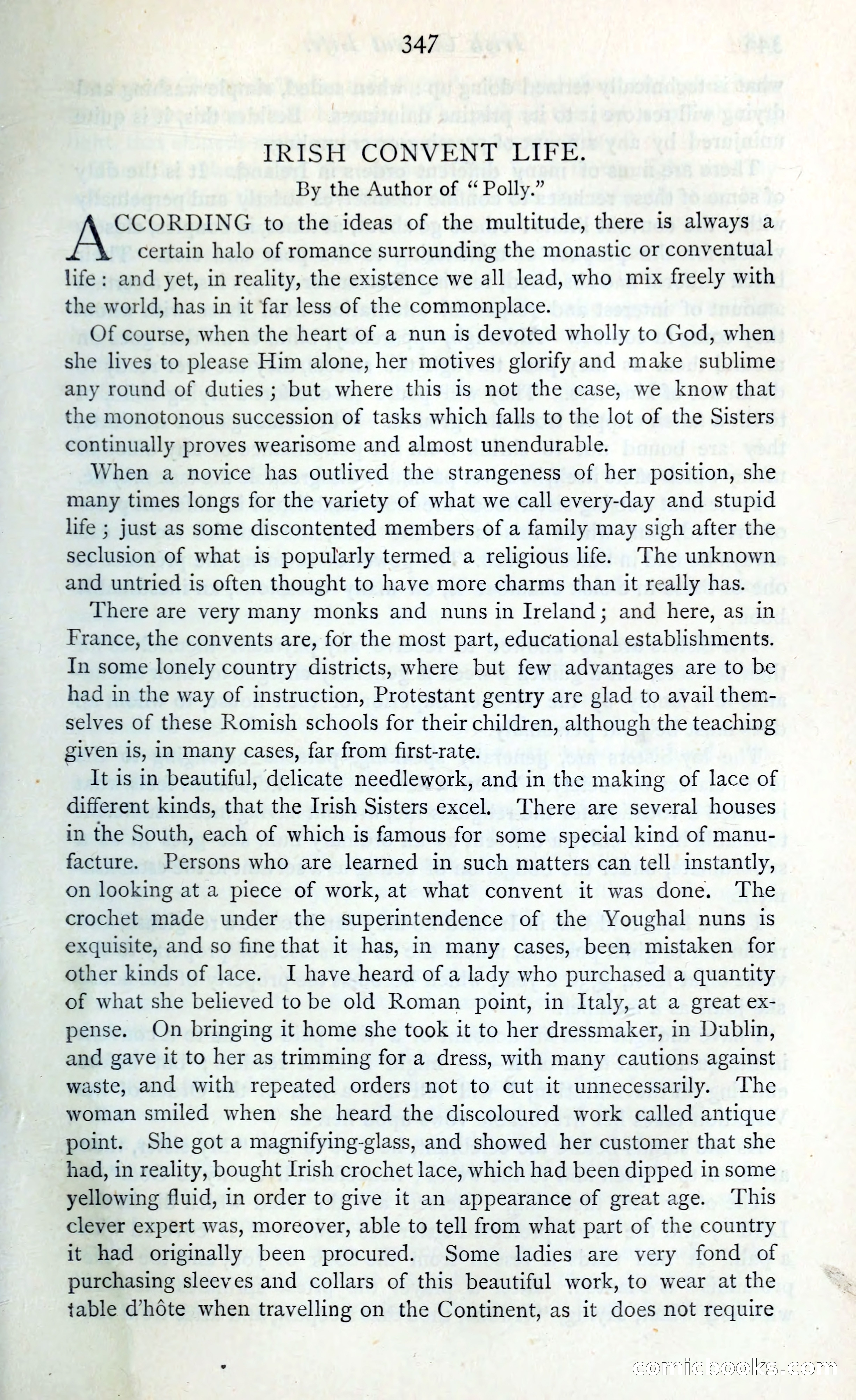
A restored page from Pulp Fiction, 1865. Page through the whole issue in the reader above.
📄 Transcribed text from this page (OCR, searchable)
Machine-transcribed from the original scan — historical spelling and the odd misread are preserved.
347 IRISH CONVENT LIFE. By the Author of “ Polly.” CCORDING to the ideas of the multitude, there is always a certain halo of romance surrounding the monastic or conventual life: and yet, in reality, the existence we all lead, who mix freely with the world, has in it far less of the commonplace. Of course, when the heart of a nun is devoted wholly to God, when she lives to please Him alone, her motives glorify and make sublime any round of duties; but where this is not the case, we know that the monotonous succession of tasks which falls to the lot of the Sisters continually proves wearisome and almost unendurable. When a novice has outlived the strangeness of her position, she many times longs for the variety of what we call every-day and stupid life ; just as some discontented members of a family may sigh after the seclusion of what is popularly termed a religious life. The unknown and untried is often thought to have more charms than it really has. There are very many monks and nuns in Ireland; and here, as in France, the convents are, for the most part, educational establishments. In some lonely country districts, where but few advantages are to be had in the way of instruction, Protestant gentry are glad to avail them- selves of these Romish schools for their children, although the teaching given is, in many cases, far from first-rate. It is in beautiful, delicate needlework, and in the making of lace of different kinds, that the Irish Sisters excel. There are several houses in the South, each of which is famous for some special kind of manu- facture. Persons who are learned in such matters can tell instantly, on looking at a piece of work, at what convent it was done. The crochet made under the superintendence of the Youghal nuns is exquisite, and so fine that it has, in many cases, been mistaken for other kinds of lace. I have heard of a lady who purchased a quantity of what she believed to be old Roman point, in Italy, at a great ex- pense. On bringing it home she took it to her dressmaker, in Dublin, and gave it to her as trimming for a dress, with many cautions against waste, and with repeated orders not to cut it unnecessarily. ‘The woman smiled when she heard the discoloured work called antique point. She got a magnifying-glass, and showed her customer that she had, in reality, bought Imish crochet lace, which had been dipped in some yellowing fluid, in order to give it an appearance of great age. This clever expert was, moreover, able to tell from what part of the country it had originally been procured. Some ladies are very fond of purchasing sleeves and collars of this beautiful work, to wear at the table d’hote when travelling on the Continent, as it does not require 4 connicloooks CO im