
Pulp Fiction, 1865 · page 350 of 400
The Argosy — page 350: what you’re looking at
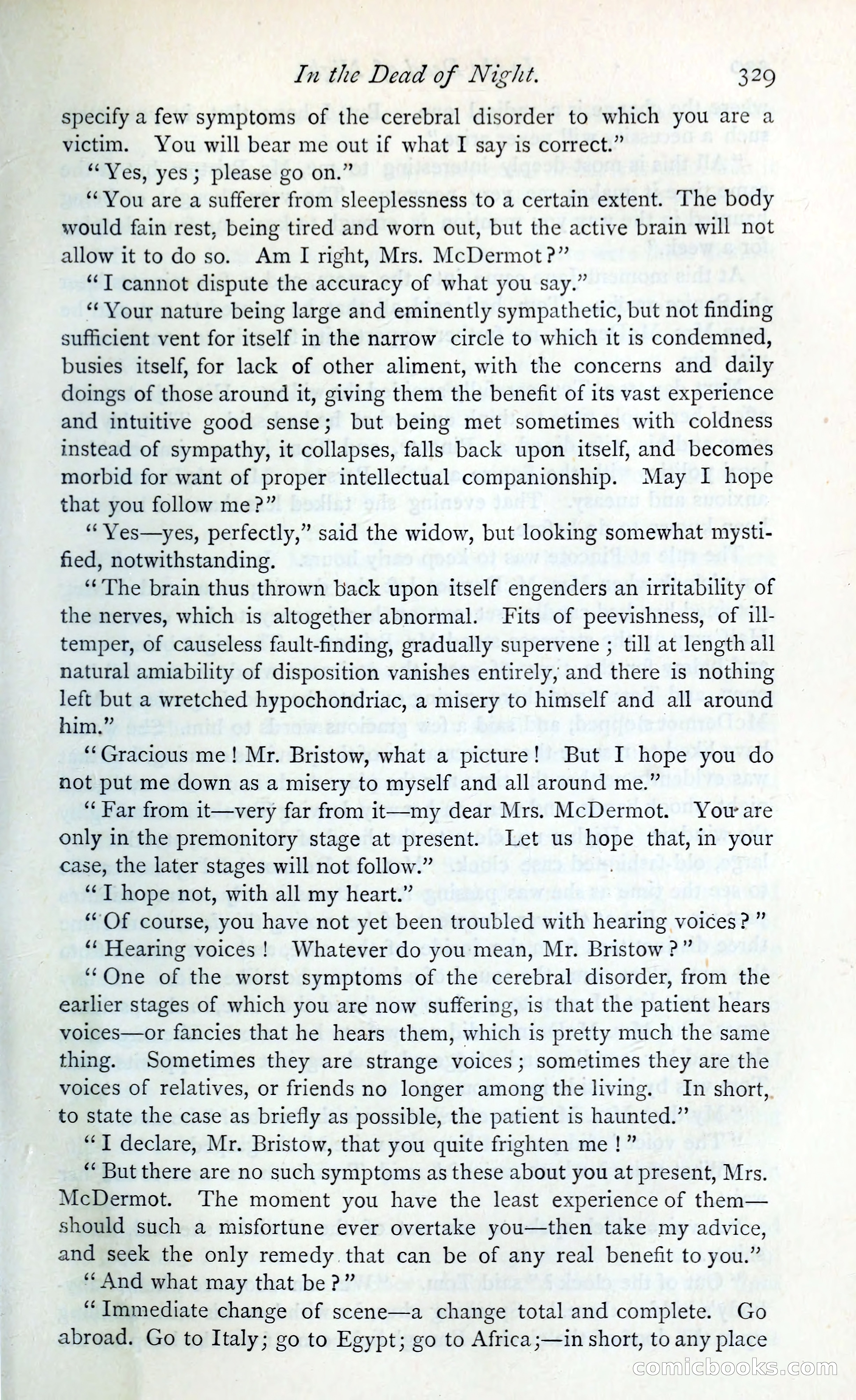
A restored page from Pulp Fiction, 1865. Page through the whole issue in the reader above.
📄 Transcribed text from this page (OCR, searchable)
Machine-transcribed from the original scan — historical spelling and the odd misread are preserved.
In the Dead of Night. 329 specify a few symptoms of the cerebral disorder to which you are a victim. You will bear me out if what I say is correct.” “Yes, yes; please go on.” ‘Vou are a sufferer from sleeplessness to a certain extent. The body would fain rest, being tired and worn out, but the active brain will not allow it todo so. Am I right, Mrs. McDermot?” “‘T cannot dispute the accuracy of what you say.” ‘Your nature being large and eminently sympathetic, but not finding sufficient vent for itself in the narrow circle to which it is condemned, busies itself, for lack of other alimeni, with the concerns and daily doings of those around it, giving them the benefit of its vast experience and intuitive good sense; but being met sometimes with coldness instead of sympathy, it collapses, falls back upon itself, and becomes morbid for want of proper intellectual companionship. May I hope that you follow me?” ‘““Yes—yes, perfectly,” said the widow, but looking somewhat mysti- fied, notwithstanding. “The brain thus thrown back upon itself engenders an irritability of the nerves, which is altogether abnormal. Fits of peevishness, of ill- temper, of causeless fault-finding, gradually supervene ; till at length all natural amiability of disposition vanishes entirely, and there is nothing left but a wretched hypochondriac, a misery to himself and all around him,” | “Gracious me! Mr. Bristow, what a picture! But I hope you do not put me down as a misery to myself and all around me.” ‘Far from it—very far from it—my dear Mrs. McDermot. Yoware only in the premonitory stage at present. Let us hope that, in your case, the later stages will not follow.” ‘“‘T hope not, with all my heart.” ““Of course, you have not yet been troubled with hearing voices ? ” ‘‘ Hearing voices! Whatever do you mean, Mr. Bristow ?” ‘“Qne of the worst symptoms of the cerebral disorder, from the earlier stages of which you are now suffering, is that the patient hears voices—or fancies that he hears them, which is pretty much the same thing. Sometimes they are strange voices; sometimes they are the voices of relatives, or friends no longer among the living. In short, to state the case as briefly as possible, the patient is haunted.” “T declare, Mr. Bristow, that you quite frighten me !” ‘“‘ But there are no such symptoms as these about you at present, Mrs. McDermot. The moment you have the least experience of them— should such a misfortune ever overtake you—then take my advice, and seek the only remedy that can be of any real benefit to you.” ‘“And what may that be?” ‘“ Immediate change of scene—a change total and complete. Go abroad. Go to Italy; go to Egypt; go to Africa;—in short, to any place connicloooks CO im