
Pulp Fiction, 1865 · page 285 of 400
The Argosy — page 285: what you’re looking at
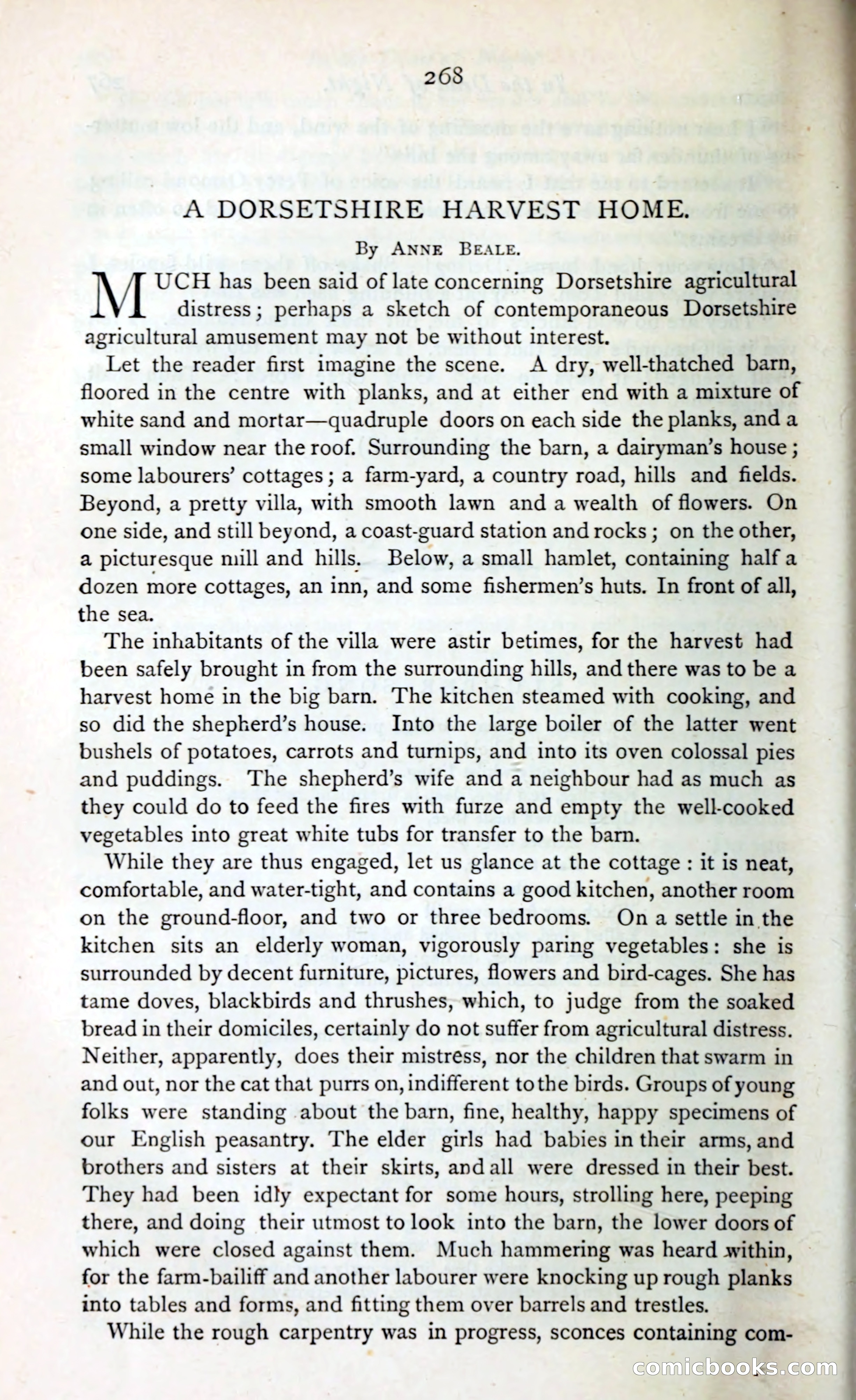
A restored page from Pulp Fiction, 1865. Page through the whole issue in the reader above.
📄 Transcribed text from this page (OCR, searchable)
Machine-transcribed from the original scan — historical spelling and the odd misread are preserved.
268 A DORSETSHIRE HARVEST HOME. By ANNE BEALE. UCH has been said of late concerning Dorsetshire agricultural distress ; perhaps a sketch of contemporaneous Dorsetshire agricultural amusement may not be without interest. Let the reader first imagine the scene. A dry, well-thatched barn, floored in the centre with planks, and at either end with a mixture of white sand and mortar—quadruple doors on each side the planks, anda small window near the roof. Surrounding the barn, a dairyman’s house ; some labourers’ cottages ; a farm-yard, a country road, hills and fields. Beyond, a pretty villa, with smooth lawn and a wealth of flowers. On one side, and still beyond, a coast-guard station and rocks; on the other, a picturesque mill and hills, Below, a small hamlet, containing half a dozen more cottages, an inn, and some fishermen’s huts. In front of all, the sea. The inhabitants of the villa were astir betimes, for the harvest had been safely brought in from the surrounding hills, and there was to be a harvest home in the big barn. The kitchen steamed with cooking, and so did the shepkerd’s house. Into the large boiler of the latter went bushels of potatoes, carrots and turnips, and into its oven colossal pies and puddings. ‘The shepherd’s wife and a neighbour had as much as they could do to feed the fires with furze and empty the well-cooked vegetables into great white tubs for transfer to the barn. While they are thus engaged, let us glance at the cottage : it is neat, comfortable, and water-tight, and contains a good kitchen, another room on the ground-floor, and two or three bedrooms. Ona settle in the kitchen sits an elderly woman, vigorously paring vegetables: she is surrounded by decent furniture, pictures, flowers and bird-cages. She has tame doves, blackbirds and thrushes, which, to judge from the soaked bread in their domiciles, certainly do not suffer from agricultural distress. Neither, apparently, does their mistréss, nor the children that swarm in and out, nor the cat that purrs on, indifferent tothe birds. Groups of young folks were standing about the barn, fine, healthy, happy specimens of our English peasantry. The elder girls had babies in their arms, and brothers and sisters at their skirts, andall were dressed in their best. They had been idly expectant for some hours, strolling here, peeping there, and doing their utmost to look into the barn, the lower doors of which were closed against them. Much hammering was heard within, — for the farm-bailiff and another labourer were knocking up rough planks into tables and forms, and fitting them over barrels and trestles. While the rough carpentry was in progress, sconces containing com- GComicbooks-c€o