
Pulp Fiction, 1865 · page 266 of 400
The Argosy — page 266: what you’re looking at
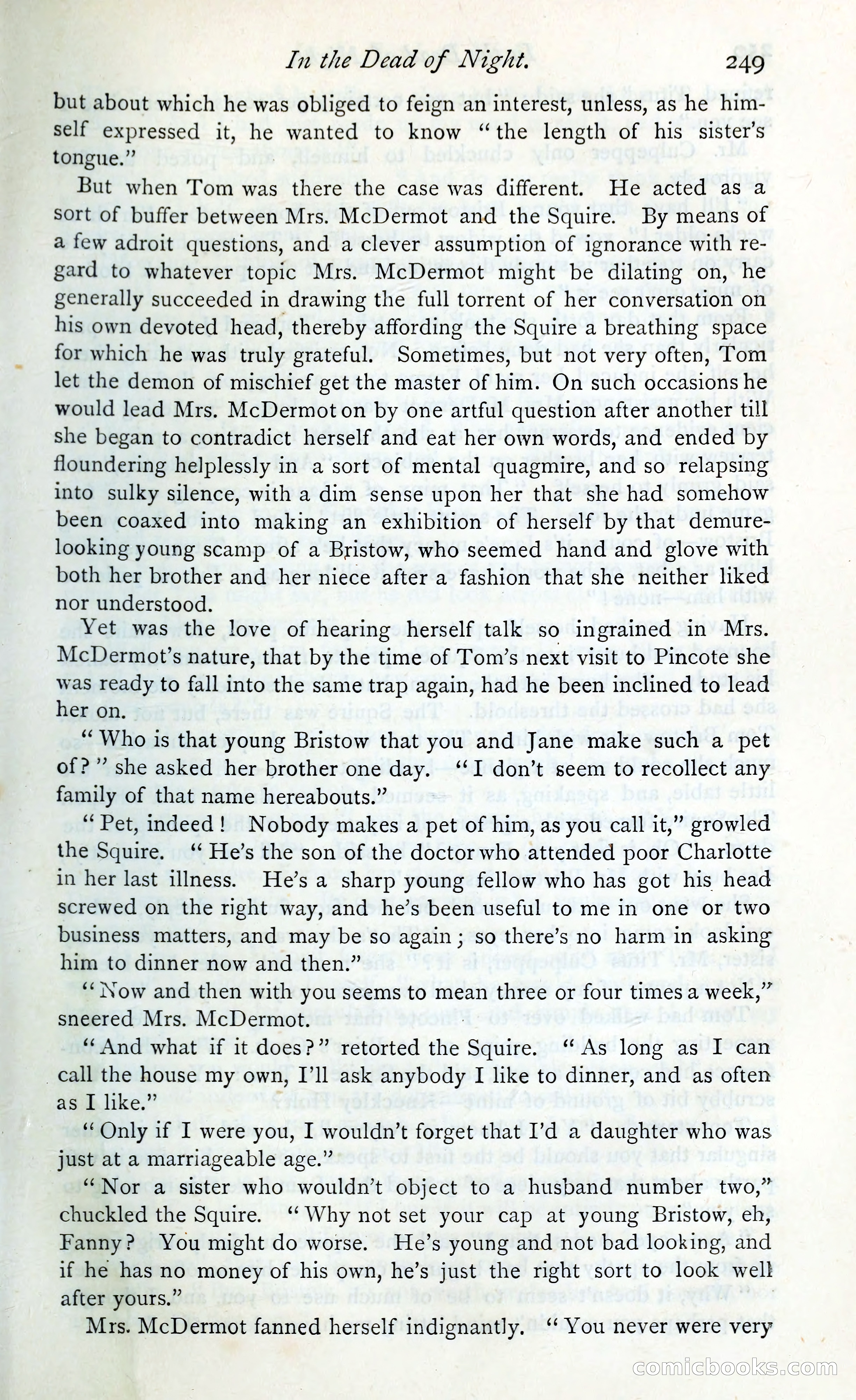
A restored page from Pulp Fiction, 1865. Page through the whole issue in the reader above.
📄 Transcribed text from this page (OCR, searchable)
Machine-transcribed from the original scan — historical spelling and the odd misread are preserved.
In the Dead of Night. 249 but about which he was obliged to feign an interest, unless, as he him- self expressed it, he wanted to know “the length of his sister’s tongue.” But when Tom was there the case was different. He acted as a sort of buffer between Mrs. McDermot and the Squire. By means of a few adroit questions, and a clever assumption of ignorance with re- gard to whatever topic Mrs. McDermot might be dilating on, he generally succeeded in drawing the full torrent of her conversation on his own devoted head, thereby affording the Squire a breathing space for which he was truly grateful. Sometimes, but not very often, Tom let the demon of mischief get the master of him. On such occasions he would lead Mrs. McDermoton by one artful question after another till she began to contradict herself and eat her own words, and ended by floundering helplessly in a sort of mental quagmire, and so relapsing into sulky silence, with a dim sense upon her that she had somehow been coaxed into making an exhibition of herself by that demure- looking young scamp of a Bristow, who seemed hand and glove with both her brother and her niece after a fashion that she neither liked nor understood. Yet was the love of hearing herself talk so ingrained in Mrs. McDermot’s nature, that by the time of Tom’s next visit to Pincote she was ready to fall into the same trap again, had he been inclined to lead her on. “Who is that young Bristow that you and Jane make such a pet of?” she asked her brother one day. ‘‘I don’t seem to recollect any family of that name hereabouts.” ‘Pet, indeed! Nobody makes a pet of him, as you call it,” growled the Squire. ‘‘ He’s the son of the doctor who attended poor Charlotte in her last illness. He’s a sharp young fellow who has got his head screwed on the right way, and he’s been useful to me in one or two business matters, and may be so again; so there’s no harm in asking him to dinner now and then.” ‘Now and then with you seems to mean three or four times a week,” sneered Mrs. McDermot. “And what if it does?” retorted the Side “As long as I can Call the house my own, I’ll ask anybody I like to dinner, and as often as I like.” ‘Only if I were you, I wouldn’t forget that I’d a daughter who was just at a marriageable age.” “Nor a sister who wouldn’t object to a husband number two,” chuckled the Squire. ‘‘ Why not set your cap at young Bristow, eh, Fanny? You might do worse. He’s young and not bad looking, and if he has no money of his own, he’s just the right sort to look well after yours.” Mrs. McDermot fanned herself indignantly. ‘‘ You never were very CoOnniclooolks (C(O)