
Pulp Fiction, 1865 · page 250 of 400
The Argosy — page 250: what you’re looking at
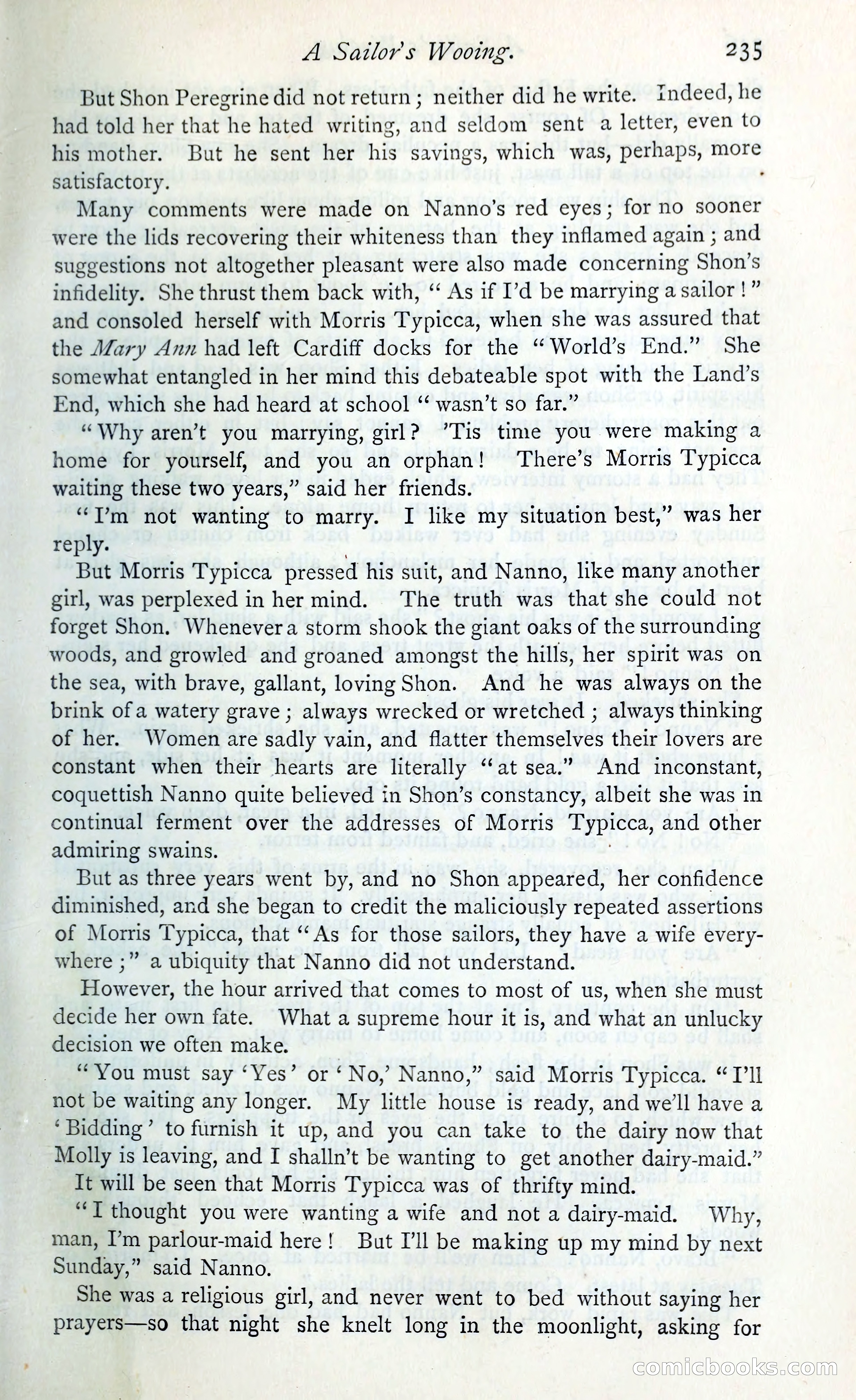
A restored page from Pulp Fiction, 1865. Page through the whole issue in the reader above.
📄 Transcribed text from this page (OCR, searchable)
Machine-transcribed from the original scan — historical spelling and the odd misread are preserved.
A Sailor's Wooing. 235 But Shon Peregrine did not return; neither did he write. indeed, he had told her that he hated writing, aid seldom sent a letter, even to his mother. But he sent her his savings, which was, perhaps, more satisfactory. Many comments were made on Nanno’s red eyes; for no sooner were the lids recovering their whiteness than they inflamed again ; and suggestions not altogether pleasant were also made concerning Shon's infidelity. She thrust them back with, “‘ As if I’d be marrying a sailor !” and consoled herself with Morris Typicca, when she was assured that the Mary Ann had left Cardiff docks for the “World’s End.” She somewhat entangled in her mind this debateable spot with the Land’s End, which she had heard at school ‘‘ wasn’t so far.” “Why aren’t you marrying, girl? ’Tis time you were making a home for yourself, and you an orphan! There’s Morris Typicca waiting these two years,” said her friends. “Tm not wanting to marry. I like my situation best,” was her reply. But Morris Typicca pressed his suit, and Nanno, like many another girl, was perplexed in her mind. The truth was that she could not forget Shon. Whenevera storm shook the giant oaks of the surrounding woods, and growled and groaned amongst the hills, her spirit was on the sea, with brave, gallant, loving Shon. And he was always on the brink ofa watery grave ; always wrecked or wretched ; always thinking of her. Women are sadly vain, and flatter themselves their lovers are constant when their hearts are literally “‘at sea.” And inconstant, coquettish Nanno quite believed in Shon’s constancy, albeit she was in continual ferment over the addresses of Morris Typicca, and other admiring swains. But as three years went by, and no Shon appeared, her confidence diminished, and she began to credit the maliciously repeated assertions of Morris Typicca, that “‘As for those sailors, they have a wife every- where ;” a ubiquity that Nanno did not understand. However, the hour arrived that comes to most of us, when she must decide her own fate. What a supreme hour it is, and what an unlucky decision we often make. “You must say ‘Yes’ or ‘No,’ Nanno,” said Morris Typicca. “I'll not be waiting any longer. My little house is ready, and we'll have a ‘Bidding’ to furnish it up, and you can take to the dairy now that Molly is leaving, and I shalln’t be wanting to get another dairy-maid.” It will be seen that Morris Typicca was of thrifty mind. “I thought you were wanting a wife and not a dairy-maid. Why, man, I’m parlour-maid here! But I’ll be making up my mind by next Sunday,” said Nanno. She was a religious girl, and never went to bed without saying her prayers—so that night she knelt long in the moonlight, asking for COMICOOolKS (S©)