
Pulp Fiction, 1865 · page 118 of 400
The Argosy — page 118: what you’re looking at
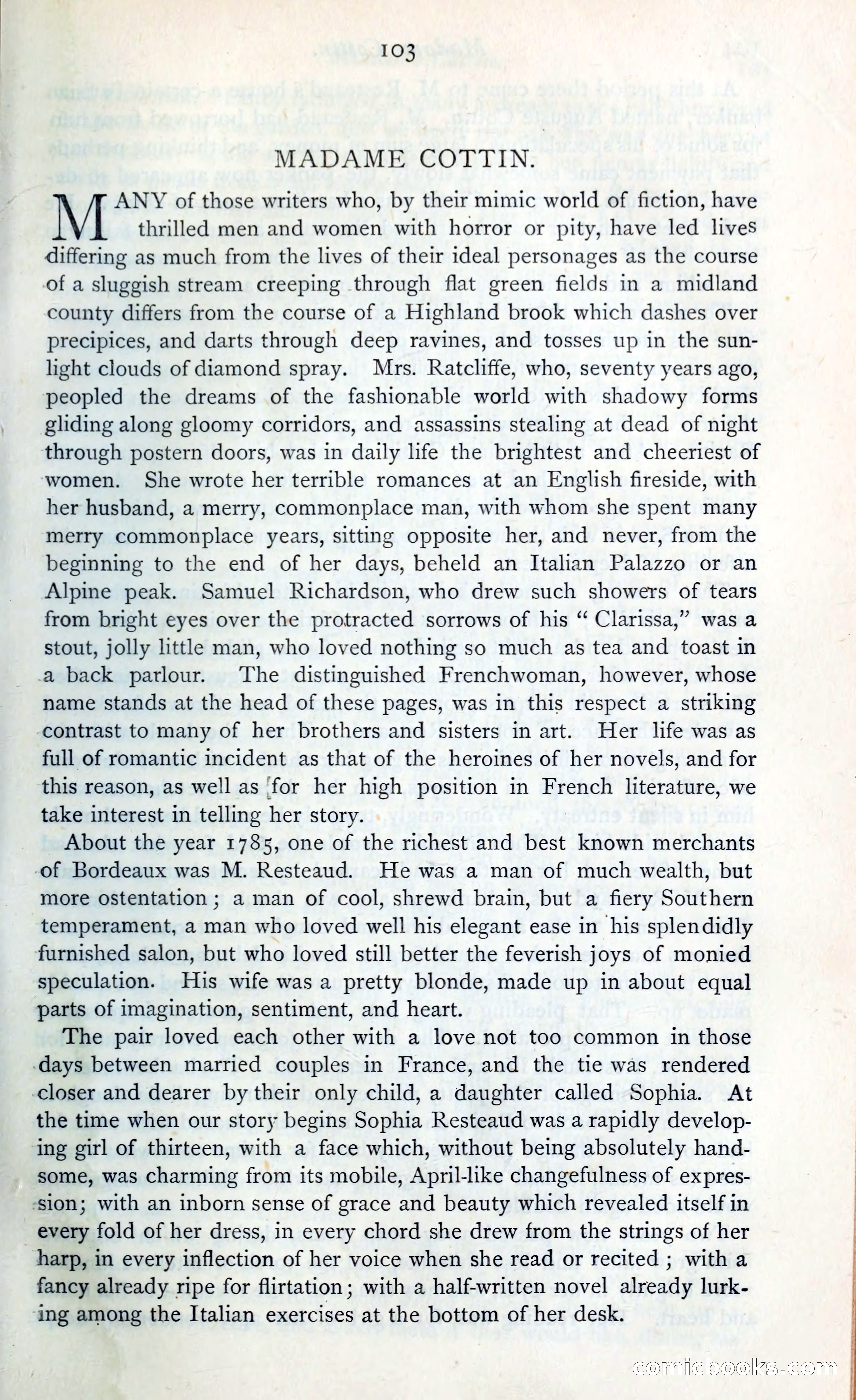
A restored page from Pulp Fiction, 1865. Page through the whole issue in the reader above.
📄 Transcribed text from this page (OCR, searchable)
Machine-transcribed from the original scan — historical spelling and the odd misread are preserved.
103 MADAME COTTIN. ANY of those writers who, by their mimic world of fiction, have M thrilled men and women with horror or pity, have led lives differing as much from the lives of their ideal personages as the course of a sluggish stream creeping through flat green fields in a midland county differs from the course of a Highland brook which dashes over precipices, and darts through deep ravines, and tosses up in the sun- light clouds of diamond spray. Mrs. Ratcliffe, who, seventy years ago, peopled the dreams of the fashionable world with shadowy forms gliding along gloomy corridors, and assassins stealing at dead of night through postern doors, was in daily life the brightest and cheeriest of women. She wrote her terrible romances at an English fireside, with her husband, a merry, commonplace man, with whom she spent many merry commonplace years, sitting opposite her, and never, from the beginning to the end of her days, beheld an Italian Palazzo or an Alpine peak. Samuel Richardson, who drew such showers of tears from bright eyes over the protracted sorrows of his “ Clarissa,” was a stout, jolly little man, who loved nothing so much as tea and toast in a back parlour. The distinguished Frenchwoman, however, whose name stands at the head of these pages, was in this respect a striking contrast to many of her brothers and sisters in art. Her life was as full of romantic incident as that of the heroines of her novels, and for this reason, as well as for her high position in French literature, we take interest in telling her story. About the year 1785, one of the richest and best known merchants of Bordeaux was M. Resteaud. He was a man of much wealth, but more ostentation ; a man of cool, shrewd brain, but a fiery Southern temperament, a man who loved well his elegant ease in his splendidly furnished salon, but who loved still better the feverish joys of monied speculation. His wife was a pretty blonde, made up in about equal parts of imagination, sentiment, and heart. The pair loved each other with a love not too common in those days between married couples in France, and the tie was rendered closer and dearer by their only child, a daughter called Sophia. At the time when our story begins Sophia Resteaud was a rapidly develop- ‘ing girl of thirteen, with a face which, without being absolutely hand- some, was charming from its mobile, April-like changefulness of expres- ‘sion; with an inborn sense of grace and beauty which revealed itself in _ every fold of her dress, in every chord she drew from the strings of her sharp, in every inflection of her voice when she read or recited ; with a fancy already ripe for flirtation; with a half-written novel already lurk- ing among the Italian exercises at the bottom of her desk. COnnIIClOO <S (©) im