
Pulp Fiction, 1865 · page 74 of 400
The Argosy — page 74: what you’re looking at
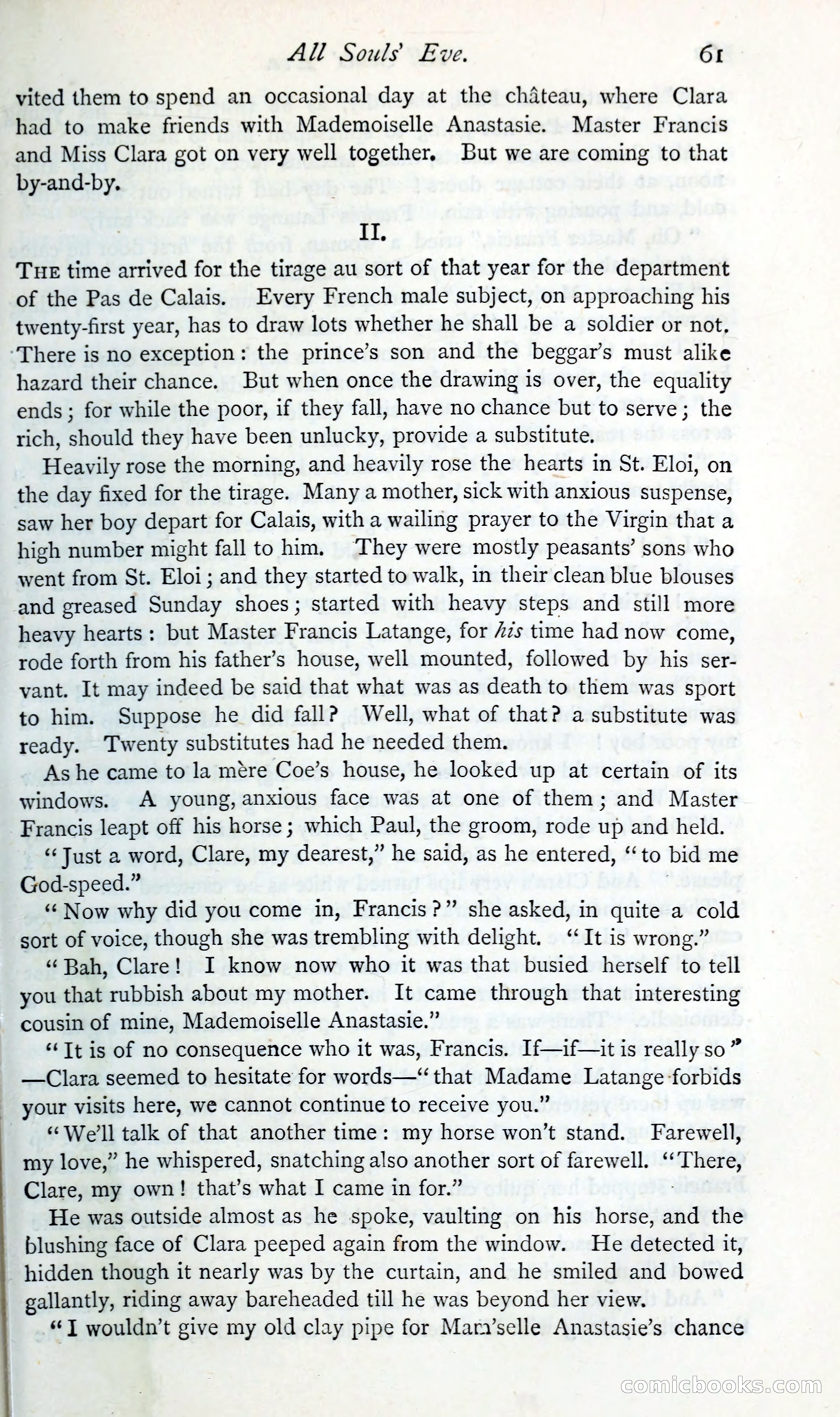
A restored page from Pulp Fiction, 1865. Page through the whole issue in the reader above.
📄 Transcribed text from this page (OCR, searchable)
Machine-transcribed from the original scan — historical spelling and the odd misread are preserved.
All Souls Eve. 6. vited them to spend an occasional day at the chateau, where Clara had to make friends with Mademoiselle Anastasie. Master Francis and Miss Clara got on very well together. But we are coming to that by-and-by. IT, Tue time arrived for the tirage au sort of that year for the department of the Pas de Calais. Every French male subject, on approaching his twenty-first year, has to draw lots whether he shall be a soldier or not. ‘There is no exception: the prince’s son and the beggar’s must alike hazard their chance. But when once the drawing is over, the equality ends ; for while the poor, if they fall, have no chance but to serve; the rich, should they have been unlucky, provide a substitute. Heavily rose the morning, and heavily rose the hearts in St. Eloi, on the day fixed for the tirage. Many a mother, sick with anxious suspense, saw her boy depart for Calais, with a wailing prayer to the Virgin that a high number might fall to him, They were mostly peasants’ sons who went from St. Eloi; and they started to walk, in their clean blue blouses and greased Sunday shoes; started with heavy steps and still more heavy hearts: but Master Francis Latange, for 4zs time had now come, rode forth from his father’s house, well mounted, followed by his ser- vant. It may indeed be said that what was as death to them was sport to him. Suppose he did fall? Well, what of that? a substitute was ready. Twenty substitutes had he needed them. As he came to la mére Coe’s house, he looked up at certain of its windows. A young,anxious face was at one of them; and Master Francis leapt off his horse; which Paul, the groom, rode up and held. ‘Just a word, Clare, my dearest,” he said, as he entered, “to bid me God-speed.” ‘¢ Now why did you come in, Francis?” she asked, in quite a cold sort of voice, though she was trembling with delight. ‘“‘It is wrong.” “ Bah, Clare! I know now who it was that busied herself to tell you that rubbish about my mother. It came through that interesting cousin of mine, Mademoiselle Anastasie.” ‘¢Tt is of no consequence who it was, Francis. If—if—it is really so” —Clara seemed to hesitate for words—“ that panei Latange forbids your visits here, we cannot continue to receive you.” “We'll talk of that another time: my horse won’t stand. Farewell, my love,” he whispered, snatching also another sort of farewell. “There, Clare, my own! that’s what I came in for.” He was outside almost as he spoke, vaulting on his horse, and the blushing face of Clara peeped again from the window. He detected it, hidden though it nearly was by the curtain, and he smiled and bowed gallantly, riding away bareheaded till he was beyond her view. “T wouldn’t give my old clay pipe for Mam’selle Anastasie’s chance CORIELOO© am