
Pulp Fiction, 1865 · page 70 of 400
The Argosy — page 70: what you’re looking at
A restored page from Pulp Fiction, 1865. Page through the whole issue in the reader above.
📄 Transcribed text from this page (OCR, searchable)
Machine-transcribed from the original scan — historical spelling and the odd misread are preserved.
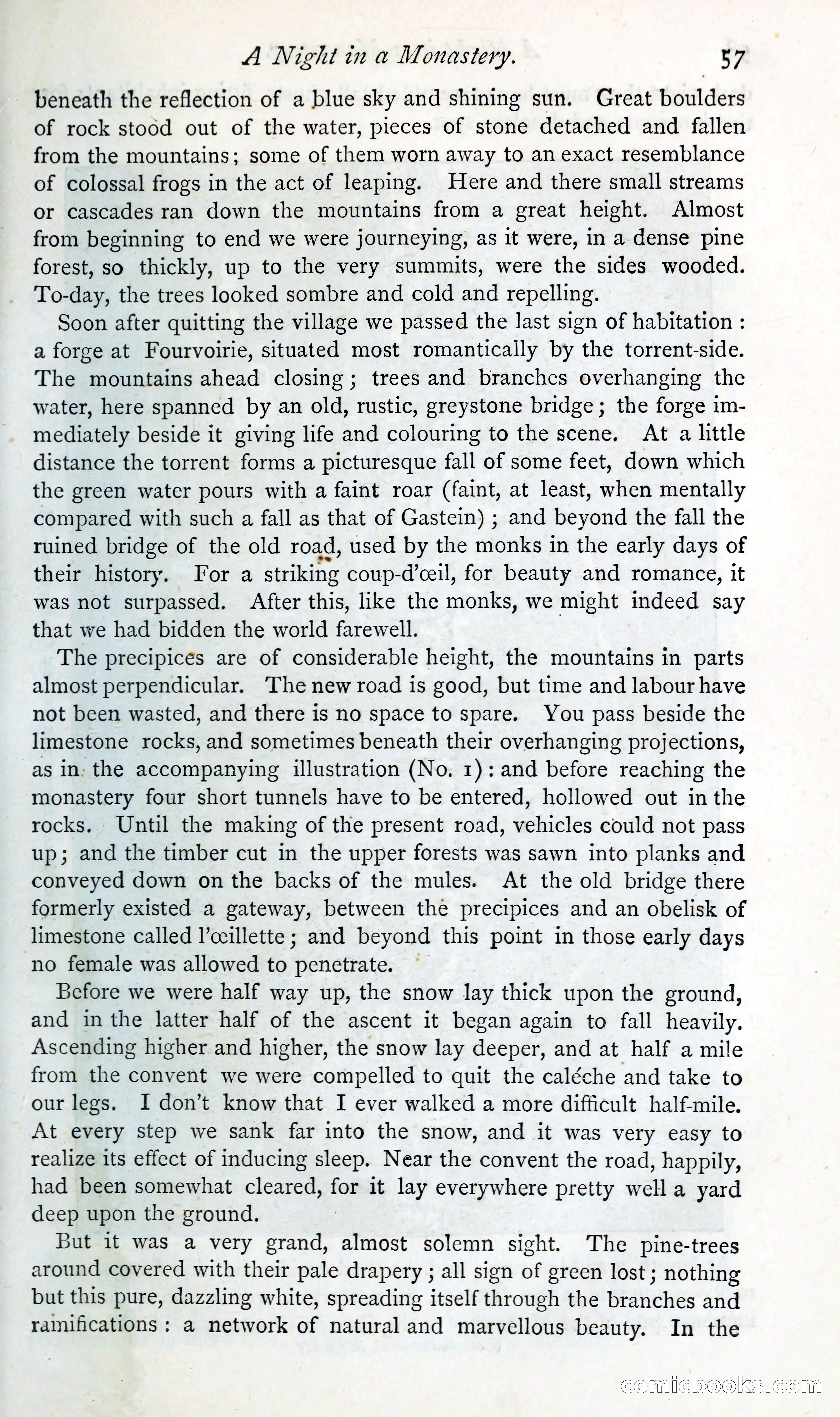
A Night in a Monastery. b7 beneath the reflection of a blue sky and shining sun. Great boulders of rock stood out of the water, pieces of stone detached and fallen from the mountains; some of them worn away to an exact resemblance of colossal frogs in the act of leaping. Here and there small streams or cascades ran down the mountains from a great height. Almost from beginning to end we were journeying, as it were, in a dense pine forest, so thickly, up to the very summits, were the sides wooded. To-day, the trees looked sombre and cold and repelling. Soon after quitting the village we passed the last sign of habitation : a forge at Fourvoirie, situated most romantically by the torrent-side. The mountains ahead closing; trees and branches overhanging the water, here spanned by an old, rustic, greystone bridge; the forge im- mediately beside it giving life and colouring to the scene. At a little distance the torrent forms a picturesque fall of some feet, down which the green water pours with a faint roar (faint, at least, when mentally compared with such a fall as that of Gastein) ; and beyond the fall the ruined bridge of the old road, used by the monks in the early days of their history. For a striking coup-d’ceil, for beauty and romance, it was not surpassed. After this, like the monks, we might indeed say that we had bidden the world farewell. The precipicés are of considerable height, the mountains in parts almost perpendicular. The new road is good, but time and labour have not been wasted, and there is no space to spare. You pass beside the limestone rocks, and sometimes beneath their overhanging projections, as in. the accompanying illustration (No. 1): and before reaching the monastery four short tunnels have to be entered, hollowed out in the rocks. Until the making of the present road, vehicles could not pass up; and the timber cut in the upper forests was sawn into planks and conveyed down on the backs of the mules. At the old bridge there formerly existed a gateway, between the precipices and an obelisk of limestone called l’ceillette ; and beyond this point in those early days no female was allowed to penetrate. ~ Before we were half way up, the snow lay thick upon the ground, and in the latter half of the ascent it began again to fall heavily. Ascending higher and higher, the snow lay deeper, and at half a mile from the convent we were compelled to quit the caléche and take to our legs. I don’t know that I ever walked a more difficult half-mile. At every step we sank far into the snow, and it was very easy to realize its effect of inducing sleep. Near the convent the road, happily, had been somewhat cleared, for it lay everywhere pretty well a yard deep upon the ground. But it was a very ae almost solemn sight. The pine-trees around covered with their pale drapery ; all sign of green lost ; nothing but this pure, dazzling white, spreading itself through the Reabches and ramifications : a network of natural and marvellous beauty. In the COmiclooolkKks (C(O) an =)