
Pulp Fiction, 1865 · page 58 of 400
The Argosy — page 58: what you’re looking at
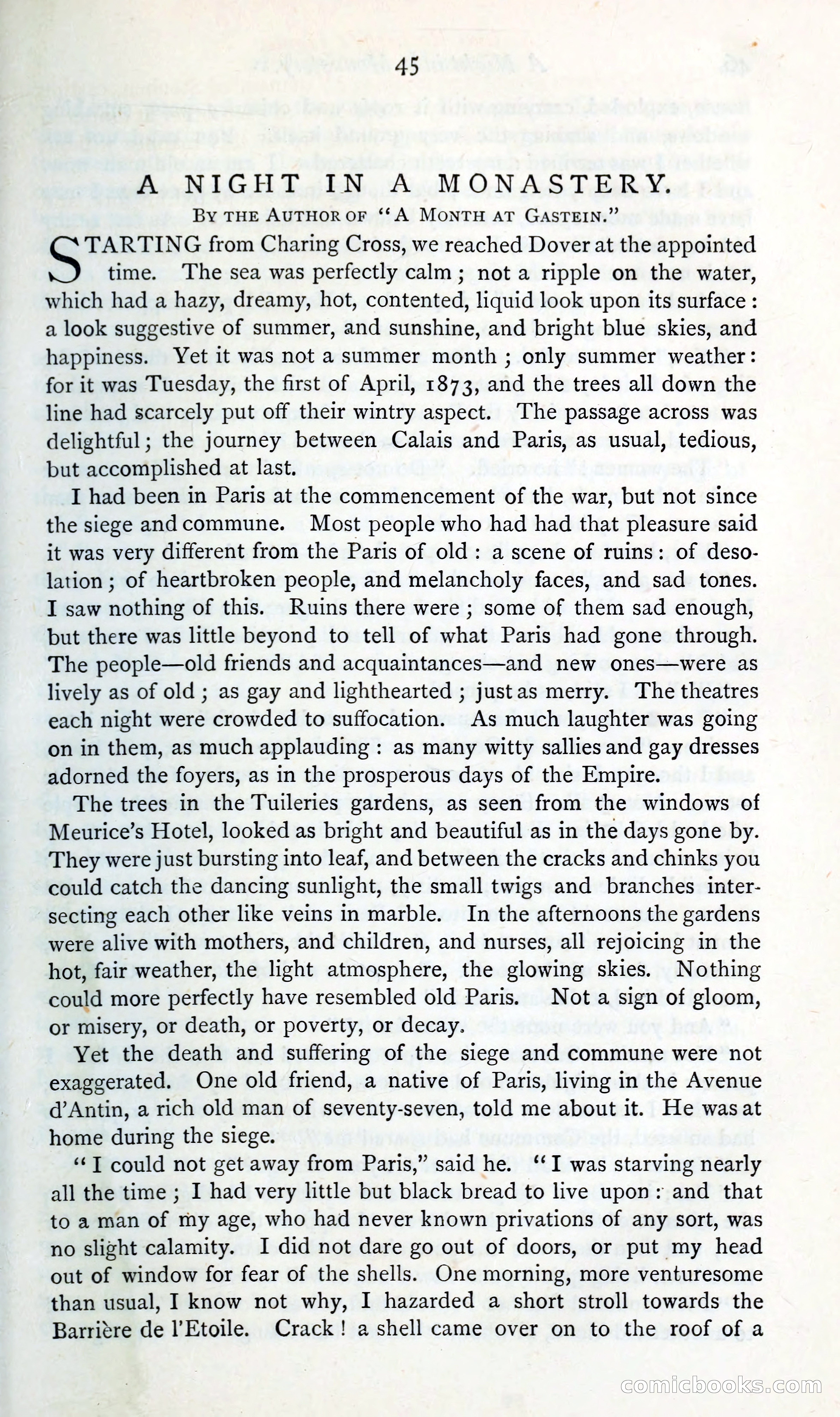
A restored page from Pulp Fiction, 1865. Page through the whole issue in the reader above.
📄 Transcribed text from this page (OCR, searchable)
Machine-transcribed from the original scan — historical spelling and the odd misread are preserved.
45 A NIGHT IN A MONASTERY. By THE AUTHOR OF ‘fA MONTH AT GASTEIN.” TARTING from Charing Cross, we reached Dover at the appointed time. ‘The sea was perfectly calm; nota ripple on the water, which had a hazy, dreamy, hot, contented, liquid look upon its surface : a look suggestive of summer, and sunshine, and bright blue skies, and happiness. Yet it was not asummer month ; only summer weather: for it was Tuesday, the first of April, 1873, and the trees all down the line had scarcely put off their wintry aspect. ‘The passage across was delightful ; the journey between Calais and Paris, as usual, tedious, but accomplished at last. I had been in Paris at the commencement of the war, but not since the siege andcommune. Most people who had had that pleasure said it was very different from the Paris of old: a scene of ruins: of deso- lation; of heartbroken people, and melancholy faces, and sad tones. I saw nothing of this. Ruins there were ; some of them sad enough, but there was little beyond to tell of what Paris had gone through. The people—old friends and acquaintances—and new ones—were as lively as of old ; as gay and lighthearted ; justas merry. The theatres each night were crowded to suffocation. As much laughter was going on in them, as much applauding: as many witty sallies and gay dresses adorned the foyers, as in the prosperous days of the Empire. The trees in the Tuileries gardens, as seen from the windows of Meurice’s Hotel, looked as bright and beautiful as in the days gone by. They were just bursting into leaf, and between the cracks and chinks you could catch the dancing sunlight, the small twigs and branches inter- secting each other like veins in marble. In the afternoons the gardens were alive with mothers, and children, and nurses, all rejoicing in the hot, fair weather, the light atmosphere, the glowing skies. Nothing could more perfectly have resembled old Paris. Not a sign of gloom, or misery, or death, or poverty, or decay. Yet the death and suffering of the siege and commune were not exaggerated. One old friend, a native of Paris, living in the Avenue d’Antin, a rich old man of seventy-seven, told me about it. He wasat home during the siege. ‘¢T could not get away from Paris,” said he. ‘‘I was starving nearly all the time ; I had very little but black bread to live upon: and that to a man of my age, who had never known privations of any sort, was no slight calamity. I did not dare go out of doors, or put my head out of window for fear of the shells. One morning, more venturesome than usual, I know not why, I hazarded a short stroll towards the Barriére de l’Etoile. Crack! a shell came over on to the roof of a CoOnmmiclbooolkKks (SO) am =>)