
Pulp Fiction, 1865 · page 53 of 400
The Argosy — page 53: what you’re looking at
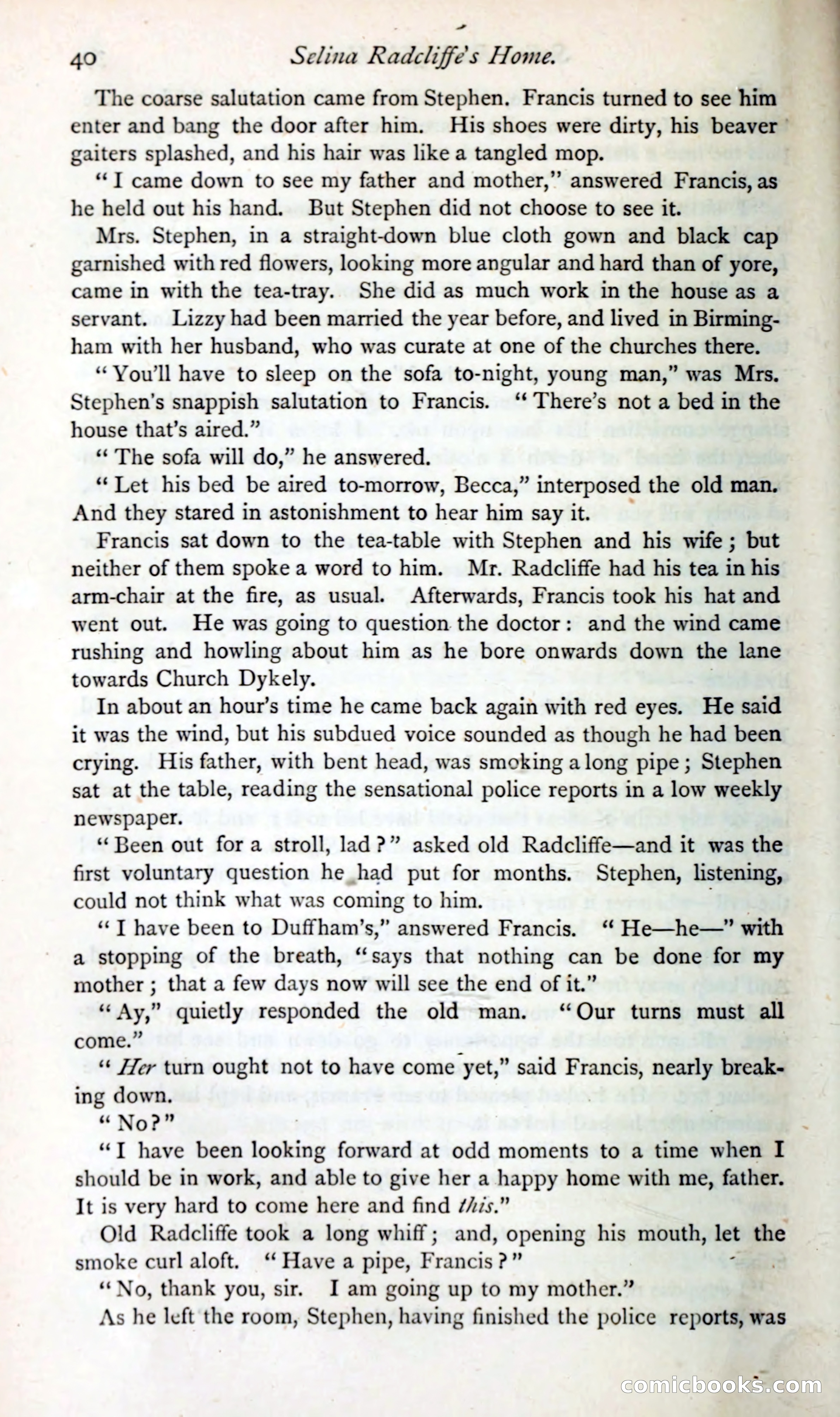
A restored page from Pulp Fiction, 1865. Page through the whole issue in the reader above.
📄 Transcribed text from this page (OCR, searchable)
Machine-transcribed from the original scan — historical spelling and the odd misread are preserved.
- 40 Selina Radcliffe’s Home. The coarse salutation came from Stephen. Francis turned to see him > enter and bang the door after him. His shoes were dirty, his beaver ” gaiters splashed, and his hair was like a tangled mop. “T came down to see my father and mother,” answered Francis, as he held out his hand. But Stephen did not choose to see it. Mrs. Stephen, in a straight-down blue cloth gown and black cap garnished with red flowers, looking more angular and hard than of yore, came in with the tea-tray. She did as much work in the house as a servant. Lizzy had been married the year before, and lived in Birming- ham with her husband, who was curate at one of the churches there. ‘You'll have to sleep on the sofa to-night, young man,” was Mrs. Stephen's snappish salutation to Francis. ‘‘ There’s not a bed in the house that’s aired.” “The sofa will do,” he answered. “Let his bed be aired to-morrow, Becca,” interposed the old man. And they stared in astonishment to hear him say it. Francis sat down to the tea-table with Stephen and his wife ; but neither of them spoke a word to him. Mr. Radcliffe had his tea in his arm-chair at the fire, as usual. Afterwards, Francis took his hat and went out. He was going to question the doctor: and the wind came rushing and howling about him as he bore onwards down the lane towards Church Dykely. In about an hour’s time he came back again with red eyes. He said it was the wind, but his subdued voice sounded as though he had been crying. His father, with bent head, was smoking along pipe; Stephen sat at the table, reading the sensational police reports in a low weekly newspaper. “Been out fora stroll, lad?” asked old Radcliffe—and it was the first voluntary question he had put for months. Stephen, listening, could not think what was coming to him. TAA ‘‘T have been to Duffham’s,” answered Francis. ‘‘ He—he—” with a stopping of the breath, “ an that nothing can be done for my mother ; that a few days now will see the end of it.” “Ay,” quietly responded the old man. “Our turns must all come.” : ‘“« [Ter turn ought not to have come yet,” said Francis, nearly break- ing down. “ Nor “T have been eS forward at odd moments to a time when I should be in work, and able to give her a happy home with me, father. It is very hard to come here and find //zs.” Old Radcliffe took a long whiff; and, opening his mouth, at the smoke curl aloft. ‘“‘ Havea pipe, F rancis ?” ‘No, thank you, sir. I am going up to my mother.” As he left the room, Stephen, having finished the police reports, was EoOmichbooks.co m