
Pulp Fiction, 1865 · page 46 of 400
The Argosy — page 46: what you’re looking at
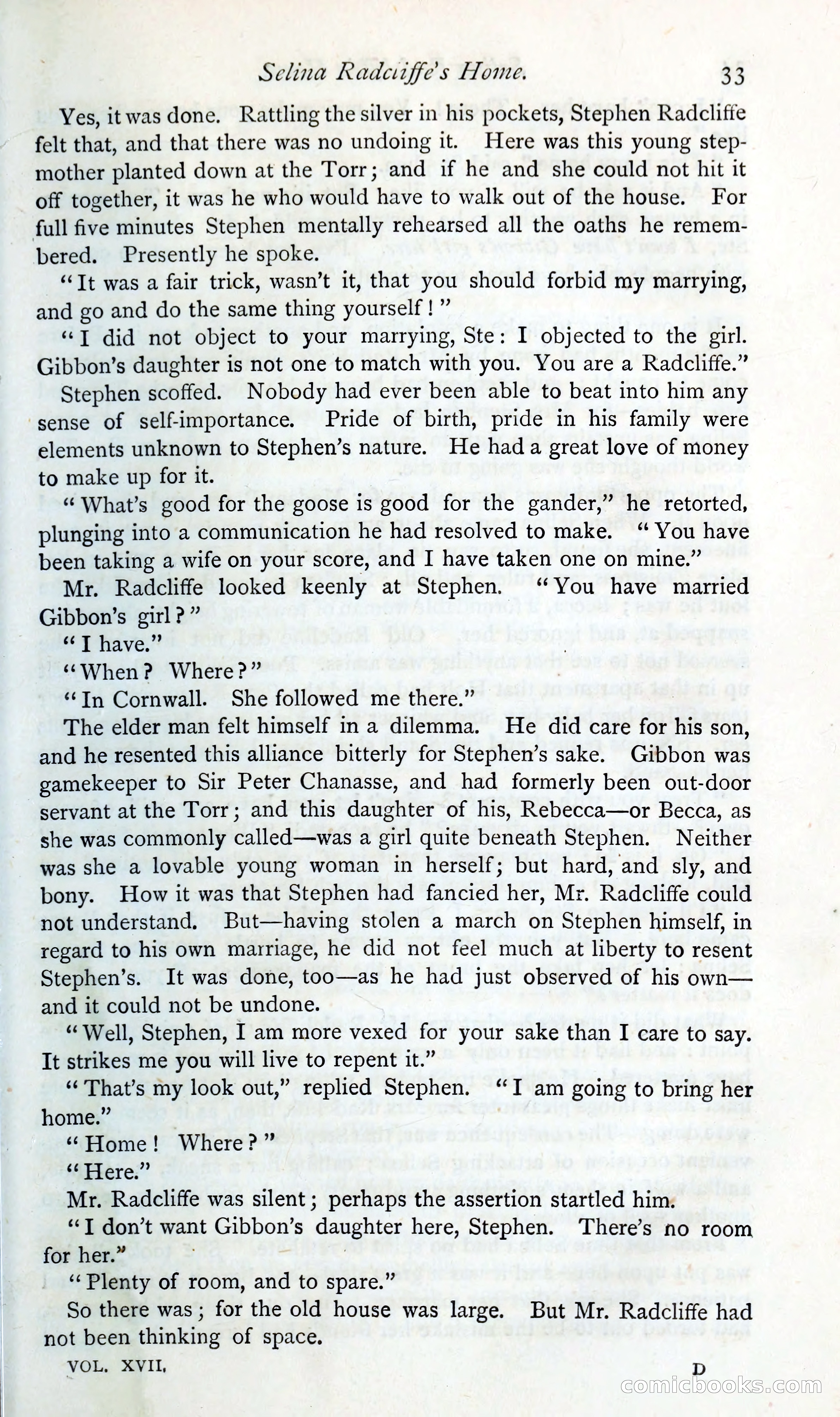
A restored page from Pulp Fiction, 1865. Page through the whole issue in the reader above.
📄 Transcribed text from this page (OCR, searchable)
Machine-transcribed from the original scan — historical spelling and the odd misread are preserved.
Selina Radcatffe's Home. 33 Yes, itwas done. Rattling the silver in his pockets, Stephen Radclifie felt that, and that there was no undoing it. Here was this young step- mother planted down at the Torr; and if he and she could not hit it off together, it was he who would have to walk out of the house. For full five minutes Stephen mentally rehearsed all the oaths he remem- bered. Presently he spoke. “Tt was a fair trick, wasn’t it, that you should forbid my marrying, and go and do the same thing yourself!” “T did not object to your marrying, Ste: I objected to the girl. Gibbon’s daughter is not one to match with you. You are a Radcliffe.” Stephen scoffed. Nobody had ever been able to beat into him any ‘sense of self-importance. Pride of birth, pride in his family were elements unknown to Stephen’s nature. He hada great love of money to make up for it. “ What’s good for the goose is good for the gander,” he retorted, plunging into a communication he had resolved to make. “You have been taking a wife on your score, and I have taken one on mine.” Mr. Radcliffe looked keenly at Stephen. ‘You have married Gibbon’s girl?” *' rave.” ‘When? Where?” ‘In Cornwall. She followed me there.” The elder man felt himself ina dilemma. He did care for his son, and he resented this alliance bitterly for Stephen’s sake. Gibbon was gamekeeper to Sir Peter Chanasse, and had formerly been out-door servant at the Torr; and this daughter of his, Rebecca—or Becca, as she was commonly called—was a girl quite beneath Stephen. Neither was she a lovable young woman in herself; but hard, and sly, and bony. How it was that Stephen had fancied her, Mr. Radcliffe could not understand. But—having stolen a march on Stephen himself, in regard to his own marriage, he did not feel much at liberty to resent Stephen’s. It was done, too—as he had just observed of his own— and it could not be undone. “Well, Stephen, I am more vexed for your sake than I care to say. It strikes me you will live to repent it.” ‘‘That’s my look out,” replied Stephen. “I am going to bring her home.” ‘Home! Where?” ‘éFiere:” Mr. Radcliffe was silent; perhaps the assertion startled him. ‘‘T don’t want Gibbon’s daughter here, Stephen. ‘There’s no room for her.” : | ‘Plenty of room, and to spare.” So there was ; for the old house was large. But Mr. Radcliffe had not been thinking of space. VOL, XVII, D COnnicloookks (CO)