
Pulp Fiction, 1865 · page 39 of 400
The Argosy — page 39: what you’re looking at
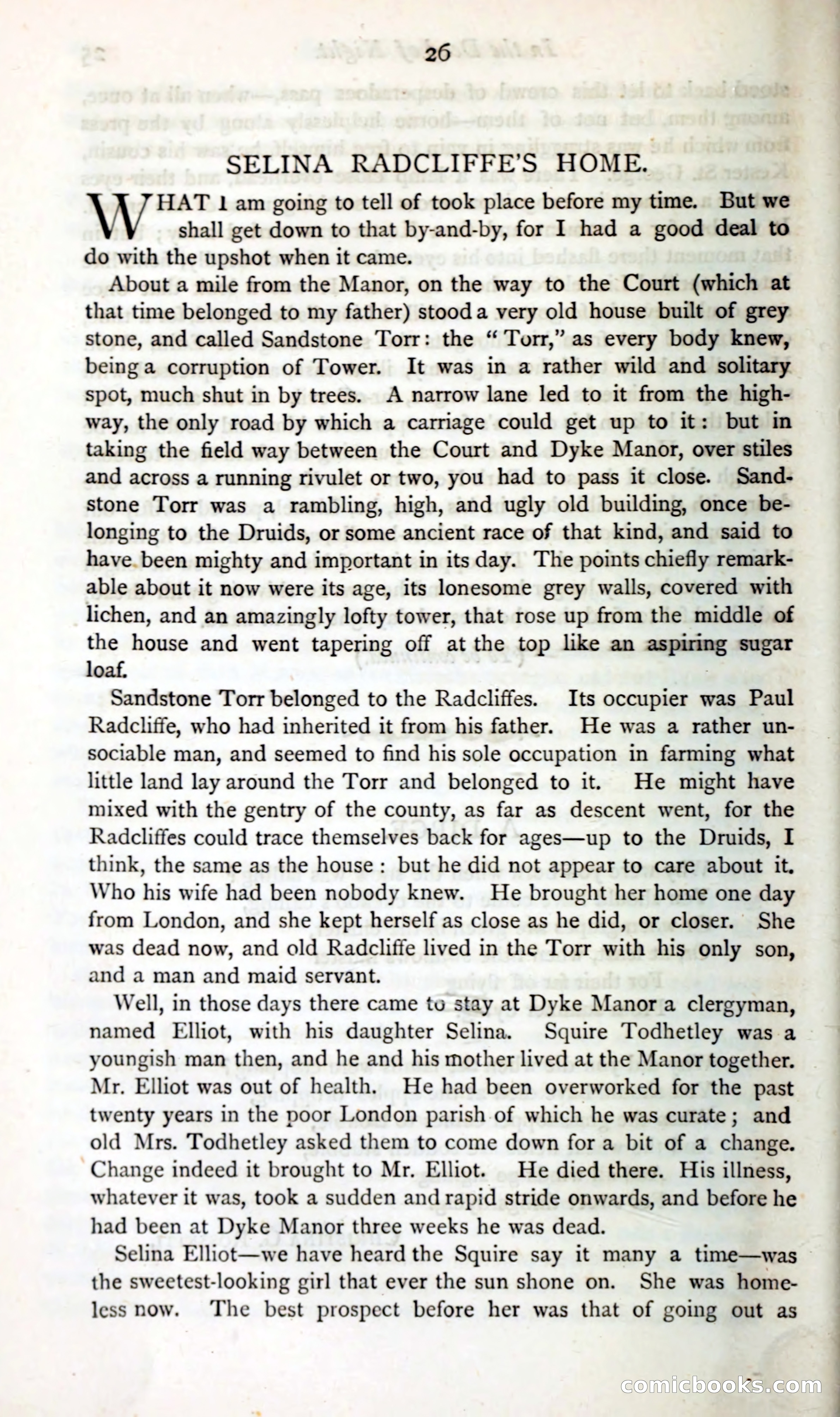
A restored page from Pulp Fiction, 1865. Page through the whole issue in the reader above.
📄 Transcribed text from this page (OCR, searchable)
Machine-transcribed from the original scan — historical spelling and the odd misread are preserved.
26 SELINA RADCLIFFE’S HOME. HAT 1 am going to tell of took place before my time. But we shall get down to that by-and-by, for I had a good deal to do with the upshot when it came. About a mile from the Manor, on the way to the Court (which at that time belonged to my father) stooda very old house built of grey stone, and called Sandstone Torr: the “ Torr,” as every body knew, being a corruption of Tower. It was in a rather wild and solitary spot, much shut in by trees. A narrow lane led to it from the high- way, the only road by which a carriage could get up to it: but in taking the field way between the Court and Dyke Manor, over stiles and across a running rivulet or two, you had to pass it close. Sand- stone Torr was a rambling, high, and ugly old building, once be- longing to the Druids, or some ancient race of that kind, and said to have. been mighty and important in its day. The points chiefly remark- able about it now were its age, its lonesome grey walls, covered with lichen, and an amazingly lofty tower, that rose up from the middle of the house and went tapering off at the top like an aspiring sugar loaf. : Sandstone Torr belonged to the Radcliffes. Its occupier was Paul Radcliffe, who had inherited it from his father. He was a rather un- sociable man, and seemed to find his sole occupation in farming what little land lay around the Torr and belonged to it. He might have mixed with the gentry of the county, as far as descent went, for the Radcliffes could trace themselves back for ages—up to the Druids, I think, the same as the house: but he did not appear to care about it. Who his wife had been nobody knew. He brought her home one day from London, and she kept herself as close as he did, or closer. She was dead now, and old Radcliffe lived in the Torr with his only son, and a man and maid servant. Well, in those days there came tu stay at Dyke Manor a clergyman, named Elliot, with his daughter Selina. Squire Todhetley was a youngish man then, and he and his mother lived at the Manor together. Mr. Elliot was out of health. He had been overworked for the past twenty years in the poor London parish of which he was curate; and old Mrs. Todhetley asked them to come down for a bit of a change. Change indeed it brought to Mr. Elliot. He died there. His illness, whatever it was, took a sudden and rapid stride onwards, and before he had been at Dyke Manor three weeks he was dead. Selina Elliot—we have heard the Squire say it many a time—was the sweetest-looking girl that ever the sun shone on. She was home- less now. ‘The best prospect before her was that of going out as GOmicbdooks.co