
Pulp Fiction, 1865 · page 37 of 400
The Argosy — page 37: what you’re looking at
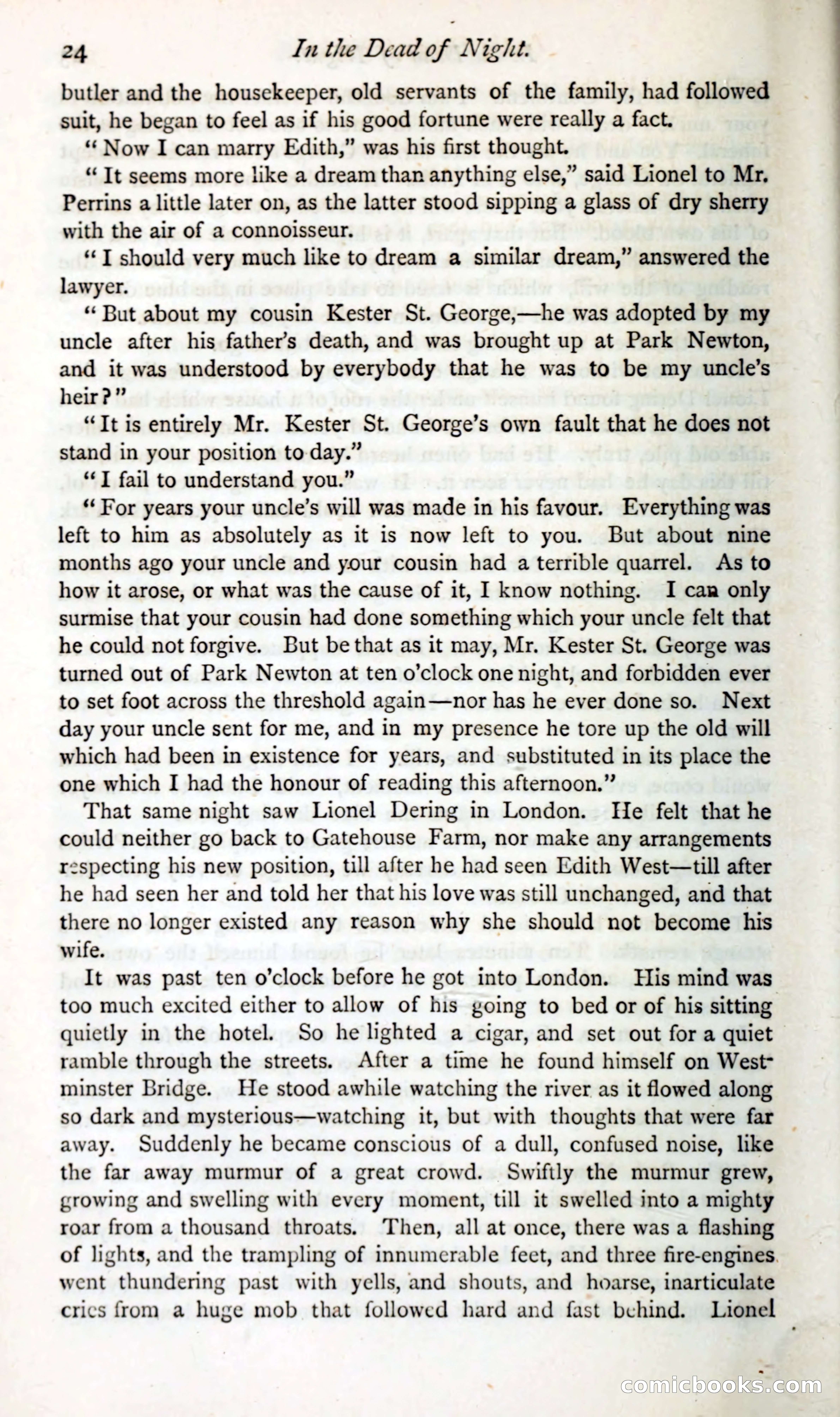
A restored page from Pulp Fiction, 1865. Page through the whole issue in the reader above.
📄 Transcribed text from this page (OCR, searchable)
Machine-transcribed from the original scan — historical spelling and the odd misread are preserved.
24 In the Dead of Night. butler and the housekeeper, old servants of the family, had followed suit, he began to feel as if his good fortune were really a fact. “ Now I can marry Edith,” was his first thought. “ It seems more like a dream than anything else,” said Lionel to Mr, Perrins a little later on, as the latter stood sipping a glass of dry sherry with the air of a connoisseur. | ‘“‘T should very much like to dream a similar dream,” answered the lawyer. “ But about my cousin Kester St. George,—he was adopted by my uncle after his father’s death, and was brought up at Park Newton, and it was understood by everybody that he was to be my uncle’s heir?” “Tt is entirely Mr. Kester St. George’s own fault that he does not stand in your position to day.” ‘I fail to understand you.” “For years your uncle’s will was made in his favour. Everything was left to him as absolutely as it is now left to you. But about nine months ago your uncle and your cousin had a terrible quarrel. As to how it arose, or what was the cause of it, I know nothing. I car only surmise that your cousin had done something which your uncle felt that he could not forgive. But be that as it may, Mr. Kester St. George was turned out of Park Newton at ten o’clock one night, and forbidden ever to set foot across the threshold again—nor has he ever done so. Next day your uncle sent for me, and in my presence he tore up the old will which had been in existence for years, and substituted in its place the one which I had the honour of reading this afternoon.” That same night saw Lionel Dering in London. He felt that he could neither go back to Gatehouse Farm, nor make any arrangements respecting his new position, till after he had seen Edith West—till after he had seen her and told her that his love was still unchanged, and that there no longer existed any reason why she should not become his wife. It was past ten o’clock before he got into London. His mind was too much excited either to allow of his going to bed or of his sitting quietly in the hotel. So he lighted a cigar, and set out for a quiet ramble through the streets. After a time he found himself on West- minster Bridge. He stood awhile watching the river as it flowed along so dark and mysterious—watching it, but with thoughts that were far — away. Suddenly he became conscious of a dull, confused noise, like the far away murmur of a great crowd. Swiftly the murmur grew, growing and swelling with every moment, till it swelled into a mighty roar from a thousand throats. ‘Then, all at once, there was a flashing of lights, and the trampling of innumerable feet, and three fire-engines. went thundering past with yells, and shouts, and hoarse, inarticulate crics from a huge mob that followed hard and fast behind. Lionel ECORNIELIOW <Saeeyin)