
Pulp Fiction, 1865 · page 35 of 400
The Argosy — page 35: what you’re looking at
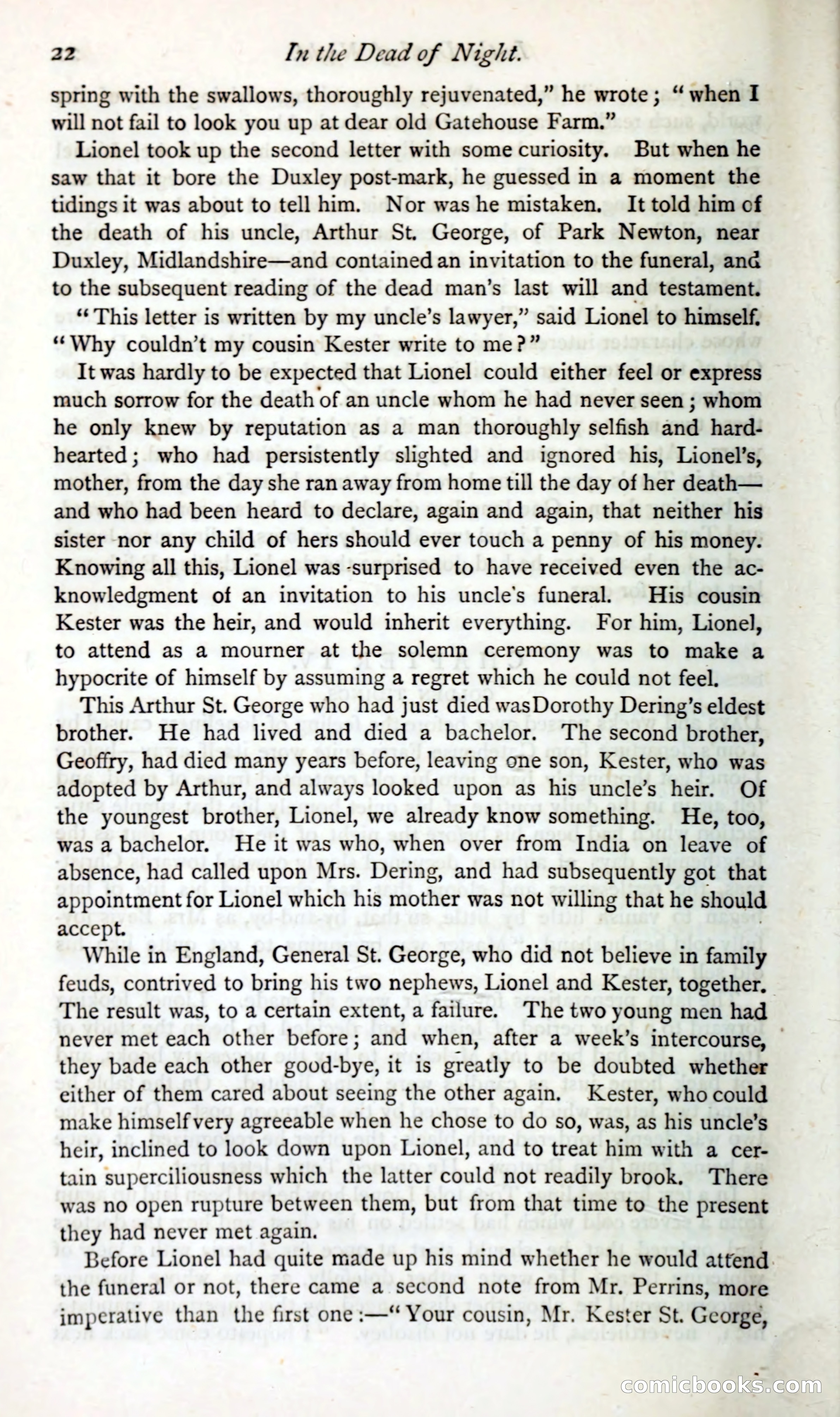
A restored page from Pulp Fiction, 1865. Page through the whole issue in the reader above.
📄 Transcribed text from this page (OCR, searchable)
Machine-transcribed from the original scan — historical spelling and the odd misread are preserved.
22 In the Dead of Night. spring with the swallows, thoroughly rejuvenated,” he wrote; “when I will not fail to look you up at dear old Gatehouse Farm.” Lionel took up the second letter with some curiosity. But when he saw that it bore the Duxley post-mark, he guessed in a moment the tidings it was about to tell him. Nor washe mistaken, It told him of the death of his uncle, Arthur St. George, of Park Newton, near Duxley, Midlandshire—and contained an invitation to the funeral, ana to the subsequent reading of the dead man’s last will and testament. “‘ This letter is written by my uncle’s lawyer,” said Lionel to himself, ‘Why couldn’t my cousin Kester write to me?” It was hardly to be expected that Lionel could either feel or express much sorrow for the death of an uncle whom he had never seen ; whom he only knew by reputation as a man thoroughly selfish and hard- hearted; who had persistently slighted and ignored his, Lionel’s, mother, from the day she ran away from home till the day of her death— and who had been heard to declare, again and again, that neither his sister nor any child of hers should ever touch a penny of his money. Knowing all this, Lionel was -surprised to have received even the ac- knowledgment of an invitation to his uncle’s funeral. His cousin Kester was the heir, and would inherit everything. For him, Lionel, to attend as a mourner at the solemn ceremony was to make a hypocrite of himself by assuming a regret which he could not feel. This Arthur St. George who had just died was Dorothy Dering’s eldest brother. He had lived and died a bachelor. The second brother, Geoffry, had died many years before, leaving one son, Kester, who was adopted by Arthur, and always looked upon as his uncle’s heir. Of the youngest brother, Lionel, we already know something. He, too, was a bachelor. He it was who, when over from India on leave of absence, had called upon Mrs. Dering, and had subsequently got that appointment for Lionel which his mother was not willing that he should accept. : While in England, General St. George, who did not believe in family feuds, contrived to bring his two nephews, Lionel and Kester, together, The result was, to a certain extent, a failure. The two young men had never met each other before; and when, after a week’s intercourse, — they bade each other good-bye, it is greatly to be doubted whether either of them cared about seeing the other again. Kester, who could make himself very agreeable when he chose to do so, was, as his uncle’s heir, inclined to look down upon Lionel, and to treat him with a cer- tain superciliousness which the latter could not readily brook. There was no open rupture between them, but from that time to the present they had never met again. Before Lionel had quite made up his mind whether he would attend. the funeral or not, there came a second note from Mr. Perrins, more imperative than the first one :—“ Your cousin, Mr. Kester St. George, CoOmiGoooks (E(0) m