
Pulp Fiction, 1865 · page 322 of 400
The Argosy — page 322: what you’re looking at
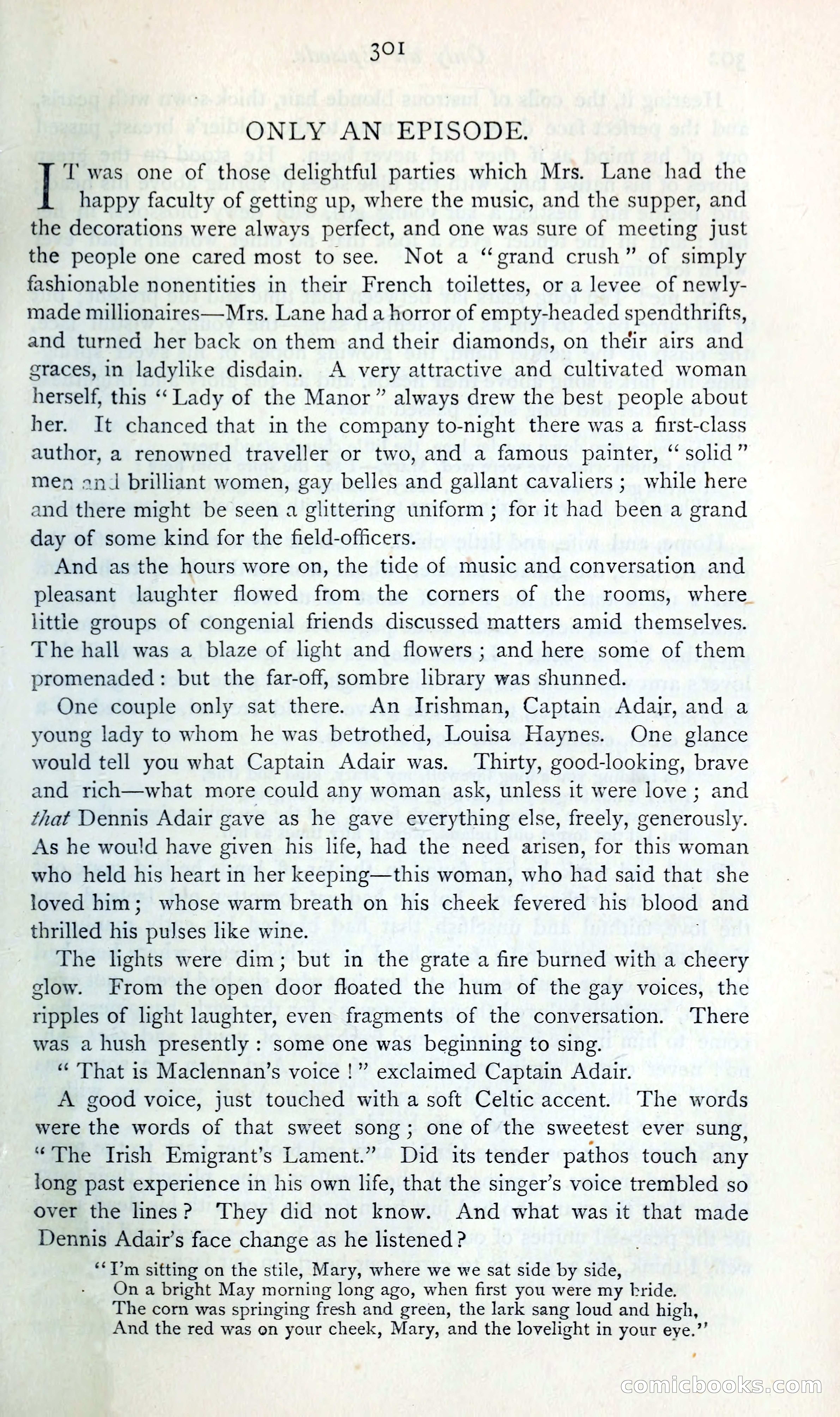
A restored page from Pulp Fiction, 1865. Page through the whole issue in the reader above.
📄 Transcribed text from this page (OCR, searchable)
Machine-transcribed from the original scan — historical spelling and the odd misread are preserved.
301 ONLY AN EPISODE. T was one of those delightful parties which Mrs. Lane had the happy faculty of getting up, where the music, and the supper, and the decorations were always perfect, and one was sure of meeting just the people one cared most to see. Not a “grand crush” of simply fashionable nonentities in their French toilettes, or a levee of newly- made millionaires—Mrs. Lane had a horror of empty-headed spendthrifts, and turned her back on them and their diamonds, on their airs and graces, in ladylike disdain. A very attractive and cultivated woman herself, this ‘‘ Lady of the Manor” always drew the best people about her. It chanced that in the company to-night there was a first-class author, a renowned traveller or two, and a famous painter, “ solid” men ani brilliant women, gay belles and gallant cavaliers; while here and there might be seen a glittering uniform ; for it had bee a grand day of some kind for the field-officers. And as the hours wore on, the tide of music and conversation and pleasant laughter flowed from the corners of the rooms, where. littie groups of congenial friends discussed matters amid themselves. The hall was a blaze of light and flowers ; and here some of them promenaded: but the far-off, sombre hbrary was shunned. One couple only sat there. An Irshman, Captain Adair, and a young lady to whom he was betrothed, Louisa Haynes. One glance would tell you what Captain Adair was. ‘Thirty, good-looking, brave and rich—what more could any woman ask, unless it were love ; and that Dennis Adair gave as he gave everything else, freely, generously. As he would have given his life, had the need arisen, for this woman who held his heart in her keeping—this woman, who had said that she loved him; whose warm breath on his cheek fevered his blood and thrilled his pulses hike wine. The lights were dim; but in the grate a fire burned with a cheery glow. From the open door floated the hum of the gay voices, the ripples of light laughter, even fragments of the conversation. There was a hush presently : some one was beginning to sing. “That is Maclennan’s voice !” exclaimed Captain Adair. A good voice, just touched with a soft Celtic accent. The words were the words of that sweet song; one of the sweetest ever sung, “The Irish Emigrant’s Lament.” Did its tender pathos touch any long past experience in his own life, that the singer’s voice trembled so over the lines? They did not know. And what was it that made Dennis Adair’s face change as he listened? **1’m sifting on the stile, Mary, where we we sat side by side, On a bright May morning long ago, when first you were my bride. The corn was springing fresh and green, the lark sang loud and high, | And the red was on your cheek, Mary, and the lovelight in your eye.’ CoOnniclooolkks (S©) am