
Pulp Fiction, 1865 · page 317 of 400
The Argosy — page 317: what you’re looking at
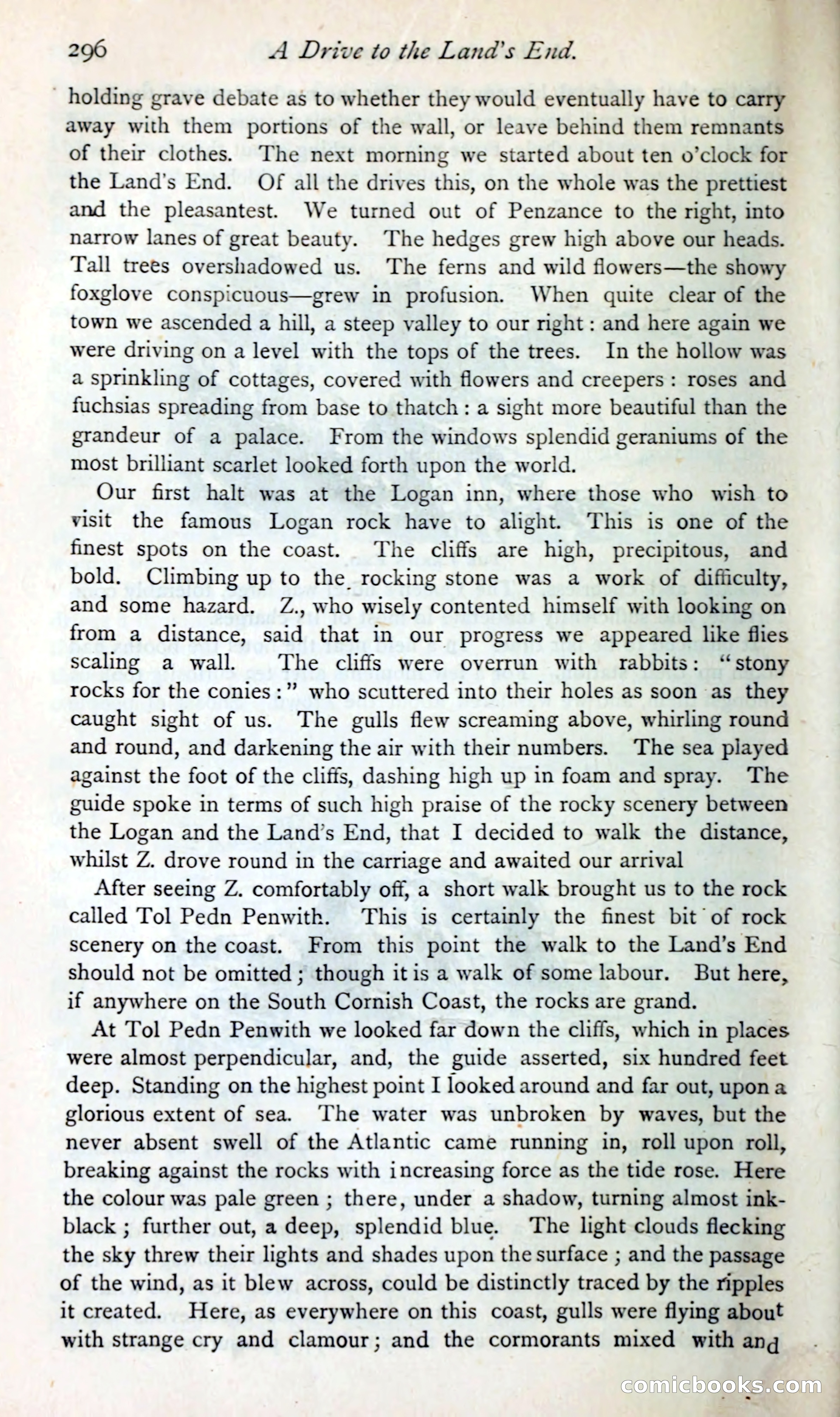
A restored page from Pulp Fiction, 1865. Page through the whole issue in the reader above.
📄 Transcribed text from this page (OCR, searchable)
Machine-transcribed from the original scan — historical spelling and the odd misread are preserved.
290 A Drive to the Lana’s End. holding grave debate as to whether they would eventually have to carry away with them portions of the wall, or leave behind them remnants of their clothes. The next morning we started about ten o’clock for the Land’s End. Of all the drives this, on the whole was the prettiest and the pleasantest. We turned out of Penzance to the right, into narrow lanes of great beauty. The hedges grew high above our heads. Tall trees overshadowed us. ‘The ferns and wild flowers—the showy foxglove conspicuous—grew in profusion. When quite clear of the town we ascended a hill, a steep valley to our right : and here again we were driving on a level with the tops of the trees. In the hollow was a sprinkling of cottages, covered with flowers and creepers: roses and fuchsias spreading from base to thatch: a sight more beautiful than the grandeur of a palace. From the windows splendid geraniums of the most brilliant scarlet looked forth upon the world. Our first halt was at the Logan inn, where those who wish to visit the famous Logan rock have to alight. This is one of the finest spots on the coast. The cliffs are high, precipitous, and bold. Climbing up to the rocking stone was a work of difficulty, and some hazard. Z., who wisely contented himself with looking on from a distance, said that in our progress we appeared like flies scaling a wall. The cliffs were overrun with rabbits: “stony rocks for the conies:” who scuttered into their holes as soon as they caught sight of us. The gulls flew screaming above, whirling round and round, and darkening the air with their numbers. The sea played against the foot of the cliffs, dashing high up in foam and spray. The guide spoke in terms of such high praise of the rocky scenery between the Logan and the Land’s End, that I decided to walk the distance, whilst Z. drove round in the carriage and awaited our arrival After seeing Z. comfortably off, a short walk brought us to the rock called Tol Pedn Penwith. This is certainly the finest bit of rock scenery on the coast. From this point the walk to the Land’s End should not be omitted ; though itis a walk of some labour. But here, if anywhere on the South Cornish Coast, the rocks are grand. At Tol Pedn Penwith we looked far down the cliffs, which in places were almost perpendicular, and, the guide asserted, six hundred feet deep. Standing on the highest point I looked around and far out, upon a glorious extent of sea. ‘The water was unbroken by waves, but the never absent swell of the Atlantic came running in, roll upon roll, breaking against the rocks with increasing force as the tide rose. Here the colour was pale green ; there, under a shadow, turning almost ink- black ; further out, a deep, splendid blue. The light clouds flecking the sky threw their lights and shades upon the surface ; and the passage of the wind, as it blew across, could be distinctly traced by the ripples it created. Here, as everywhere on this coast, gulls were flying about with strange cry and clamour; and the cormorants mixed with ang Gomicbooks.co m 4