
Pulp Fiction, 1865 · page 308 of 400
The Argosy — page 308: what you’re looking at
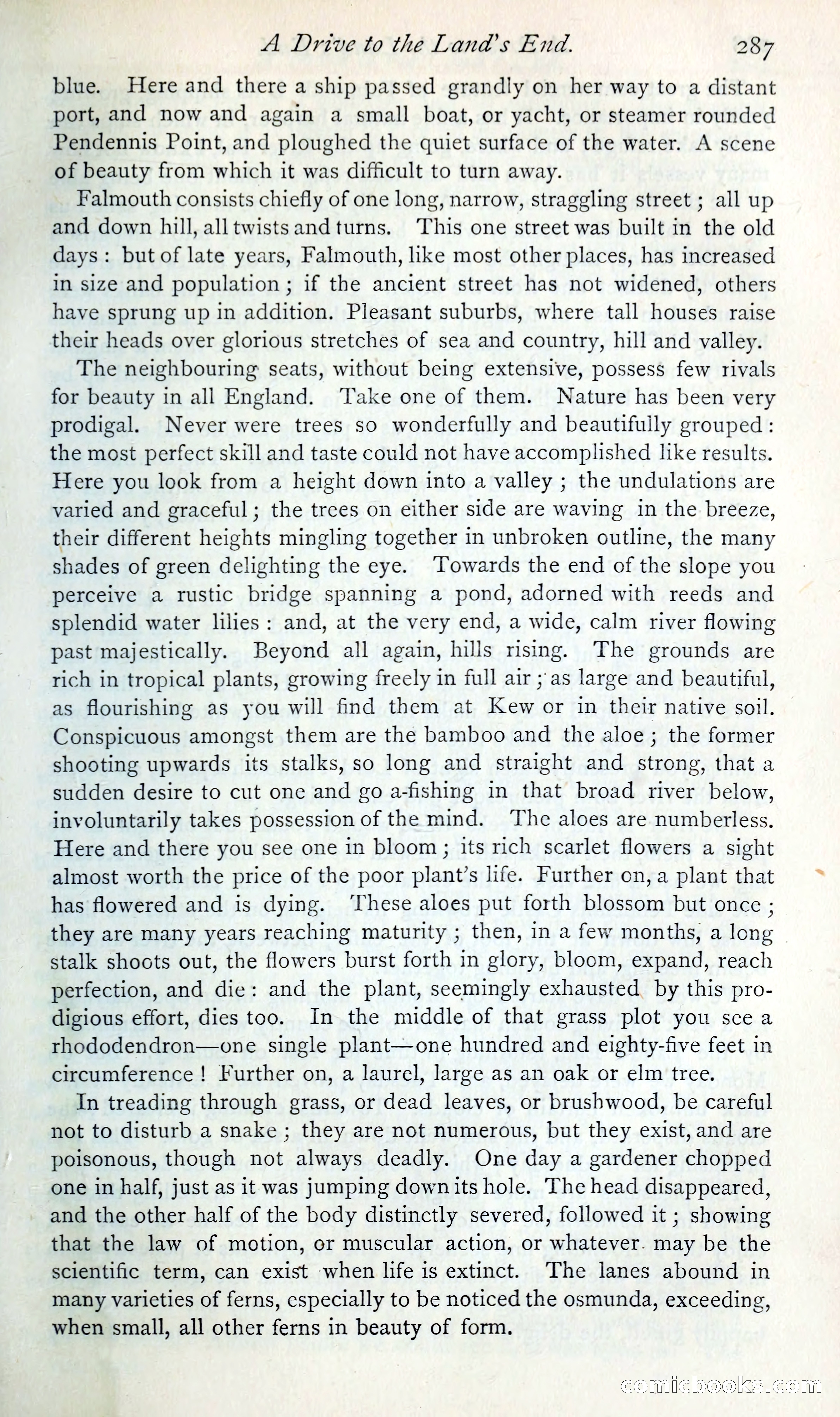
A restored page from Pulp Fiction, 1865. Page through the whole issue in the reader above.
📄 Transcribed text from this page (OCR, searchable)
Machine-transcribed from the original scan — historical spelling and the odd misread are preserved.
A Drive to the Land’s End. 287 blue. Here and there a ship passed grandly on her way to a distant port, and now and again a small boat, or yacht, or steamer rounded Pendennis Point, and ploughed the quiet surface of the water. A scene of beauty from which it was difficult to turn away. Falmouth consists chiefly of one long, narrow, straggling street ; all up and down hill, alltwistsandturns. This one street was built in the old days: but of late years, Falmouth, like most other places, has increased in size and population; if the ancient street has not widened, others have sprung up in addition. Pleasant suburbs, where tall houses raise their heads over glorious stretches of sea and country, hill and valley. The neighbouring seats, without being extensive, possess few rivals for beauty in all England. ‘Take one of them. Nature has been very prodigal. Never were trees so wonderfully and beautifully grouped: the most perfect skill and taste could not have accomplished like results. Here you look from a height down into a valley ; the undulations are varied and graceful; the trees on either side are waving in the breeze, their different heights mingling together in unbroken outline, the many shades of green delighting the eye. Towards the end of the slope you perceive a rustic bridge spanning a pond, adorned with reeds and splendid water lilies: and, at the very end, a wide, calm river flowing past majestically. Beyond all again, hills rising. The grounds are rich in tropical plants, growing freely in full air; as large and beautiful, as flourishing as you will find them at Kew or in their native soil. Conspicuous amongst them are the bamboo and the aloe; the former shooting upwards its stalks, so long and straight and strong, that a sudden desire to cut one and go a-fishing in that broad river below, involuntarily takes possession of the mind. ‘The aloes are numberless. Here and there you see one in bloom; its rich scarlet flowers a sight almost worth the price of the poor plant’s life. Further on, a plant that has flowered and is dying. ‘These aloes put forth blossom but once ; they are many years reaching maturity ; then, in a few months, a long stalk shoots out, the flowers burst forth in glory, bloom, expand, reach perfection, and die: and the plant, seemingly exhausted. by this pro- digious effort, dies too. In the middle of that grass plot you see a rhododendron—one single plant—one hundred and eighty-five feet in circumference! Further on, a laurel, large as an oak or elm tree. In treading through grass, or dead leaves, or brushwood, be careful not to disturb a snake ; they are not numerous, but they exist, and are poisonous, though not always deadly. One day a gardener chopped one in half, just as it was jumping downits hole. The head disappeared, and the other half of the body distinctly severed, followed it ; showing that the law of motion, or muscular action, or whatever. may be the scientific term, can exist when life is extinct. ‘The lanes abound in many varieties of ferns, especially to be noticed the osmunda, exceeding, when small, all other ferns in beauty of form. ECORNICIHOOKS. EO am