
Pulp Fiction, 1865 · page 273 of 400
The Argosy — page 273: what you’re looking at
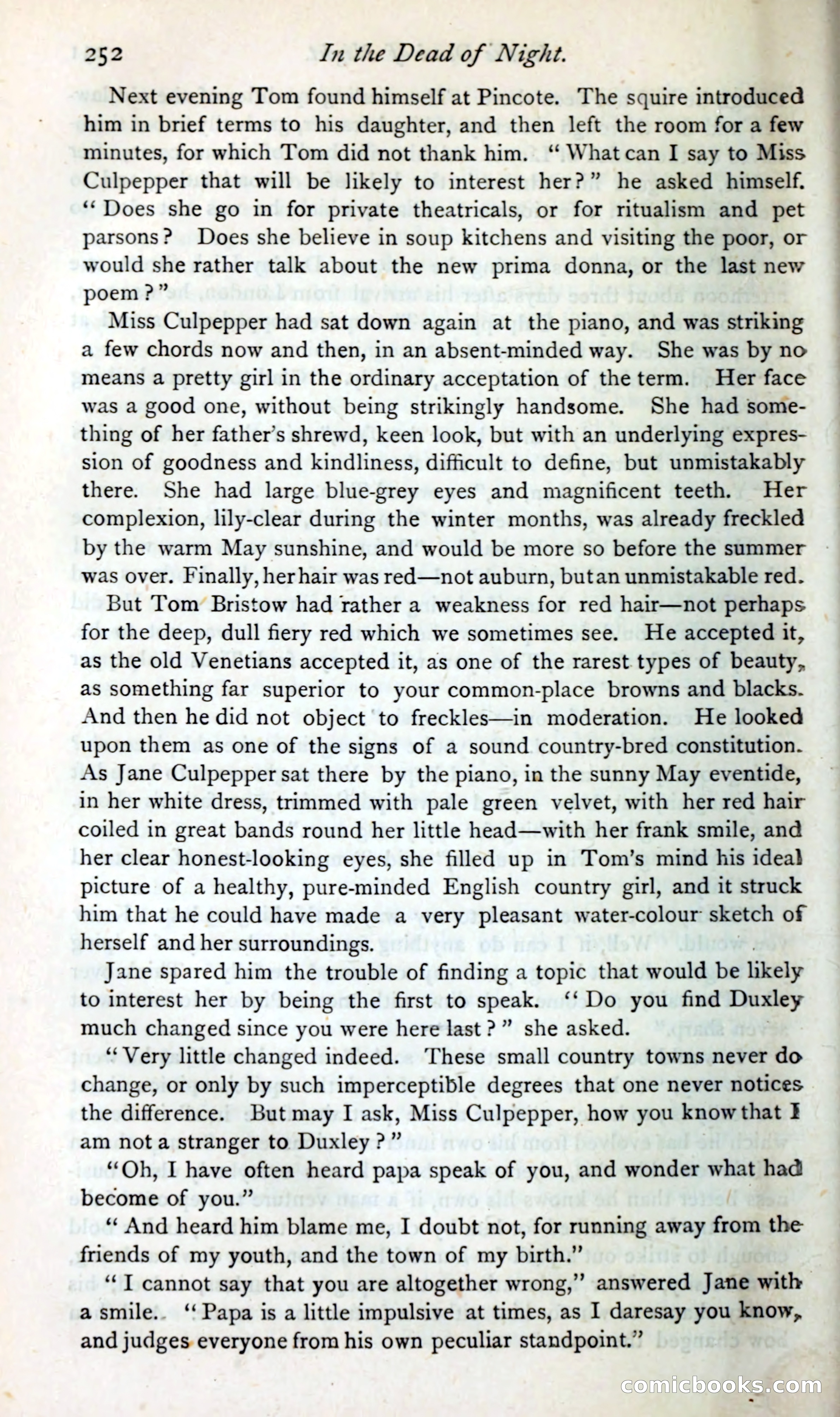
A restored page from Pulp Fiction, 1865. Page through the whole issue in the reader above.
📄 Transcribed text from this page (OCR, searchable)
Machine-transcribed from the original scan — historical spelling and the odd misread are preserved.
252 In the Dead of Night. Next evening Tom found himself at Pincote. The squire introduced him in brief terms to his daughter, and then left the room for a few minutes, for which Tom did not thank him. ‘“ Whatcan I say to Miss Culpepper that will be likely to interest her?” he asked himself. ‘“Does she go in for private theatricals, or for ritualism and pet parsons? Does she believe in soup kitchens and visiting the poor, or would she rather talk about the new prima donna, or the last new poem ?” Miss Culpepper had sat down again at the piano, and was striking a few chords now and then, in an absent-minded way. She was by no means a pretty girl in the ordinary acceptation of the term. Her face was a good one, without being strikingly handsome. She had some- thing of her father’s shrewd, keen look, but with an underlying expres- sion of goodness and kindliness, difficult to define, but unmistakably there. She had large blue-grey eyes and magnificent teeth. Her complexion, lily-clear during the winter months, was already freckled by the warm May sunshine, and would be more so before the summer was over. Finally, herhair was red—not auburn, butan unmistakable red. But Tom Bristow had rather a weakness for red hair—not perhaps for the deep, dull fiery red which we sometimes see. He accepted it, as the old Venetians accepted it, as one of the rarest types of beauty, as something far superior to your common-place browns and blacks. And then he did not object to freckles—in moderation. He looked upon them as one of the signs of a sound country-bred constitution. As Jane Culpepper sat there by the piano, in the sunny May eventide, in her white dress, trimmed with pale green velvet, with her red hair coiled in great bands round her little head—with her frank smile, and her clear honest-looking eyes, she filled up in Tom’s mind his ideal picture of a healthy, pure-minded English country girl, and it struck him that he could have made a very pleasant water-colour sketch of herself and her surroundings. Jane spared him the trouble of finding a topic that would be likely to interest her by being the first to speak. ‘‘Do you find Duxley much changed since you were here last ?” she asked. ‘Very little changed indeed. ‘These small country towns never do change, or only by such imperceptible degrees that one never notices the difference. But may I ask, Miss Culpepper, how you knowthat } am nota stranger to Duxley ?” “Oh, I have often heard papa speak of you, and wonder what had become of you.” ‘¢ And heard him blame me, I doubt not, for running away frost the friends of my youth, and the town of my birth.” ‘‘T cannot say that you are altogether wrong,” answered Jane with asmile.. ‘Papa is a little impulsive at times, as I daresay you know, and judges everyone from his own peculiar standpoint.” Gomicbooks.com